
June Reads
A list of the books I read and what I thought of them.

Light in August by William Faulkner
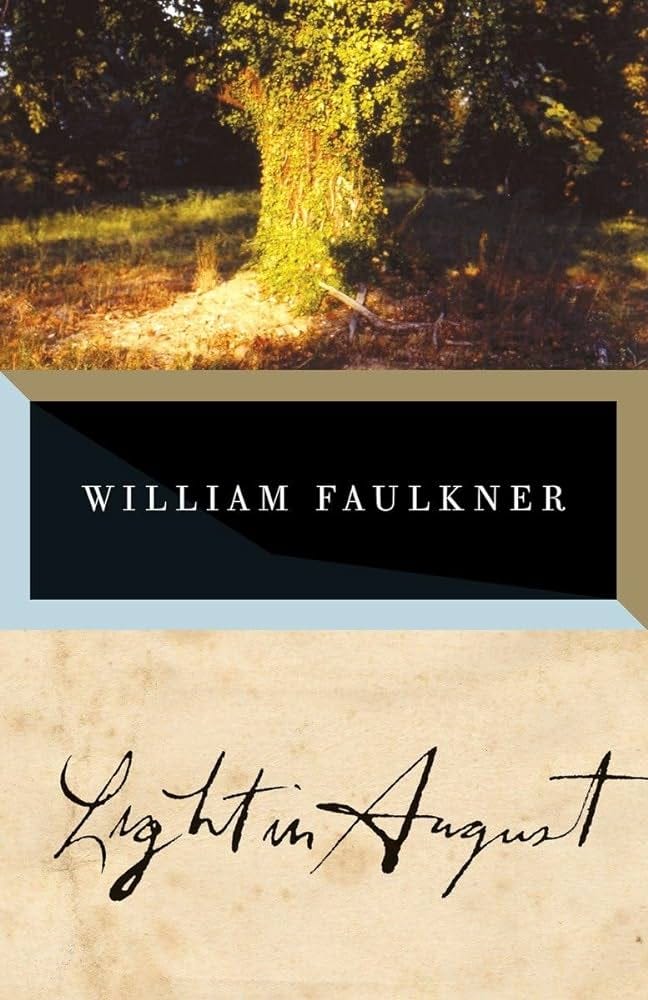
This 1932 seventh novel by American writer William Faulkner is a tragic and violent literary tapestry from whose unfurling threads surges an exploration of identity, race, religion, interconnection, and the cosmic consequences which ripple out from the shadow of fortuity. Set mostly in Jefferson, Mississippi during the 1930s, a time of rampant racism, the novel centers on Lena Grove and Joe Christmas, two strangers whose lives are intricately and inextricably connected through a third individual, one man with two names: Lucas Burch/Joe Brown. Lena Grove, a young pregnant woman in search of her baby’s father, arrives in Jefferson as a house burns to the ground in the outskirts of the town. The man she searches for is Lucas Burch, who, after abandoning Lena in Alabama, had moved to Jefferson, changed his name to Joe Brown and taken up work in a planing mill where he met and befriended Joe Christmas, a man of mixed ancestry whose life has largely been defined by abandonment, abuse, and apathy. Joe Christmas and Joe Brown, though still moonlighting at the mill, become bootleggers while living in a cabin in the woods behind the house of Joanna Burden, with whom Joe Christmas has a long, complicated history. Central to the story are Byron Bunch, another mill worker, who meets Lena Grove and soon falls in love with her; and Gail Hightower, a former minister who strives to provide spiritual and moral guidance to young Byron, as well as Joe Christmas. While events unfold in the present, the pasts of all these characters unfold as well, swirling and surging in their spectral reverberations until ultimately revealing a tale whose complex tragedy is bound the bloody and brutal history of the American South.
Alongside As I Lay Dying, Sanctuary, The Sound and the Fury, and Absalom, Absalom! I can now add Light in August to my growing list of read Faulkner novels, and like the others, this one only served to bolster my widely shared conviction that William Faulkner is truly the Master of Modern American Fiction, an author who sits alone among the pantheon, a writer whose works and legacy are sure to stand the tides of time for eternity. Over the course of a weekend, I read Light; I took a trip up to Rhode Island, five hours from Philly on Friday, and five back on Sunday, during both which I sat captivated before the book, as the pages turned themselves. It is longest of the above-listed Faulkner works, though certainly the most accessible. Spanning 500 pages split into twenty-one chapters, Faulkner relies more on dialogue and descriptive action, often rendered through flashbacks and frame narratives, to transmit his tale, rather than feats of form and experimentation, such as the stream of consciousness style and long-winded, meandering sentence structures seen in many of his other novels. However, Light is not devoid of Faulkner’s famous experimental leaps and bounds; they still appear in the temporality of the tale, in the structure of time’s portrayal. Symmetry, architectonics, progression d’effet are not terms apt to describe Light’s narrative structure, and though the narratological tools fabula and sjuzhet offer better points of analytical entry, they fail to reach the scope that extends beyond the pages of the novel into the expanse of Faulkner’s famed Yoknapatawpha cosmos to which Light indisputably belongs.
Light flaunts its fractured time, disunity, and structural lapses through digressions, asymmetries, and imbalances, expounding a polyphonic form: the voices of many characters act as shards scattered and separated at first but which slowly crawl together and stick, creating finally a unified portrait, a literary mosaic. This contrapuntal method forces the text’s multiple elements to work dialectically, in turn forcing readers to interact: the reader is confronted not with coherence but difference, not unity but multiplicity, not monologue but dialogue, and therefore must consistently read and reevaluate the events, characters, and themes that are constantly kept in flux–combining, fragmenting, then combining again in new configurations. To read Light is not simply to accept the meaning one can glimpse from the fabula and sjuzhet of the novel, but rather to construct, deconstruct, and reconstruct meaning in the interplay between the chronological sequence of events and the disjointed representation of those events. And that interplay, in Faulkner’s ingenious yet whimsical writerly ways, is continuously muddled in the entangled relations and exchanges between characters.
About Light, American literary critic Irving Howe wrote that “the arrangement of the book resembles an early Renaissance painting–in the foreground a bleeding martyr, far to the rear a scene of bucolic peacefulness with women quietly working in the fields.” Howe’s apt description contains the duality of the forces emblematic of the Southern Gothic tradition: good and evil, light and dark, white and black, God and Satan, peace and violence, etc., all of which run rampant throughout Faulkner’s Light, announcing their symbolic salience in the violent scars lancing across the text. These are the themes to which many critics have focused their critical investigations: religion, race, sex, class, alienation, and the uniquely American brand of violence that arises in their thematic multiplication. Readers note the Christian parallels of the text: how the trajectory of Joe Christmas mirrors that of the passion of Christ; how Lena is analogous to Mary; how Byron Bunch seems a Joseph figure; and how the 21 chapters of the novel reflect the structure of the Gospel of St. John, replete with a crucifixion that appears in the same numbered section. Yet religion pales to race in its thematic presentation, as the central Joe Christmas is a character defined by his mixed identity, despite never truly knowing the roots of his race. This unresolution of identity becomes the fulcrum on which all his actions, logic, and the events that ensue revolve, spinning around the vacant unknowing at the crux of his turbulent conscious, the empty eye of Hurricane Joe Christmas.
And it is this imaginative feat that scaffolds Light’s mastery, as well makes William Faulkner truly one of the greatest: the play between form and content, the structure and themes, which unfolds in perilous scenes of flight, in captivating scenes of discursive dialogue, in heartbreaking scenes of childhood innocence, love, and understanding, and in the thought-provoking scenes of fleeting circumstances, instances in which a reader glimpses the interconnectivity that binds humanity even in the most unlikeliest of ways, catalyzing the effects that ripple and reverberate across time in their wake. Light in August is a fascinating novel, a masterly novel, an entertaining novel that, for me, contains all of the pieces and parts that make Faulkner’s fiction so wondrously addictive. Harold Bloom wrote that “Light in August must be Faulkner’s grandest achievement...the American novel of this century, fit heir of Melville, Hawthorne, Mark Twain,” and, after reading this wild novel, I’m surely inclined to agree.
Silas Marner by George Eliot
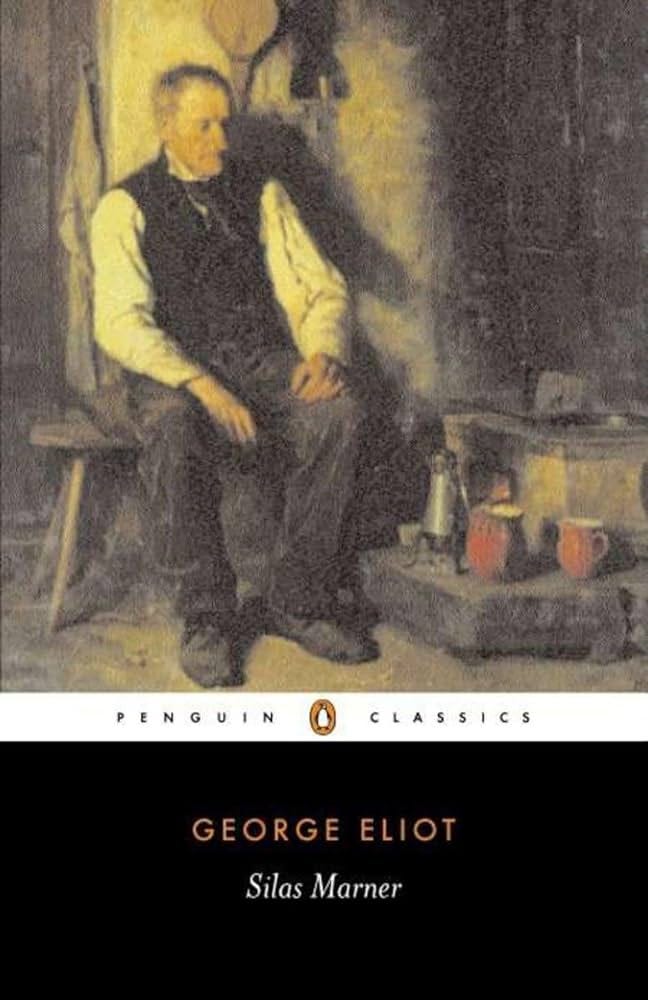
This 1861 third novel by English novelist George Eliot depicts the fall of man and the surprising turn of events that propel his ascent. Set at the top of the 19th century, the novel follows Silas Marner, a reserved elderly weaver, whose mysterious and solitary ways make him an outcast in his hometown of Lantern Yard. After being framed for stealing the parish charity, Marner is excommunicated from his home and forced to relocate to the rural village of Raveloe, where, for the next fifteen years, he devotes himself to his loom, producing linens for the villagers and amassing a hoard of wealth. His gold and silver coins become his sole prized possession, his object of adoration and a beacon of light in his quiet and lonely life. But when one foggy night a thief breaks into his house and steals his wealth, Marner slips into a state of deep despair and despondency, the last flickering flame in his life having been extinguished. Disheartened, downtrodden, Marner persists through life no more a man than a shadow, a vestige of a life once lived. But then, one snowy night, a tiny two-year-old girl with golden hair wanders into Marner’s cottage, seeking refuge from the frigid outdoors. At first surprised, addled, Marner starts to care for the child, eventually deciding to take custody after it’s learned the girl’s mother has died and father refuses to reveal himself. The young girl – whom Marner names Eppie, his sister’s namesake – begins to reawaken the light in Marner’s life which he’d lost, becoming his pride and joy as she comes of age in a tale that incants the strength of love and reckoning in the wake of loss.
Silas Marner is my second Eliot read after tackling Middlemarch last June, which was my absolute favorite book I read last year. I’d long wanted read Marner, certain that it would entail another incredible experience, and I was particularly inspired to pick it up after listening to the Mookse and the Gripes Podcast episode dedicated to Victorian literature, during which expert Victorian scholar Rohan Maitzen championed the novel as one of Eliot’s best. The way she described it completely captivated me and, when I saw that hosts Paul and Trevor were buddy reading it at the beginning of the month, I knew it was time to take it up. And of course, unsurprisingly, I was absolutely enthralled: the story of Silas Marner gripped and rattled me, pushing me to an emotional brink time and time again, and Eliot’s prose, elegant, rich, clever, returned me to the overwhelming experience I first had with Middlemarch. But though Marner spans less than a quarter the length of Middlemarch, it nonetheless contains a world within as vivid, affecting, and real as her magnum opus. Marner is a character who, from the first page, a reader is drawn to; however, the why is something that shifts as the novel moves on. From the beginning, he is an enigmatic figure, more a myth than a man, whose capricious actions and behavior belie an uncertainty that pushes the reader forward toward discovery. But as the reader continues on, the tiny details of his personality come to light, the sorrow lying beneath his stoic veneer, multiplied into despair by the unfortunate sequence of events in the first half. The second half sees his upward climb, when sorrow transforms into light, and the myth that was once the man finally becomes human. The way Eliot wrenches the reader downward then upward, like falling into a void before being caught by the wind and flown up again, makes Marner a magnificent ride, at once condensed yet sprawling, replete with all the trademarks feats and bounds that have established Eliot as truly one of the greatest writers of the Victorian Age.
Purity by Jonathan Franzen
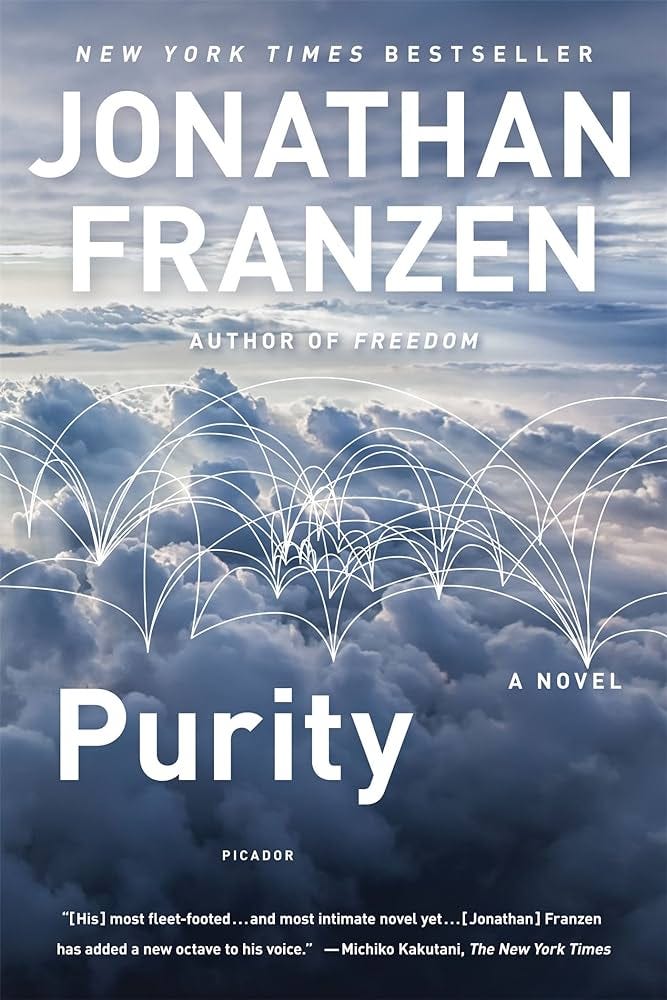
This 2015 fifth novel by American author Jonathan Franzen regales the interconnecting stories of various individuals, all directly or indirectly linked to one Purity “Pip” Tyler, a twenty-three-year-old woman whose search for her unknown father ushers forth an insane series of events. In Felton, California, Pip, saddled with enormous debt, lives sparingly in a ramshackle house with her anarchist roommates and grapples with her reclusive, hypochondriacal mother. After an awful rejection, Pip takes up an opportunity to move to Bolivia to join The Sunshine Project, a fictional WikiLeaks operation run by the Julian Assange-like leader, Andreas Wolf, who promises to help resolve her financial issues and track down her father. Andreas Wolf, a famed activist, carries a dark history: in his late twenties, living in East Germany at the cusp of the communist collapse, Wolf commits a crime, a secret which he would soon come to share with an American journalist named Tom Aberant, for whom, many years later, Pip would come to work as an intern at his Denver-based news publication. The life of Pip intersecting with the life of Andreas intersecting with the life of Tom intersecting with many others scaffolds the backbone of this novel as it unfolds at the turn of the twenty-first century. And it’s in their persistent fracturing that a tale of deception and deceit, mistakes and mysteries, love and loss, unfurls in a grand tapestry unveiling, behind our central Pip, a portrait of our strange modern age.
The next in my list of Franzen fictions, Purity was an entertaining ride, though one that, for me, forwent the gusto, verve, and depth of his preceding novels The Corrections and Freedom in favor of winding thriller plotlines and discursive political digressions. Purity starts off strong, pulling the reader in with Franzen’s trademark characterization: Pip Tyler is a remarkable invention, a character to whom I instantly gravitated, could see and sense and feel as if I knew her in real life. Her lines of dialogue, lines of logic, mannerisms and machinations, made her immediately memorable, the veneer of her demeanor belying a psychological depth that kept me completely captivated. But though she sits centerstage of this novel, her presence fades under the shifting limelight as narrative slips into subsequent narrative. But this is not totally a fault, as the other characters, particularly Andreas Wolf, Tom Aberant, and Anabel Baird, proved to be just as captivating, even if lacking in the hypnotic enchantment of our introductory protagonist. Unlike the aforementioned previous novels, Purity seems steeped in more action, more events, is more plot-weighted than character-weighted; the meticulousness of detail, rinsed in witty descriptions and elegant, meandering lines of prose, that has made Franzen one of my favorites, subsides under the action, exposition, and events in this novel, in turn edging the writing into a reversal of the “show don’t tell” sentiment, a literary realm equivalent of a graveyard. However, I use the word “edging” because Franzen doesn’t step entirely into that space: the novel is largely well done, but repeatedly misses the magnificent marks of his prior novels due in part to long explanations imbued in character exchanges alongside discursive diatribes, many of which teem with gratuitousness. The summation of these parts equals a flattening of a novel that could have stood as tall as its forbears. But that isn’t to say I didn’t enjoy it. Not enjoying a Franzen novel seems an uncertainty for me, but I didn’t enjoy this one as much as The Corrections and Freedom, which for me still stand his greatest works.