The Eighty-fifth
Friday, March 27th, 2026

“It brightened; the sky turned to a glowing pink which I strove, glueing my eyes to the window, to see more clearly, for I felt that it was related somehow to the most intimate life of Nature, but, the course of the line altering, the train turned, the morning scene gave place in the frame of the window to a nocturnal village, its roof still blue with moonlight, its pond encrusted with the opalescent sheen of night, beneath a firmament still spangled with all its stars, and I was lamenting the loss of my strip of pink sky when I caught sight of it anew, but red this time, in the opposite window which it left at a second bend in the line; so that I spent my time running from one window to the other to reassemble, to collect on a single canvas the intermittent, antipodean fragments of my fine, scarlet, ever-changing morning, and to obtain a comprehensive view and a continuous picture of it. - Marcel Proust, In Search of Lost Time Volume II: Within a Budding Grove (p. 317)
Book in the Pipeline: The Gray Notebook by Josep Pla
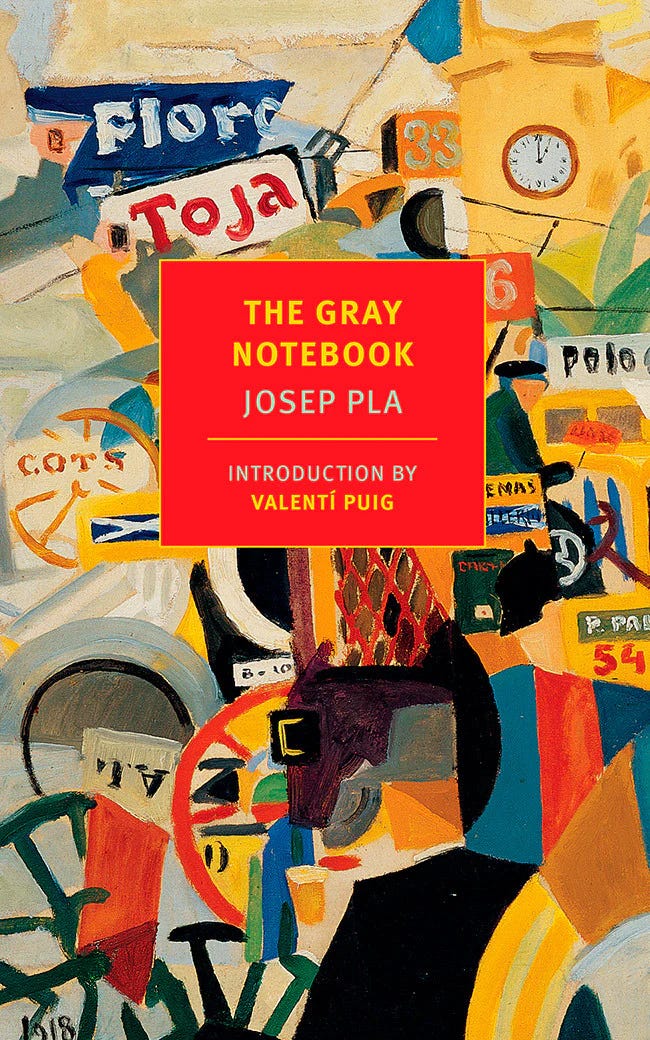
While perusing the stacks at the Free Library a couple weeks back, I stumbled upon The Gray Notebook by Catalan author Josep Pla, whose beautiful red binding and gargantuan girth quickly stole my eye from the shelf. A 650-page tome written by, as Colm Tóibin described, “a great noticer of things and places,” who “wrote in a style which registered both the smallest detail and the large picture,” The Gray Notebook is considered Pla’s masterpiece, crafted from fragments, journal entries, notes and scribbles compiled over a decade of personal transformation. In 1918, while studying law in Barcelona in his early twenties, Josep Pla was forced to return to his family home in the coastal town of Palafrugell when the Spanish flu shuttered his university. Already convinced of his destiny to become a writer rather than a lawyer, he began keeping a journal to refine his prose. In its pages he recorded family life, local personalities, café conversations, the rivalries, revelries, romances of friends and loved ones, his solitary perambulations about the country- and seaside, and so much more. When he later returned to Barcelona to finish school, Pla maintained his diary, observing the rhythms of city life with the same fervor, keen eye, wit, and curiosity that would become the defining literary characteristics of a writer later deemed one of the most influential Catalan authors of the twentieth century. Reading the back-cover description, gently leaning against the shelves secured to the upper balcony of the library’s cavernous literature department, concretized my conviction to read this one work, a book sure to be an invigorating introduction to Catalan literature.
Book Still on the Mind: Drifts by Kate Zambreno
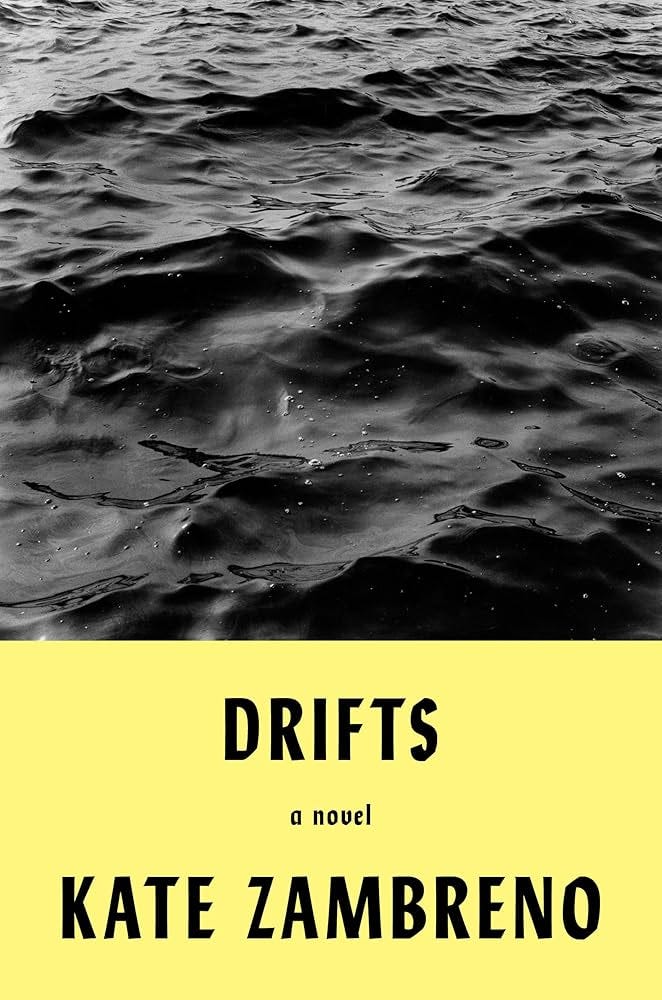
Writing about Pla’s notebook reminded me of a similarly experimental book, a collection of fragments compiled and novelized into a wondrous work I read in April of 2023: Drifts by American author Kate Zambreno. She’s a Brooklyn-based writer whose cult following among the literary underground surely stems from her unique writing style that combines confession, criticism, and narration to deconstruct the literary conventions of the contemporary novel. And nowhere is this style more evident than in Drifts, published in 2020, her seventh book. Often regarded as Zambreno’s “entry into autofiction,” Drifts is a “fantasy of a memoir about nothing,” a work composed of brief, diaristic vignettes tracing the writer’s daily life with her husband John (who, later, was one of my professors in library school) and dog as she struggles to begin a new novel. Moving fluidly between neighborhood scenes, encounters with stray animals, teaching, relationships, and erudite reflections on literature, art, and film, the book gradually accumulates into a portrait of a unique, and undeniably rich, artistic and intellectual life. Midway through, however, unexpected news subtly alters the emotional register of the first half, imbuing ordinary moments with new weight and urgency, resulting in an intimate meditation on perception and meaning, as Zambreno strives to bridge inner and outer worlds to “fold time into a book.” Stippled throughout the work are black-and-white photographs which, as I described in my original review, “contextualize subjects and settings—artwork and artists included—expanding the limits of focalized narration into a greater picture that, like the work of WG Sebald, transcends the boundaries dividing fact and fiction.” Last year, I re-experienced Zambreno’s kaleidoscopic, collage-like craft with Book of Mutter, which only further cemented my sense that she’s one of the most exciting writers working today.
Art(ist) of the Week: “Spring” by Nicolas Poussin (c. 1660-1664)
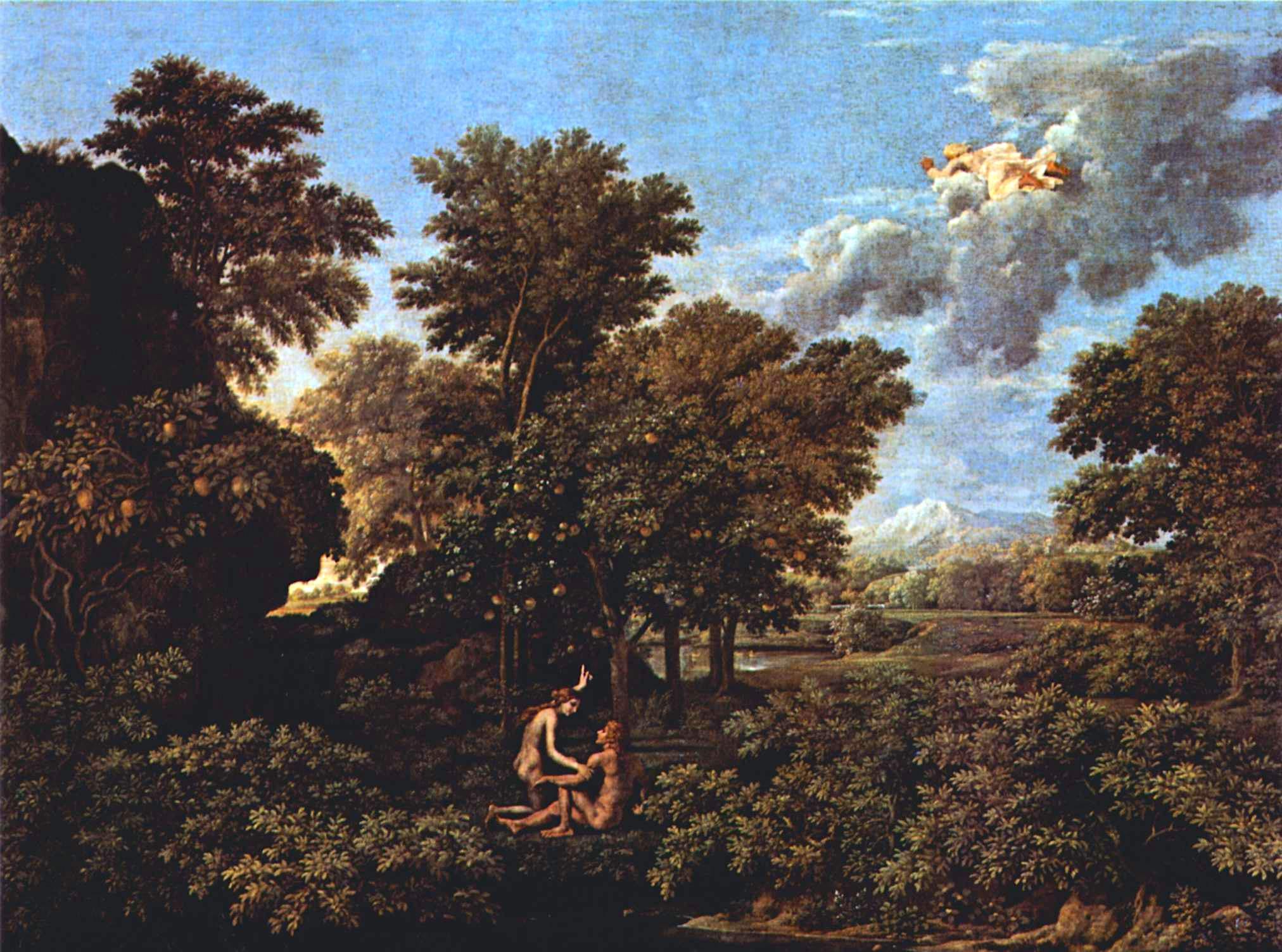
Last Friday was the vernal equinox. At long last, after a soul-crushingly brutal and dizzyingly sporadic winter here in Philadelphia, Spring has finally sprung, and I can think of no better painting to celebrate the beginning of this long and eagerly awaited season than classical French Baroque painter Nicolas Poussin’s Le Printemps, or “Spring,” unveiled between 1660 and 1664. I came across it in Karpeles’s Paintings in Proust, one of the final works mentioned in Swann’s Way, and it immediately seized my attention. At first glance, it presents a vision of serene Spring equilibrium: an Edenic landscape ordered with almost architectural precision, where light, trees, and distance unfurl in harmonious layers of viridian vegetation, golden rays, and deep azure, guiding the eye with quiet deliberation. Yet at its center, Adam and Eve introduce a subtle but decisive tension into the frame—Eve’s upward gesture drawing Adam, and the viewer in tow, toward the climactic moment that will undo this beatific balance. Above them, God passes not as a dominating force but as a presence woven into the same measured order, crowned upon a cloud, rendering divine immanence and catastrophic imminence in a single swish of his hand, the moment before the Fall. What Poussin captures, then, is not only the innocence of Spring, but a world portrayed in perfect ontological alignment, where nature, humanity, and the divine are held in fragile harmony at the very brink of dissolution. Fortunately, a protological interpretation of a Spring depiction need not apply to advent of our own, which always brings out the best of Philly. So, in spite of the buried undertones of this painting, it still spurs my excitement for this new season, of which I cannot wait to make the most this year.
Music(ian) of the Week: “Horses” by Maggie Rogers
Maggie Rogers is the only musician in recent memory my introduction to whom came not from her music but from her story. In April 2024, New Yorker music critic Amanda Petrusich (one of my favorites) published a spotlight profile on the Maryland artist, detailing Rogers’s rise to stardom through a viral video (the ten-year anniversary of which arrived this past week), subsequent record label bidding wars to sign her before she even finished her music degree from Tisch, then reckoning with the pressure of the limelight by pursuing a master’s degree in religion and public life from Harvard Divinity School—all before the age of thirty. Captivated, I dove into her discography and fell in love with a sound situated at the nexus of pop, country, folk, electronica, rock, and indie, and a voice whose earthy, wind-worn timbre absolutely mesmerized me. Her voice is truly distinct. Buried beneath her breath is a subtle grain, a soft rasp that never quite hardens into grit yet belays the tone into a grounded, almost conversational warmth in her lower register and a shining brightness in her higher, flickering with a strain that elevates the emotion in her lyrics. Also, sporadically, she sings slightly behind the beat, lending a light latency, a little lag limning a looseness in an inflection that floats and flows so fluidly through her phrasing. “Horses,” both the song and video, seizes this syncopated signature so simply, so sonorously. A girl, an acoustic guitar slung across her shoulder, standing in a summer-lightened field pleads to feel free again, to be unburdened by a loss shrouding her in a cloak of numbness. Whom she addresses remains ambiguous; she sings as if in prayer, blurring the interior of her words in a way so that all who listen can relate, feeling that singular blend of inward-turned love and melancholy. And, for me, the video matches this sensibility spot on, especially as I can’t help but see Emma Corrin as Lady Chatterley running through Wragby’s fields, unchaining herself from a life of discontent. It’s truly a tear-jerker of a tune, and it’s not the only one of hers I can say that about.
Wild Card: Ministry of Awe


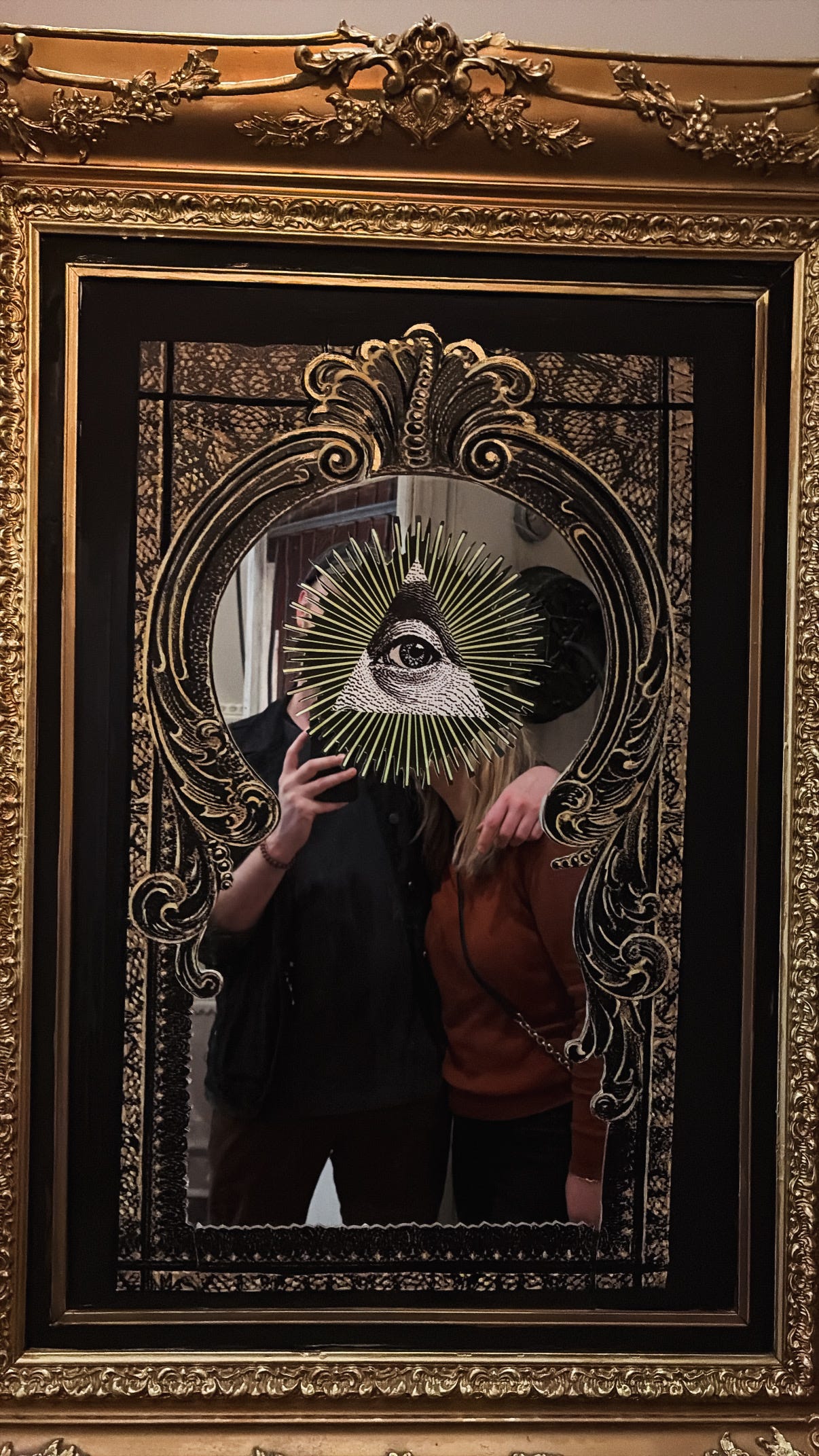
Last Thursday, I went to Philadelphia’s newest museum, the Ministry of Awe, located on 3rd street between Market and Arch over in Old City, which opened March 14th—and had an experience that truly evades words. Less an art venue than a six-story philosophical apparatus disguised as an immersive playground, the MOA is the brainchild of internationally renowned muralist and public artist Meg Saligman, who reimagined the decommissioned 19th century bank to explore how the idea of value can be destabilized and re-authored in strange, thought-provoking ways. Replacing money is the human spirit, as visitors are invited to deposit not currency but fragments of themselves at various junctures: memories on deposit slips, words in a directory, gestures in a photographic mirror, even meditations on mortality through a telephone. Moving through its shifting maze of installations, replete with performance artists and reactive rooms, visitors vacillate between wonder and worry—encountering spaces that simulate death, confession, and afterlife alongside stimulating spectacles of the surreal—until sublimity, awe itself, becomes the governing principle. And a governing principle it was: I was absolutely floored by some of the things I saw, heard, felt, and learned there, from alien basement-lurking sculptures and deathly piles of bones to beautiful stained-glass windows and massive, magnificent murals. My favorite room was on the very top floor, “The Heavens,” where one opens a door into an ethereal atrium whose walls and ceiling bear a hallucinatory holographic expanse overlooking a sea of sofas. Clouds scatter and shift into stars, brightening and darkening in tandem to observers’ movement, creating a space that I felt I could spend hours inside without tiring. “Awe is all around these walls” reads MOA’s mantra, and even that, after experiencing it firsthand myself, seems an understatement. I highly recommend it to everyone and personally cannot wait to go back.