
The Eighty-ninth
Friday, May 22nd, 2026

“At most some passing Parisian lady, stopping for some reason in the town, had raised her eyes to his, had asked him perhaps to serve her in her room before she took the train again, and, in the pellucid, monotonous, profound void of the existence of this good husband and provincial hotel servant, had buried the secret of a short-lived whim which no one would ever bring to light.” - Marcel Proust, In Search of Lost Time Volume III: The Guermantes Way (p. 219)
Book in the Pipeline: The Vegetarian by Han Kang
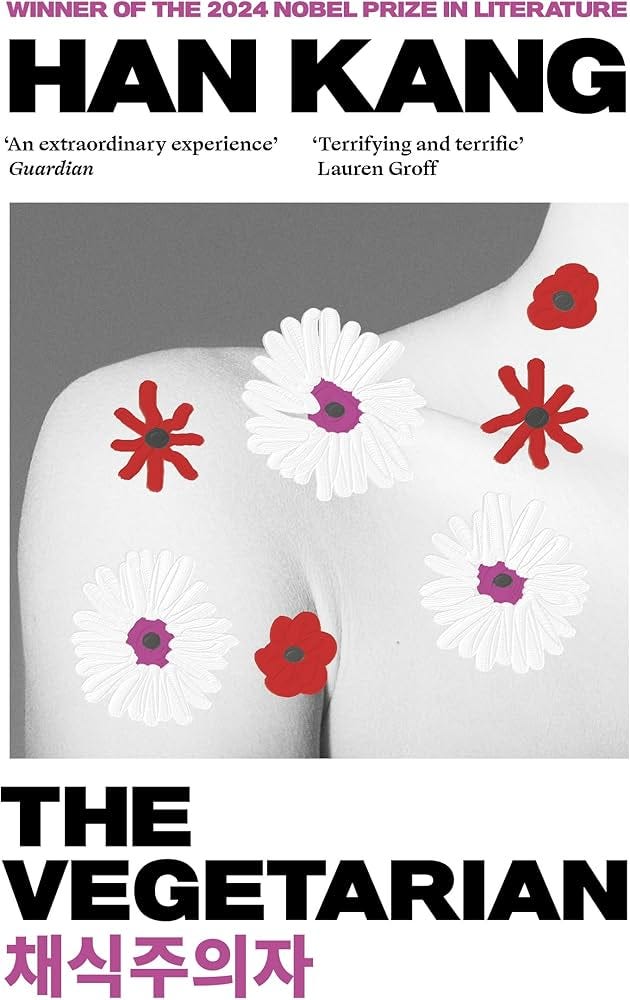
On the plane ride from Tokyo to Atlanta, I read my first novel by Nobel Prize-winning South Korean author Han Kang, The White Book, published in 2016, whose fragmented vignette style, spare prose, and themes of trauma, memory, and meditation not only held me spellbound from cover to cover but have now driven me to read more of Kang’s work. And of her oeuvre, her 2007 novel The Vegetarian stands foremost, her most popular and the first of her works to be translated into English, in 2015 courtesy of British translator Deborah Smith. It charts the story of Yeong-hye, an ordinary woman living in Seoul whose life unravels after she begins having horrific nightmares involving blood and slaughter and soon vows to stop eating meat. An innocuous act, her vegetarianism, Yeong-hye discovers, quickly becomes an act of rebellion against the rigid expectations imposed by her family and society at large, inciting outrage in her domineering father, confusion from her emotionally detached husband, obsession in her brother-in-law, and concern from her sister—the proportions of which only crescendo throughout the course of the novel. Structured in three interconnected sections from the perspectives of those surrounding Yeong-hye, the novel, as I understand it, subverts domestic realism to unearth a distinct psychological and bodily horror as readers see Yeong-hye retreat further from human life and closer to the life of plants. It won the International Booker Prize in 2016 and was recently voted the most popular winner of the decade; The Guardian named it one of the 100 Best Novels of All Time; it has been described as “Kafka-esque”; and about it, the writer Daniel Hahn wrote, “Sentence by sentence, The Vegetarian is an extraordinary experience.” With accolades and epithets like that, and having just visited Seoul, Kang’s iconic work has shot up towards the top of my to-read list, a novel I’m eager to viscerally experience.
Book Still on the Mind: The Woman in the Dunes by Kōbō Abe
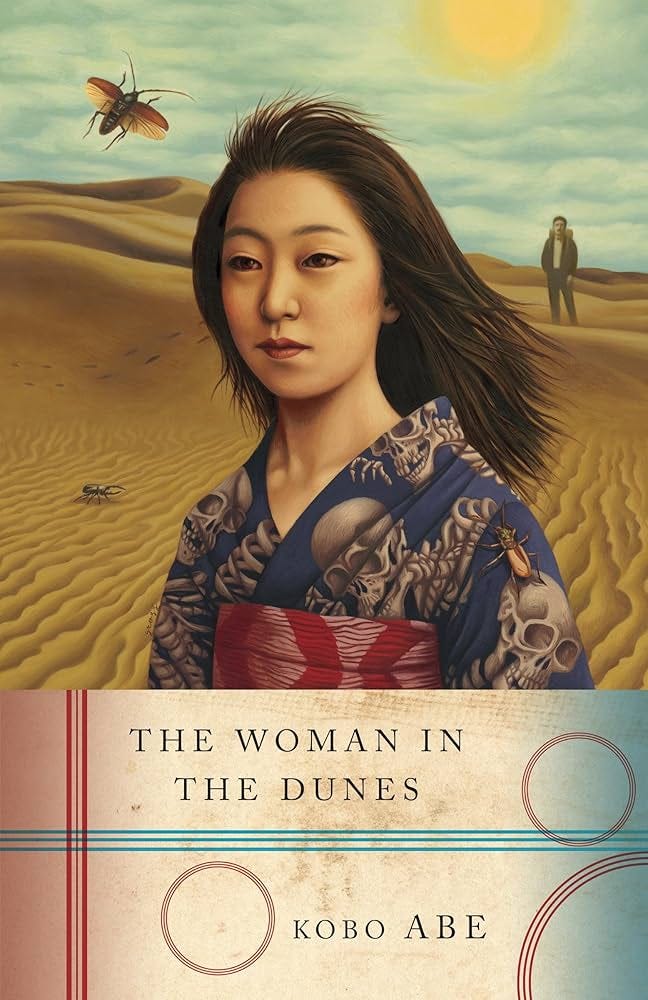
Just before I left for Asia, my dad told me he was reading a book that he wanted to give me after finishing, a book by a Japanese author he had found at the thrift store. When he told me the title, I had to inform him that not only was I already familiar with it, but I had read the book back in 2020, engrossed in the wild tale it contains. The Woman in the Dunes by Kōbō Abe, published in 1962, his most popular novel, follows Niki Jumpei, an amateur entomologist who travels to a remote coastal village in search of rare insects, only to find himself trapped in a deep sand pit with a mysterious widow who spends her days and nights shoveling out sand to prevent her house and the village above from being buried—an endless task Jumpei is, too, soon forced to undertake. As days stretch into weeks and weeks into months, Jumpei’s initial desperation, fury, and fear slowly give way to a disorienting acceptance as he comes to realize the inescapability of his conditions and futility in the work which fills his days. The result is a novel that, as I wrote in my original review, is “often described as Sisyphean for the absurdist and existential themes that pervade the story wherein Abe’s commentary on meaning—in life, work, love, and existence—shines through with disturbing brilliance.” It won Abe the prestigious Yomiuri Prize for Literature and was later adapted to film, which itself has garnered a cult following over the years. Writing this blurb impels me to reread this novel and surely watch the film that, I see, is available via the Criterion collection.
Art(ist) of the Week: “The Great Wave off Kanagawa” by Katsushika Hokusai (1831)
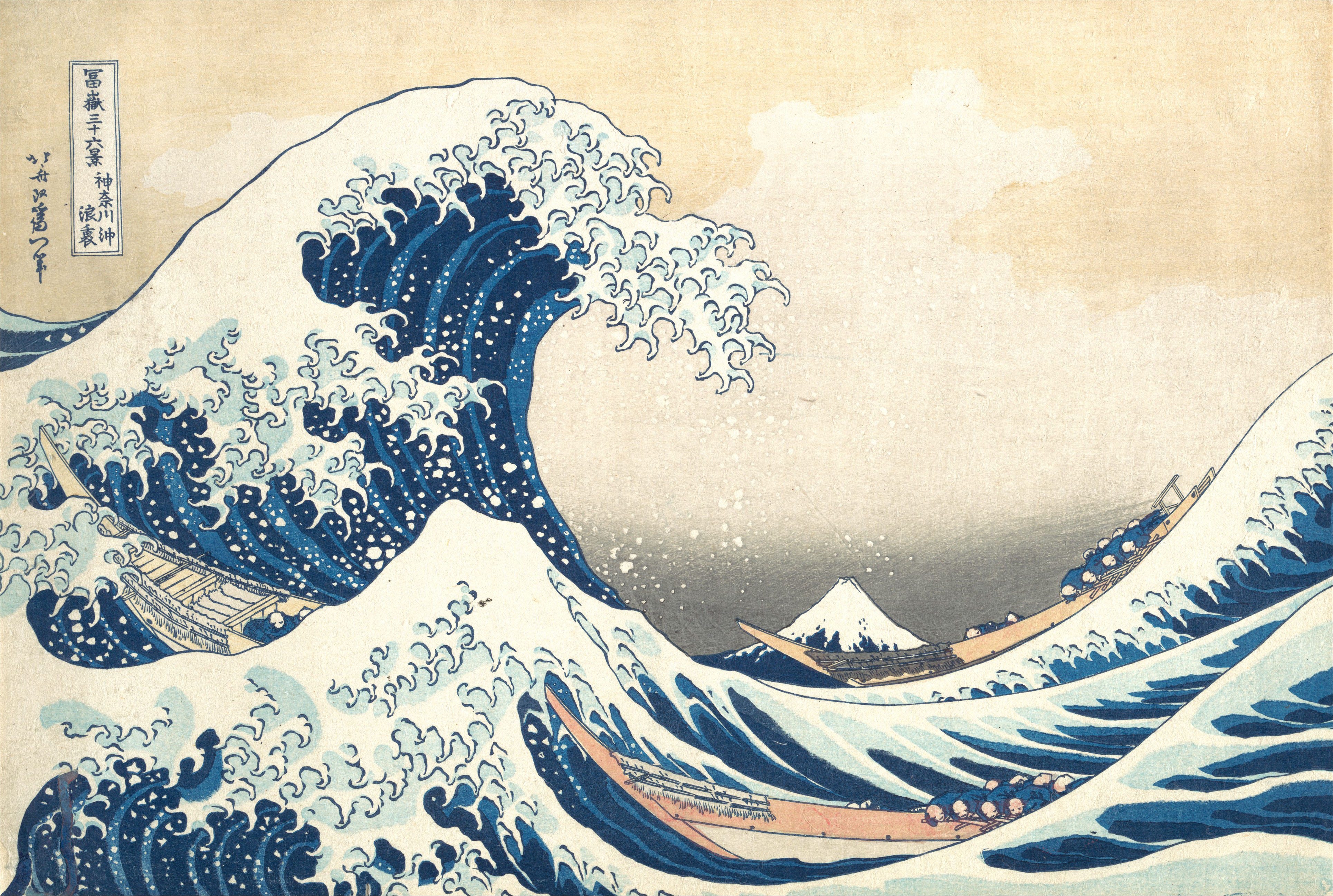
In keeping with my post-trip Asiatic theme, I submit for my art selection this week one of the most recognizable images in all of art: The Great Wave off Kanagawa by the Japanese ukiyo-e master Katsushika Hokusai, created and unveiled around 1831. The first part of his celebrated pictorial series Thirty-six Views of Mount Fuji, this work is not a painting but a multicolored woodblock print depicting an enormous, claw-like tsunami towering over three narrow fishing boats off the coast of Kanagawa, as the small, distant form of Mount Fuji sits calmly backgrounded beneath the oceanic chaos. In its frame, Hokusai contrasts violent motion with serene stillness: the sea appears monstrously alive, violent and sublimely catastrophic, its curling foam like grasping talons, while the mountain—typically a symbol of permanence and spiritual stability—seems fragile, miniscule by comparison. Revolutionary for the time was Hokusai’s use of Prussian blue, an imported pigment that bolsters the drama and dynamism of the composition, helping to redefine landscape art during the Edo period of Japanese history. It was immediately popular upon unveiling and went on to become one of the most influential artworks in global visual culture, profoundly shaping European Impressionist and Post-Impressionist artists like Monet, van Gogh, Cassatt, and more during the nineteenth-century wave of Japonisme and today endures as an iconic symbol of both Japan’s and humanity’s precarious relationship with the forces of nature. Further testifying to its unwavering legacy, at the Haneda airport in Tokyo, before flying back to the States, I snagged a t-shirt with the work emblazoned on its front in black-and-white, a little sartorial souvenir to commemorate what was truly an incredible trip.
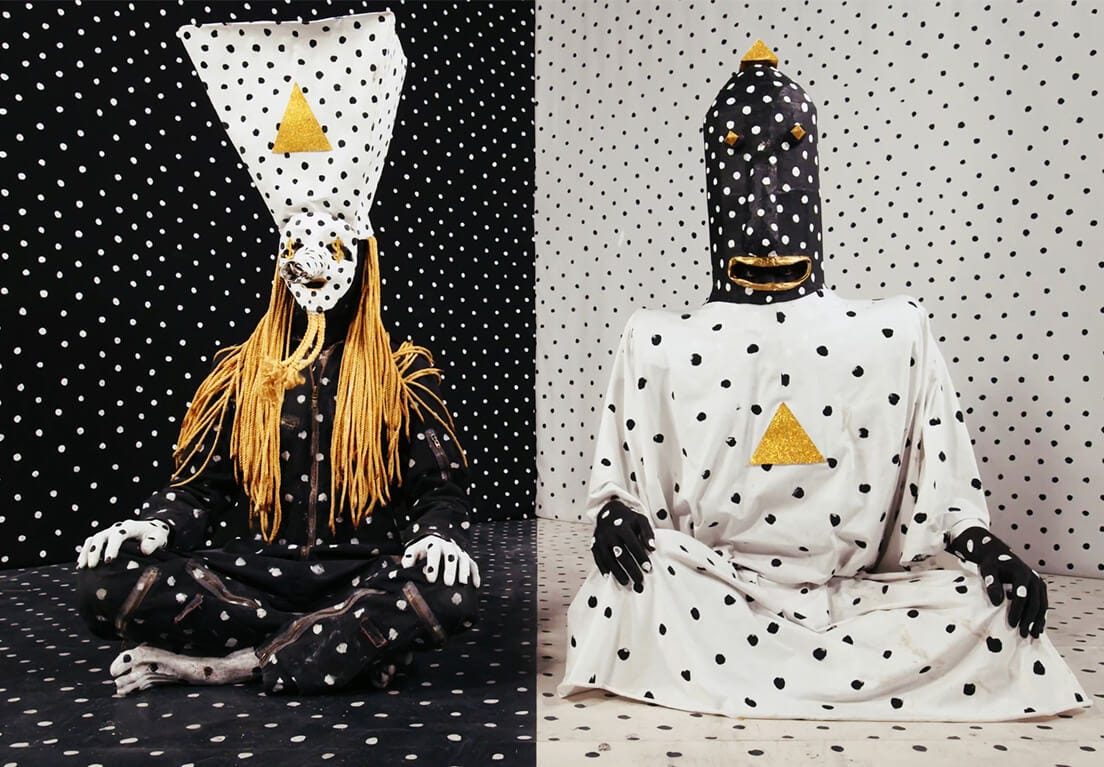
Music(ian) of the Week: Angine de Poitrine – Full Performance (Live on KEXP)
At 10 am on Tuesday this past week, presale tickets for an upcoming November concert at Franklin Music Hall here in Philly went on sale, and at 10 am on Tuesday this past week, I sat at my computer, logged on and ready to snag one. But literally within two minutes, before my spot in the virtual queue was even called, all tickets sold out. The band is Angine de Poitrine, a Canadian rock duo whose unique brand of audiovisual magic has amassed them an incredible following in recent years. Emerging from the fringes of Quebec’s avant-garde and industrial underground in 2019, the pseudonymously named Khn and Klek de Poitrine blend surrealist imagery and bizarre humor with dissonant instrumentation, manic vocal performances, and extraordinarily technical compositions into songs that sound like a circus decomposing within a haunted factory. I first discovered them, like most of their recent fan base, through this performance for KEXP, which achieved viral recognition back in February of this year and now has more than 14 million views on YouTube. It’s clear I wasn’t alone in being utterly entranced with what I was seeing. Donning alien-inspired suits covered in their now iconic black-and-white polka dots, phallic-shaped headdresses, Khn with his double-necked electric guitar playing over an array of pedals, Klek unleashing controlled chaos at the drums, their aesthetic evokes equal parts punk nihilism, Dadaist performance art, and nightmare chanson, suspending the listener in a sonic space between mayhem and sublime beauty. And surely like many people, I was struck by the musical technicality on full display. These two extraterrestrial beings play with a talent that is truly unearthly, a force that suffuses jazz pyrotechnics and Eastern-inspired microtonality with jam grooves and multi-metric percussion that thwarts any inclination of orientation. Angine de Poitrine confounds on all levels, truly the source of the awe they continue to inspire. While I’ll miss this upcoming show of theirs, I vow to try harder for the next one because damn do I want to witness their sonic weirdness in the flesh.
Wild Card: teamLab’s Borderless – Tokyo, Japan
One of the highlights of my Tokyo trip was going to teamLab’s Borderless, a digital art museum located in an underground level of the MORI Building, east of Shibuya, near Minato City. Describing this museum is a near impossible feat: how does one describe walking into a dream? a fantasy? another dimension? Every traditional notion of the word “gallery” goes out the window with this one: inside its walls, static artworks dissolve into a flowing, dreamlike kaleidoscope of light, sound, color, and motion. Rather than moving through a fixed sequence of exhibits, we wander through the wondrous labyrinth without a map, seeing artworks spill across walls, floors, ceilings, entire rooms whose massive size spurns easy discernment, waves of light morphing continuously and reacting to human presence. Flowers bloom and scatter beneath our feet; waterfalls change direction around our footsteps; lanterns pulse like living organisms; and, my personal favorite, galactic tentacles of LEDs stretch infinitely through mirrored chambers, sending us soaring through a sci-fi-inspired hyper-dimension space beyond anything we could possible conceive outside of a dream. I stepped and stood in stupefaction, in sheer awe of the illumined world, transported from real life. It was seriously awe-inspiring, a sublime sensation the likes of which I will never forget. And the museum as a whole truly seems like living for a brief moment within a lucid dream, at once tranquil, disorienting, playful, and beautiful in ways that evade words. Never had I experienced anything like this before, a museum where technology, design, and imagination unite to the deconstruct the boundaries of artistic possibility. A highlight of my Tokyo trip, a highlight of my life so far.


