
The Fifty-fourth
Friday, January 17th 2025

“Why did he know these things? He believed in aleatory reading. Through his academic friends he had stack privileges in all the great libraries—this must be a slight exaggeration—and often when he was back in what I would never dare to his face to call civilization he would go straight to the nearest university library and stand up for eight hours, wandering and reading until he had it out of his system. Now where was he? - Norman Rush, Mating (p. 414-415)
Book in the Pipeline: North and South by Elizabeth Gaskell
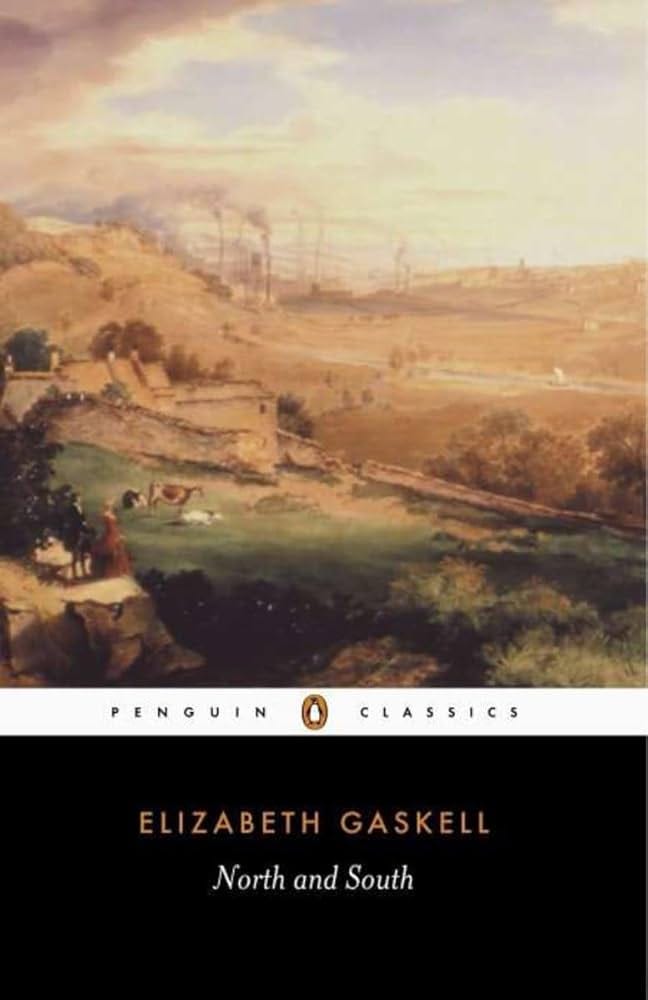
North and South, the fourth novel by English author Elizabeth Gaskell, published between 1854-1855, remains a classic of Victorian literature, providing a vivid portrait of the varied strata that comprised mid-nineteenth-century English society. Set during the burgeoning industrial revolution, the novel follows Margaret Hale, a young woman from the South of England, who is uprooted from her peaceful life in the countryside to move with her family to the industrial town of Milton in the North after her father, a clergyman, leaves his position in the Church of England. In Milton, the social atmosphere is dominated by the booming textile industry, characterized by harsh working conditions, class conflict, and a distinct divide between the wealthy mill owners and the impoverished working class. As Margaret navigates her new life, she becomes embroiled in the conflict between two men: John Thornton, a wealthy, self-made mill owner, and Frederick Hale, her rebellious brother, who, after a political scandal, is exiled from England. That’s honestly the extent I know about this novel, though I certainly recognize that there is a mountain of critical studies dedicated to the work of Elizabeth Gaskell and North and South in particular, doubtless a testament to the strength of this one time-enduring work. As I understand it, the novel explores an array of thematic elements ranging from class conflict, social expectations, the clash between industrialization and nature, personal growth, and the role of religion, among others. But what I’m most excited to discover in picking up this novel is Gaskell’s prose, which, though I’ve read “conforms to Victorian conventions,” still seems bestirred with the scalding ferocity that undergirds only the greatest of Victorian social novels.
Book Still on the Mind: The Razor’s Edge by W. Somerset Maugham
I’ve started the new year with Norman Rush’s Mating, which I’m greatly enjoying; but I nearly opted to reread one of my favorite novels, as the wonderful Jeremy Anderberg has selected it to ring in the new year with his book club, The Big Read. The novel is The Razor’s Edge by W. Somerset Maugham, published in 1944. I first read it in January five years ago and later named it among my favorites of the year. The novel follows Larry Darrell, a young American pilot who, after returning from the carnage of WWI, decides to divert the trajectory of his life. When he returns home, he ends his previous engagement with his fiancé Isabel, declines to go into her father’s business, and refuses to dedicate himself as a working man, denouncing all the wealth, the status, and the bourgeois life that his prospects originally entailed, opting instead to “loaf.” But disguised as the task of a lazy fool, Larry’s endeavor is in fact an embarkment on a spiritual and intellectual odyssey. He travels across Europe, taking lodge in dilapidated, cheap apartments and tenant housing, working menial jobs, and all the while reading book after book after book, learning languages, philosophy, and the myriad skills needed to attain an enlightenment found in education, experience, and the arts. It’s an exploration of the clash between materialism and idealism and finding one’s footing in life, with the values, morals, and actions needed to determine one’s own destiny. Ah how I so remember reading this novel, how it so shook the foundations of my being, changing me on a deep level and revealing to me parts of myself I had not seen, known, or felt beforehand. It gave me a renewed perspective of myself, others, and life as a whole. As I wrote in my original review: “This is a novel that I will forever attribute to a true and lasting revelation: that the meaning of life is found in experience and learning,” a conviction that, five years later, I still wholeheartedly stand behind.
Art(ist) of the Week: “Lane Scene at Night” by John Atkinson Grimshaw (1872)
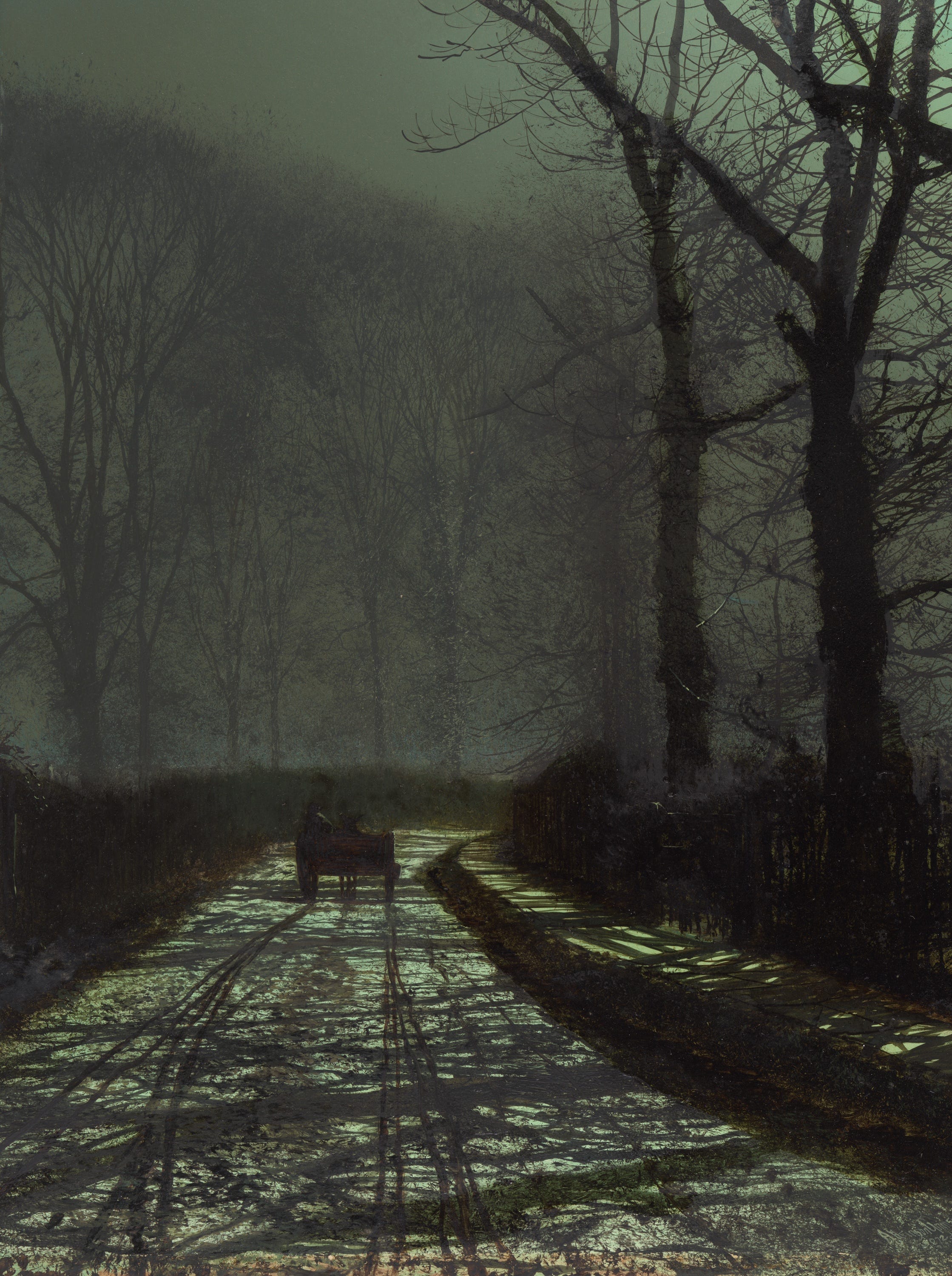
The work of English Victorian-era painter John Atkinson Grimshaw is unmistakable; one can easily recognize the vibrant nocturnal scenes of urban and rural landscapes to be the work of a single painter, whose eye for dim lighting and washing waves of shadow showcase a reverence for the night unrivaled in the annals of realism. While most may know his famous work “Liverpool from Wapping,” which currently hangs at the Philadelphia Museum of Art down the block from me, a personal favorite of mine, today’s selection goes to “Lane Scene at Night,” unveiled in 1872, which exemplifies his mastery of atmosphere, light, and meticulous detail. A quiet, moonlit lane lies in frame, slowing snaking around a bend beneath barren trees, whose stark, snaggy limbs creep overhead like static stone tentacles stuck in an unfulfilled embrace. A lone cart stands up ahead, behind it looming a forest obscured by distance and fog with towering trunk silhouettes impelling an ominous sense to the scene, bolstered by the greenish hue tinging the air. Shadows scatter across the foregrounded lane, lines limning the moonlight whose source remains just outside the frame yet whose presence is nonetheless salient, a beacon in a story of a lonesome sojourn. It is a dreamlike scene, an oneiric opus heightened by moods of solitude and introspection and a careful balance between man and nature, in turn imbuing a meticulous realism with a poetic beauty. Grimshaw has been lauded as the “Painter of Moonlight,” and with this painting, it’s easy to see why. His works, including and especially this one, explore themes of quietude, nostalgia, and the passage of time, transforming an ordinary setting into an evocative, timeless work that impels the viewer to contemplate the unique eerie beauty found only in the night.
Music(ian) of the Week: GOODBYE SALÒ by Brutalismus 3000
Last week, German techno duo Brutalismus 3000, comprised of Victoria Daldas and Theo Zeitner, unveiled an ad campaign for, of all companies, Tinder. In the ad, the couple reveal how they met through the app, started creating music together, and went on to become the brutal brace of bass music for which millions of fans across the world know and love them. It’s a surprisingly heartfelt ad and super cute––descriptors that clash hard with the music for which the couple remains so renown. One of my current favorites in the scene whom I’ve long wanted to write about, Brutalismus 3000 have skyrocketed in the past few years, due in large part for their 2021 Boiler Room set. Since then, the duo has ascended to the heights of Euro electronic music, known for their back-breaking blend of hardcore, techno, trance, and gabber, with a steady stream of tunes that absolutely smash the dance floor. Kick drums like punches to the head; screaming synths that burst ear drums; bass lines like earthquakes that shatter the Richter scale; distorted vocals that crest and crash overhead––all these components and more construct the sonic equivalent of a wall of death, an aural Armageddon, devastation by dance music. In July of last year, they released a new EP titled GOODBYE SALÒ, a collection of six songs, in total running just over twenty-two minutes, which shortly after was accompanied by this recorded reworked liveset, an audiovisual sojourn to the upward extremes of modern bass music. Rather than describe this high-energy, high-impact, wonderful forty-minute cataclysm of a performance, I’ll leave to the reader to experience a type of music that I truly cannot get enough of.

Wild Card: Stephen Blumberg, the Best Biblioklept in Modern American History
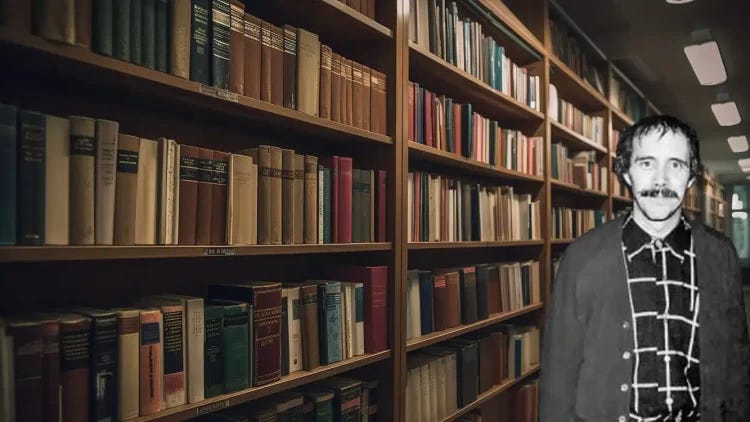
Ever since learning about the story of Stephen Blumberg in a class I took last semester, I truly have not been able to stop thinking about it. In 1990, Stephen Blumberg, a 42-year-old book and antique collector from St. Paul, Minnesota, was arrested for stealing more than 23,600 books whose value amounted to nearly $5.3 million, equivalent to more than $13.1 million today. Headlines branded him the “Book Bandit,” and he became known as the most successful book thief in the history of the United States. Blumberg had been a lifelong kleptomaniac: in addition to books, during his boyhood, he also stole doorknobs and stained-glass windowpanes from run-down Victorian houses in St. Paul, slowly amassing a collection of objects that would be his prized possession, fueling his kleptomaniacal ventures in adulthood. Between the late 1970s and 1990, Blumberg traveled across the United States and Canada, stealing rare books and manuscripts from approximately 268 libraries, museums, and archives. He would often gain access to restricted areas by posing as a scholar or academic researcher, charming staff with his deep historical and literary knowledge to gain trust, and using tools like screwdrivers and keys to dismantle locks and shelves. Blumberg claimed that he wasn’t driven by financial gain but by a desire to preserve rare materials, believing that many libraries failed to adequately protect these treasured items.
This compulsive desire would entail his downfall which occurred in the early hours of March 20th, 1990, when he was arrested after an accomplice tipped off the police. The FBI subsequently raided his home, recovering the stolen collection which was so densely packed in his house that structural reinforcements had been added to support the weight. Among the items recovered were a first edition of Harriet Beecher Stowe’s Uncle Tom’s Cabin, 25 boxes of rare materials detailing the history of Oregon, and a 16th-century volume of the Bishop’s Bible. Blumberg also claimed that he attempted to collect the full “Zamorano 80,” a list compiled by antiquarian specialists of rare books on the history of California. In 1991, Blumberg was sentenced to 71 months in prison with a fine of $200,000, and after serving four and a half years of his sentence, he was released at the end of 1995. However, two years later, he was convicted again of burglary in 1997, then again in 2003, and again in 2004. During Blumberg’s 1991 trial, it was revealed that Blumberg, in his adolescence, had been diagnosed repeatedly with varying types of schizophrenia. Whatever the psychiatric reasons, Blumberg’s compulsivity and kleptomania have propelled him into the upper echelons of biblio-infamy, and his story serves as a cautionary tale about the fine line between passion and obsession.