
The Ninetieth
Friday, June 5th, 2026

“It is in sickness that we are compelled to recognise that we do not live alone but are chained to a being from a different realm, from whom we are worlds apart, who has no knowledge of us and by whom it is impossible to make ourselves understood: our body. Were we to meet a brigand on the road, we might perhaps succeed in making him sensible of his own personal interest if not of our plight. But to ask pity of our body is like discoursing in front of an octopus, for which our words can have no more meaning than the sound of the tides, and with which we should be appalled to find ourselves condemned to live.” - Marcel Proust, In Search of Lost Time Volume III: The Guermantes Way (p. 404)
Book in the Pipeline: Pierre, or the Ambiguities by Herman Melville
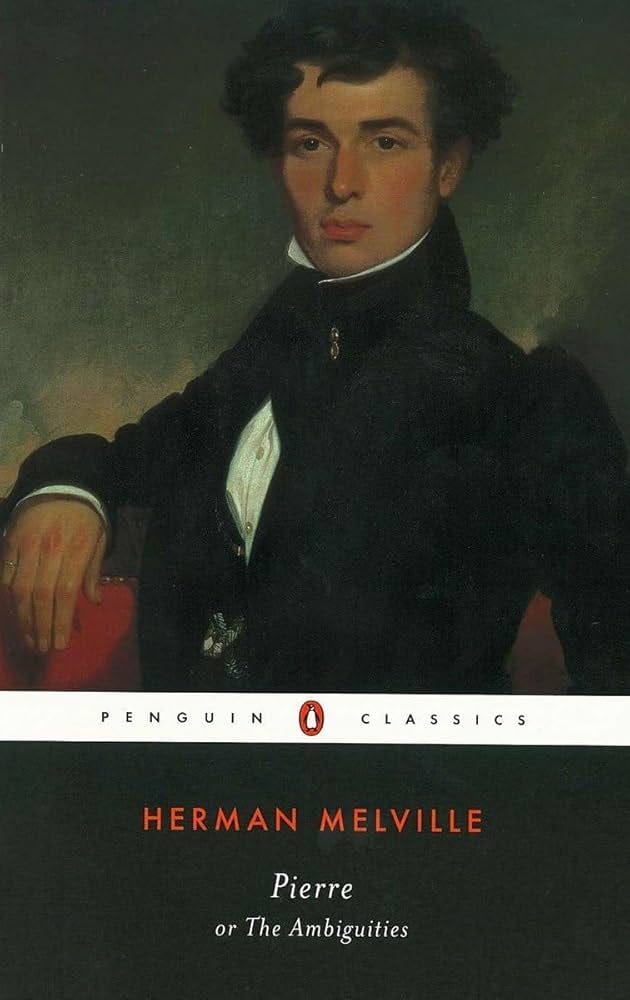
In 1852, Herman Melville submitted a manuscript to his publisher, Harper & Brothers, amidst the onslaught(er) of scathing reviews of his most recent novel Moby Dick. And if Melville’s latently recognized masterwork was a critical and commercial disaster, its successor was even worse received: the Harper brothers, as scholar Hershel Parker has noted, “tried to avoid publishing it by offering Melville less than half the royalties they had paid for his previous books,” which Melville reluctantly accepted. The resulting publication, Pierre, or the Ambiguities, came to be known as Melville’s greatest flop, deemed Melville’s “late miserable abortion,” and described as “repulsive, insane and unreadable,” a work doubtless destined to the dustbin of the American canon, a damned danse macabre, fated to be hated. But it’s been accumulating sympathy among Melville fans over the past half-century, including from contemporary readers like Sean of @travelthroughstoriesyt, whose recent posts about the book impelled me to buy a copy for myself. Set in New York City’s bohemian literary world, it follows the titular Pierre Glendinning, a privileged young man whose orderly aristocratic life collapses after he encounters Isabel Banford, a mysterious woman who claims to be his illegitimate half-sister. Enamored by Isabel, Pierre vows to protect her at the expense of his reputation and inheritance—a vow that spurs a downfall marked by psychological turmoil, poverty, and catastrophe. I’ve seen it described as part gothic melodrama, part philosophical satire, and, most commonly, a psychological novel. But what I’ve read about Melville’s writing in this one novel, and what Sean has told me over Instagram, piques my interest the most. An early critic called it a “philological reform of the English language,” and editor Henry Murray described Melville’s prose as a “miscellany of grammatical eccentricities, convoluted sentences, neologisms, and verbal fetishisms.” Perhaps it’s the literary masochist in me, but that description alone drives me to pick it up in the near future.
Book Still on the Mind: Stay True by Hua Hsu

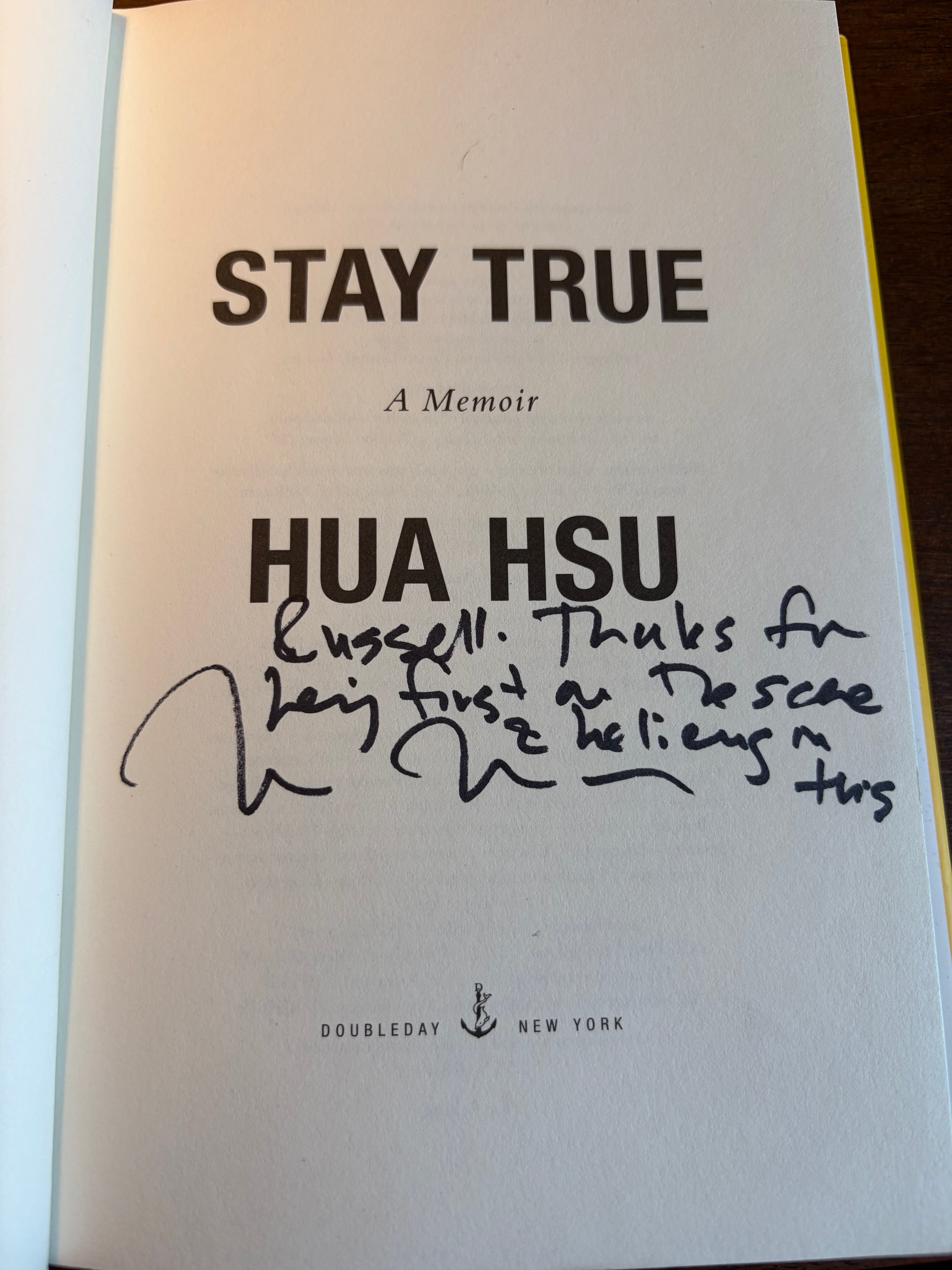
My girl recently borrowed Stay True by Hua Hsu, a book that holds a special place for me, with a story I’m surprised I haven’t regaled here before. In May 2022, I began working as a memoir reviewer for Publisher’s Weekly Magazine, and my second assignment was a work titled Stay True by a writer whose name was new to me. I started reading the galley and had it finished within two days, completely unable to put it down. I drafted my review, replete with a star rating, and sent it to my editor who replied asking if I wanted to interview the author for a spotlight article. Fast forward to the following Friday, I called Hua Hsu, a list of ten questions scribbled on a page before me, pen in hand ready to capture our chat. It was supposed to last at the most thirty minutes, but our conversation veered close to an hour, so effortless it became. We fell into an easy, flowing chat that roped in aspects of the work I hadn’t intended to ask about and meandered into various other subjects beyond the scope of his book. At the end of our phone call, Hua asked for my mailing address, and a couple weeks later I received a package filled with a zine he had made and a bunch of stickers, all which I still have to this day. Our interview was published in June, and his memoir was set to arrive on bookshelves in September. At the end of summer, Hua hit me up on Instagram and personally invited me to his book launch party in Brooklyn in October. I took the train up from Philly for two nights in NYC, attended the launch party at Pioneer Works, where I finally got to meet Hua in-person, and he inscribed my hardcover copy with a heartfelt note: “Russell. Thanks for being first in the scene & believing in this. Hua Hsu.” The following year, Stay True by Hua Hsu won the Pulitzer Prize for Memoir or Autobiography. I still vividly remember the announcement. Now, the paperback edition you can find in bookstores everywhere carries a little excerpt from my review on the inside front cover sleeve. That’s my story; read the book; it’s truly incredible.
Art(ist) of the Week: “The Song of the Lark” by Jules Breton (1884)
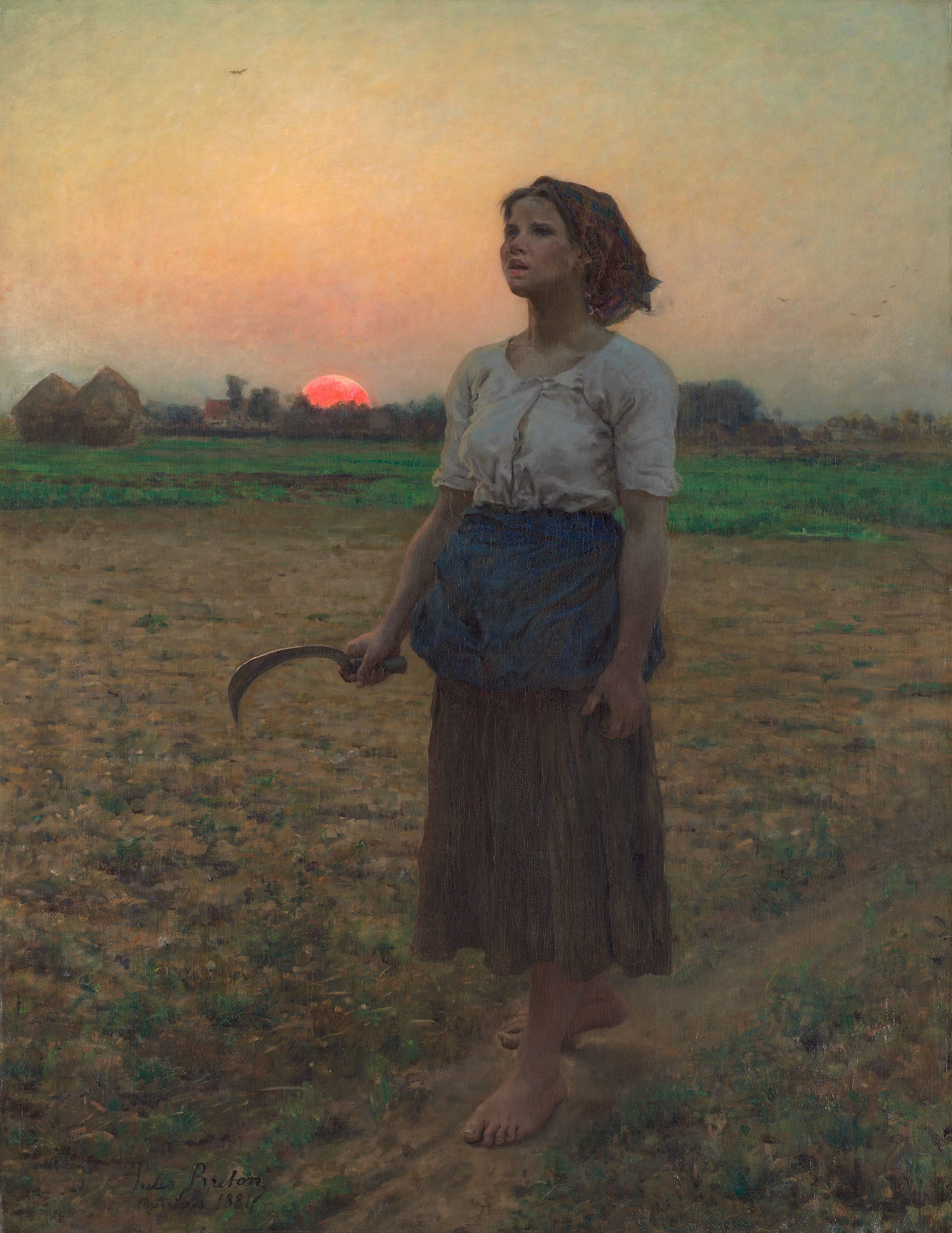
A painting saved Bill Murray’s life. The anecdote runs as follows: a young Bill Murray, contemplating suicide after a disastrous stage performance, walked into the halls of the Art Institute of Chicago, encountered the painting The Song of the Lark by French painter Jules Breton, and was so inspired with hope that he decided to continue living. While, by his own admission, the story may be “not completely true, but is pretty true,” it nonetheless speaks to the unwavering effects of this one painting, a work that remains lauded by art aficionados, critics, and audiences alike, inspiring even writers such as Willa Cather. I stumbled upon it recently and was likewise captured by its contents: a barefooted farm girl stands solitary in a field slowly lightening with the sunrise, the shade of night diminishing in the dawn to reveal the ochre of grain and green sea surrounding her. Sickle in her right hand, kerchief round her hair, she gazes northwestward, posture taut, head held straight with a concentrated countenance, listening to the song of the lark, an exaltation set out of frame. Cast against the backdrop behind her, overlaying the furrowed fields rolling into the offing, lies the softening of a new day’s sky, offering an ordinary, pastoral scene turned moment of quiet transcendence, where dignity, recognition, and renewal emerge from the interconnection of humanity and nature, bearing a beauty that breaks the banality of bucolic habit. About the work, Bill Murray said it “gave me some sort of feeling that I too am a person and get another chance everyday the sun comes up,” a sentiment I think resides at the heart of its legacy, a work that continues to remind viewers of the subtle grandeur of the natural world.
Music(ian) of the Week: Allegro con Fuoco (Movement IV), Symphony No. 9 “From the New World” by Antonín Dvořák
Last week, a good friend texted me, asking for the name of the composer whose symphony we saw performed many years ago at the Carpenter Theater in Richmond, VA. No need to think; I already knew the answer: Antonín Dvořák and his magnum opus, Symphony No. 9 “From the New World.” It’s one of the most celebrated symphonies in music history, the melodies and motifs of whose four movements have resonated across rapt audiences the world round for over a century. All its movements are iconic, but my favorite, and arguably the most popular, is its fourth: Allegro con Fuoco, translating literally to “fast, with fire.” Humming strings open the movement in Jaws-like syncopation before crescendoing into the dramatic horn-blasted fanfare that defines its lasting leitmotif and soon sending the string section into an unbridle frenzy. And we’re off, flying through a sonic sojourn across orchestral pastures whose hills and valleys wend and weave through the aural airspace, sending us soaring into heights of sound, loud in their glorious pitch, and back down to earth, slowing and quieting to catch our breath. It’s a roller coaster I first embarked on in a music theory class I took in high school, where we spent weeks analyzing the entire score, scrutinizing the elements that comprise the beauty of this timeless piece. And timeless it truly is, as its legacy, today, tinges films, TV shows, even commercials in popular culture, and has influenced some of the greatest modern composers of the last century. I fell in love with this one symphony during that class, and since then, it’s remained a mainstay of my favorite classical pieces, a serious magnum opus that I hope everyone has the chance to experience live at least once in their lives. In addition to Gustavo Dudamel and the LA Philharmonic’s wonderful performance of the fourth movement above, I also include the symphony in its entirety, performed by the Frankfurt Radio Symphony under the baton of Andrés Orozco-Estrada in 2018, truly one of the greatest interpretations I’ve ever heard.
Wild Card: History of Japan by Bill Wurtz
While the jetlag has receded, I’m still nonetheless reeling from my Japan trip: going through the photos I took, wearing the apparel I brought back, reminiscing on the food I ate, still surfing the waves rippling forth from this incredible experience. So, for this week’s Wild Card, here’s an animated short about the history of Japan. Chronically online millennials like myself will surely recognize it, as it took the Internet by storm over a decade ago (yes, it’s been that long). A classic of 2010’s YouTube, the video made the rounds when I was in college, my friends sending and sharing it over and over, basking in the joy of watching someone watch it for the first time. And I count myself one among them. It’s a delight of a history lesson. In nine quick minutes, Bill Wurtz, the creator, traces the history of Japan, from its geological origins and the arrival of its early peoples to the influence of China and Korea, the rise of the imperial court, the age of the samurai, shogunates, and civil wars, then onward into modernization and our present-day. Wurtz wields a unique blend of absurd humor and rapid-fire narration to condense the complexity of this thousands-year-spanning history into bullet-pointed explanations, resulting in an entertaining and surprisingly informative skeleton key of Japan’s past, doubtless designed to spark curiosity and further exploration.