The Ninety-fourth
Friday, July 31st, 2026

“We passionately long for there to be another life in which we shall be similar to what we are here below. But we do not pause to reflect that, even without waiting for that other life, in this life, after a few years, we are unfaithful to what we once were, to what we wished to remain immortally.” – Marcel Proust, In Search of Lost Time Volume IV: Sodom and Gomorrah (p. 349)
Book in the Pipeline: Corelli’s Mandolin by Louis de Bernières
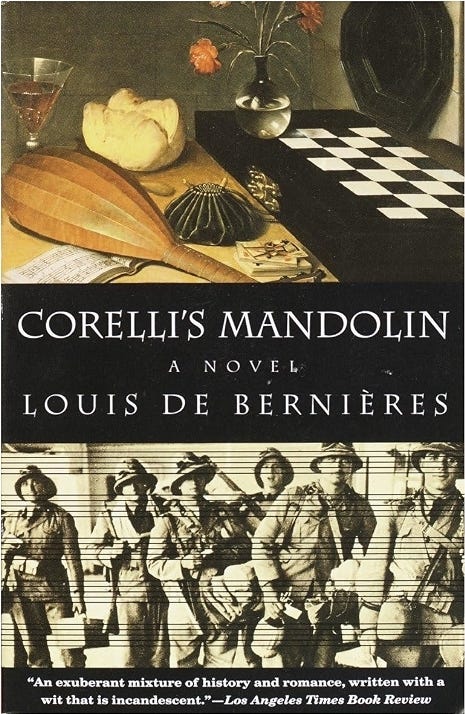
Certain novels enter a reader’s radar and remain there for years and years before they finally read them. One such novel, residing among the long and varied list alive in the readerly recesses of my mind, is Corelli’s Mandolin by the British writer Louis de Bernières, published in 1994, the year I was born. I cannot remember when I first learned of it or heard of its famous film adaptation, but only that, over the years, my ears have always perked up when encountering its title. So, when my girlfriend and I happened into the Head & the Hand Books over in Fishtown a few weekends back and I saw its spine sitting still, its horizontal title set outward unsuspectingly on the bottom shelf based against the wall, I simply had to snag it. It’s a sweeping historical novel that intertwines romance, war, and the enduring resilience of the human spirit set against the backdrop of the Italian occupation of Cephalonia during WWII. At its heart is the unlikely love story between Pelagia, the intelligent, strong-willed daughter of the island’s physician, and Captain Antonio Corelli, a charismatic Italian officer whose passion for music and reverence for his prized mandolin stand in stark contrast to the brutality of the conflict in which he finds himself embroiled. War transforms the idyllic island into a landscape of occupation, pain, tragedy, but the romance enkindled between Corelli and Pelagia imparts a beauty born from the rubble, a love that weaves humor, music, and art together, spinning the tapestry of majesty for which the novel remains so renowned. And it does so through exquisite, wit-filled prose, apparent even at the outset of the novel: “Dr. Iannis had enjoyed a satisfactory day in which none of his patients had died or got any worse. He had attended a surprisingly easy calving, lanced one abscess, extracted a molar, dosed one lady of easy virtue with Salvarsan, performed an unpleasant but spectacularly fruitful enema, and had produced a miracle by a feat of medical prestidigitation.” That opening alone, a mere two sentences, so filled with humor and intrigue, is enough is grip me and keep me reading.
Book Still on the Mind: The Odyssey by Homer
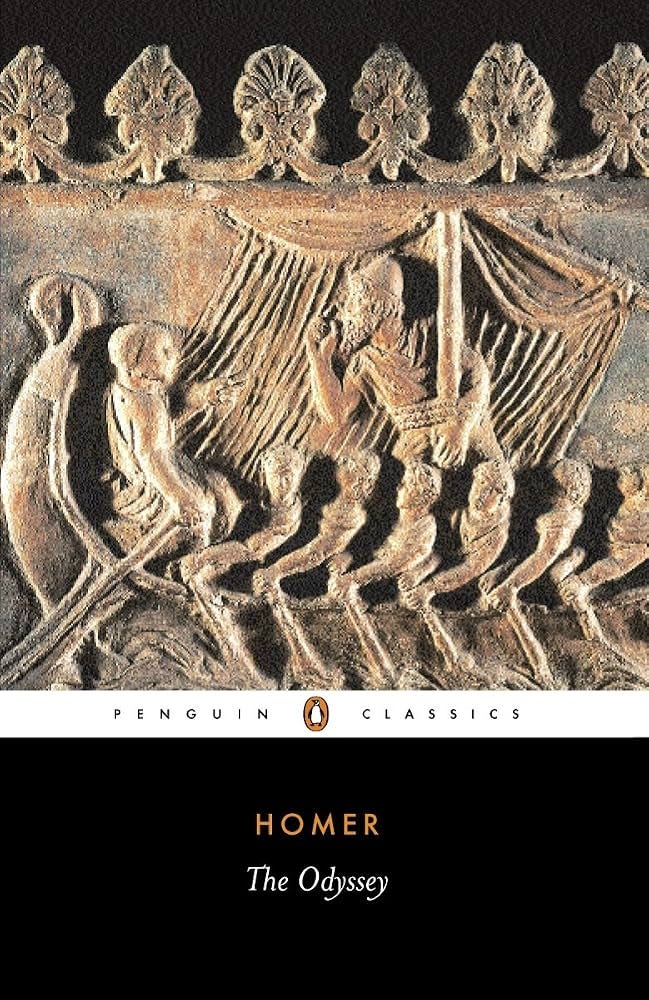
It won’t come as any surprise that I, like everyone else in the country reeling in the wake of Nolan’s latest film, have The Odyssey on the mind. My ninth-grade English class was where I first read the epic poem in E.V. Rieu’s prosified translation, which spans twenty-four books and more than 300 pages. The Odyssey itself is nearly 2,700 years old, with origins rooted in the oral tradition of bards traveling from city to city across the Ancient Western World singing the verses later compiled and attributed to the Greek poet Homer. And these verses spell a story of love and war: after leading the Achaeans to victory in the Trojan War, Odysseus, the King of Ithaca, begins his return home to his wife Penelope and son Telemachus—a decade-long journey punctuated with perils of both the body and mind. Foes include monstrous beings, like Polyphemus and the Laestrygonians; nymphs, sirens, and goddesses; and fellow men alike, amid the brutal conditions of the voyage, treacherous tempests, starvation, and sickness, fates compounded by the cosmic hands of the gods, forcing Odysseus into feats of bravery, endurance, ethical dilemmas, and outwitting. By the end of Odysseus’s perilous trek, the lessons of each labor limn universal truths that have driven and continue to drive the text’s undying importance; and it is the recognition of these truths—and the beauty and pain therein—that has sustained the legacy of this story, one of humanity’s oldest. I didn’t realize it when I first read it, but now, these many years later, as an adult and seasoned reader, I think part of being human demands experiencing the things that bind us together as a species—the stories, the ideas, the themes, the wonders that perennially persist over the course of history, truths that touch and unite, ineffable, immutable, reflective of the ways the world was then as the world is now, rendered in such sublime feats of artistic capability; and The Odyssey is an exemplum of that significance and undertaking. It’s a work to experience and re-experience, interpret and reinterpret, ponder and re-ponder over and over and over again, doubtless one of the greatest tales of all time.
Art(ist) of the Week: “The Destruction of Sodom and Gomorrah” by John Martin (1852)
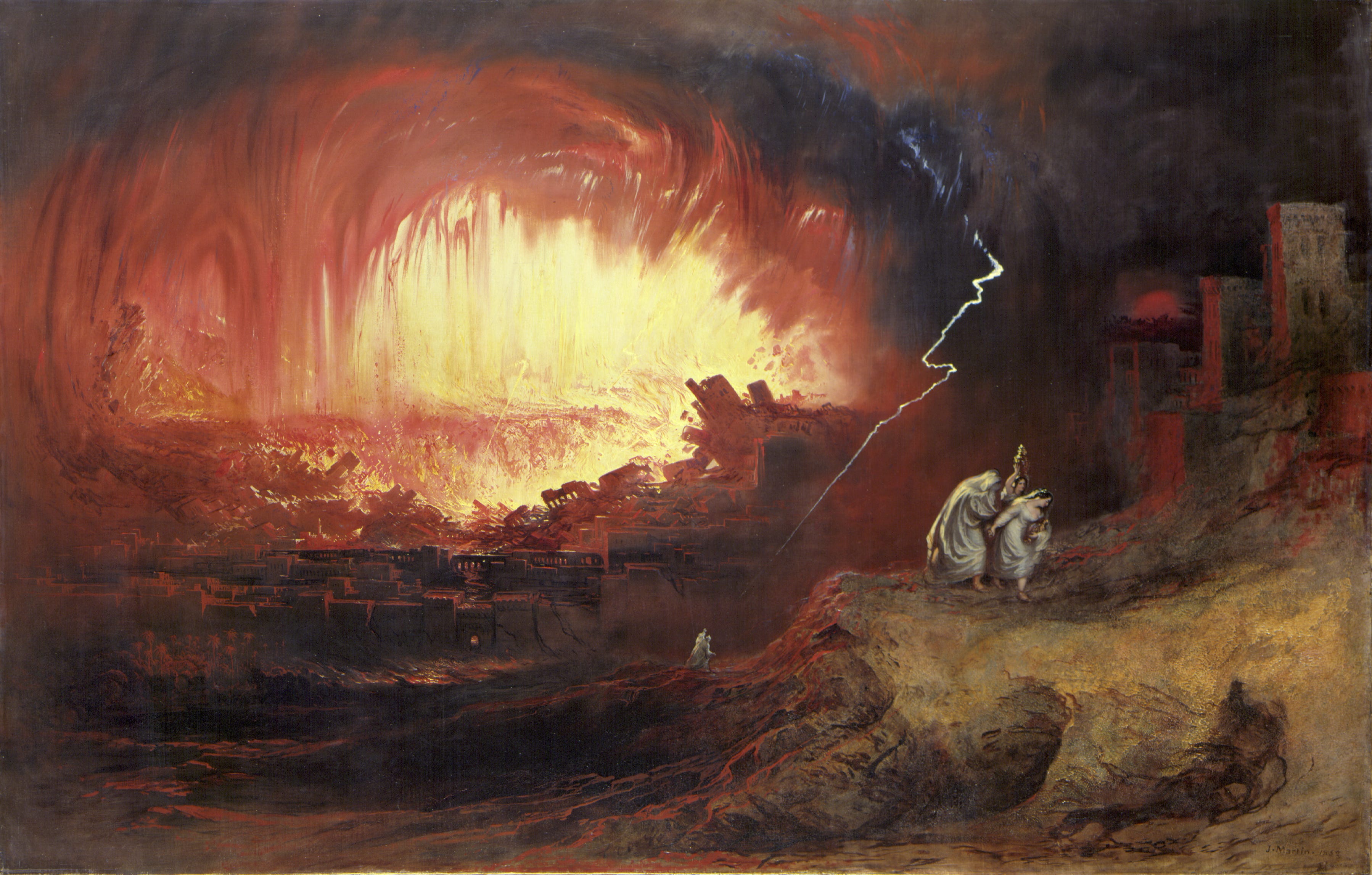
At the time of writing this, I am halfway through the fourth volume of Proust’s In Search, a volume, courtesy of Kilmartin and Moncrieff, titled Sodom and Gomorrah, alluding to the two cities of the plain which God destroyed in the Book of Genesis as punishment for the iniquitous sins of men. And it is this scene of destruction, one of the most famous sections of the Old Testament, that the English painter John Martin took as his subject in the early 1850s and captured God’s fearful wrath in a pictorial work that continues to stand a monument to the apocalyptic vision wrought within the Biblical parable. A colossal eruption of white-hot fire engulfs the cities set center frame, flame blazing the buildings, toppling towers and collapsing stone structures under a sky illumined with flaring reds, oranges, and yellows, the sable swirl of clouds above unleashing the fiery fury, as a lightning bolt carves through the canvas, the strike vanishing into the ground below. Shadows enshroud the inferno, heightening the contrast between the flowing flames and the darkness chasing Lot and his two daughters alighting up the rocky hillside, fleeing the devastation, their pale robes soft against the hard terrain, while Lot’s wife lingers behind, foreshadowing her imminent saline transmutation. By wielding light, color, and immense scale, Martin summons at once the terror of divine judgment and the deliverance of the righteous from destruction that reside at the heart of the parable, reminding readers of the wrath of God. Those who know me know my taste for the macabre, dark, and eerie, and know that I genuinely love paintings that capture the sublime horror that stipples so much of the Bible. So, it makes sense that Martin’s masterpiece is a new favorite of mine, a work whose beauty and dread will linger in the back of my mind long after I finish the final words of Proust’s fourth volume.
Music(ian) of the Week: “Doused” by DIIV
A good friend of mine has recently reawakened my love for shoegaze, a subgenre of alternative rock so named for players’ propensity to perpetually peer downward at the effect pedals spread round their feet during a performance, hence the portmanteau; they look like they’re gazing at their shoes. Though the name started pejoratively, it has since emerged as a sonic sobriquet of sorts, as the term intimates an over-reliance of distortion pedals and guitar effects, a signature of the subgenre. Sound is the emphasis, great aural expanses that range from ambient and atmospheric to aggressive and abstract, covering all the auditory bases in between, creating, as my friend so eloquently notes, “everything and nothing all at once.” And one band that seems to cover all these bases is the Brooklyn-based foursome DIIV, whose tune “Doused,” from their 2012 debut album Oshin, has been a mainstay in my playlists for years. The bass sounds the start, soloing three notes, C-E♭-B♭, setting the C-minor key with a groove that grips the shimmering guitar riffs in a shade that spans the length of the track. Pummeling percussion keeps the rhythm as loops layer upon layer, orbs of orchestral ostinato, soon send upward into Zachary Cole Smith’s reverberating vocals: “Never had you run so far but you really gotta get away/ You know it in the nighttime running to it/ Caught a rising star but then you let it drop into/ The ocean now the water’s running through it”: less lyrics than a rushing of words, lines starting, streaming, and sweeping through the song’s structure, wisps wended within their effects blurring the bounds between verse and chorus, repeating verbal phrases reflecting the repeating sonic phrases of the instrumentation, supplemental to the sound all the while. And therein lies its locus and focus, the sound itself, evolving, cycling through iterations, accumulating and diminishing, variegating and shifting, and, in the end, creating a sonic sojourn that stirs and soothes in a single fell shoegazy swoop, a sea of sound to DIIV into.

Wild Card: The Delft Explosion
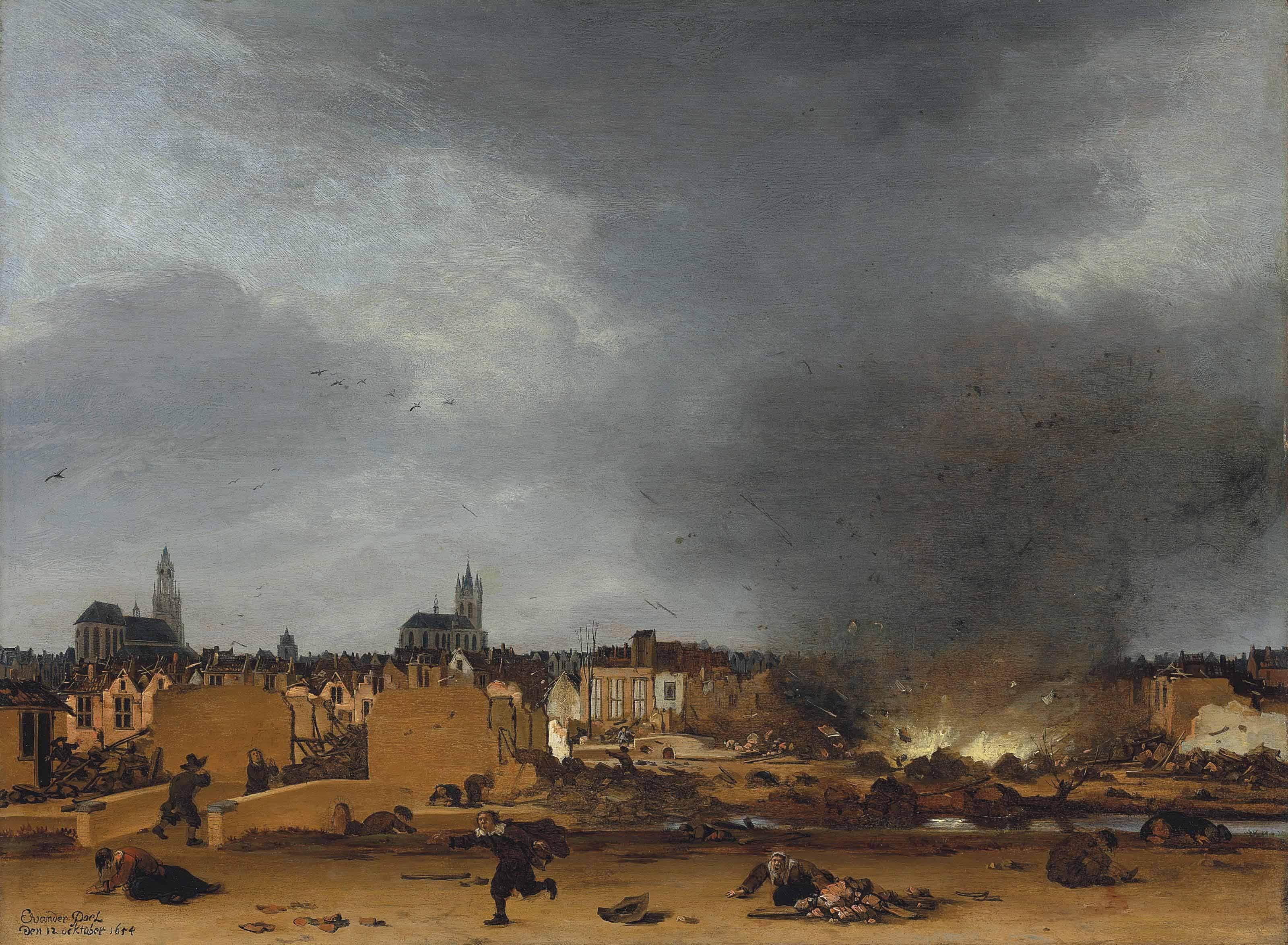
While writing about John Martin’s masterpiece, I was reminded of a famous explosion I read about a while ago, a real-life historical disaster the likes of which rival the painter’s pictorial presentation above. On the morning of October 12th, 1654, in the Dutch city of Delft, a massive store carrying over thirty tons (nearly 80,000 pounds) of black gunpowder accidentally ignited, unleashing an explosion that destroyed a quarter of the city, killing at least a hundred people, injuring thousands more, and whose burst could be heard over seventy miles away, a deafening crack described as a thunderclap. Houses were leveled within seconds, blocks blasted, the region razed, the seismic shockwave that emanated from its epicenter shattering windows, splintering wooden structures, sending citizens soaring off their feet, carving a cavernous crater below the storehouse, and shooting fire far into the surrounding thoroughfares. But if the damage done—the lives lost, the citizens injured, the homes ruined, the physical and financial toll wrought upon the city of Delft—wasn’t enough, the tragedy of the event was multiplied exponentially when it was discovered that Rembrandt’s most promising young pupil, the 32-year-old painter Carel Fabritius, had died in the blast and the overwhelming majority of his artworks destroyed. Artists and art scholars the world round mourned his death, and today, his loss is remembered as one of the greatest artistic tragedies of the Dutch Golden Age, inextricably woven with a disaster whose waves still ripple through the annals of world history.