
The Ninety-third
Friday, July 17th, 2026

“What is the World Cup really? One big theater of dreams, and it’s these moments, prior to the first kick-off, which loom largest. When all the supporters’ dreams are still alive and intact.” – Fredrik Ekelund in a letter to Karl Ove Knausgaard, Home and Away (p. 24)
Book in the Pipeline: Le Morte D’Arthur by Sir Thomas Malory
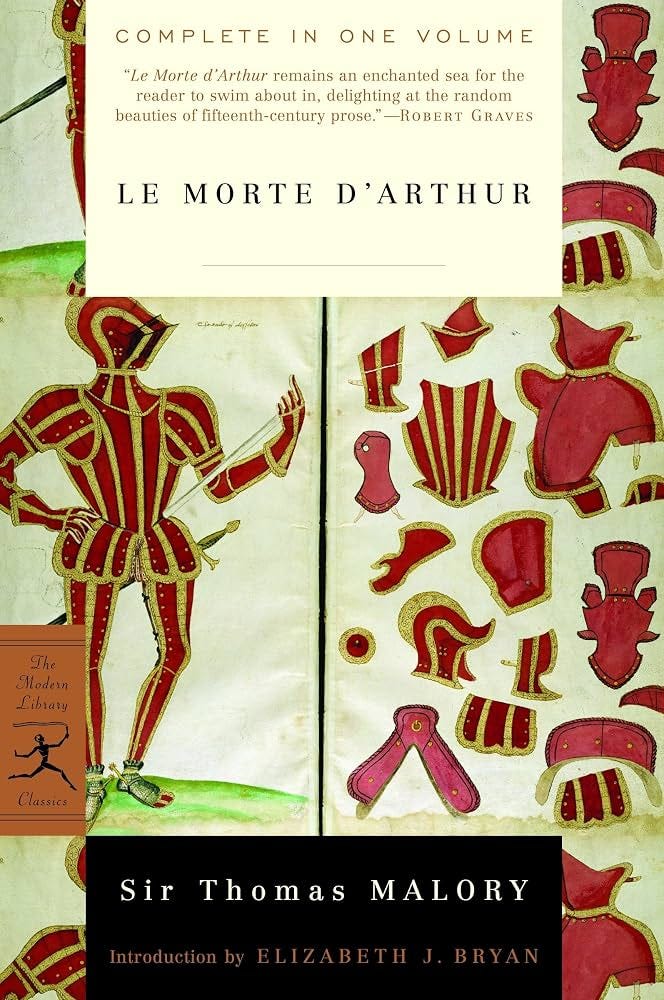
King Arthur, the Knights of the Round Table, Queen Guinevere, Lancelot, and Merlin—everyone knows their names, perhaps most know their legends, but I doubt many realize the extent of the mythology from which they spring. The legend of King Arthur comes from a massive body of medieval literature today known as the Matter of Britain, compiled of countless works of prose and poetry covering the mythical history of Britain and Brittany, and one of its foremost compendia, arguably one of the most important comprehensive texts in English literature, is Le Morte D’Arthur by Sir Thomas Malory, published in 1485, one of the earliest books ever printed. Its twenty-one sections taken together, with over five hundred chapters stretching nearly a thousand pages, assemble all the Arthurian French and English romances into a single, sweeping account of the conception and rise of King Arthur, the founding of the Knights of the Round Table, the adventures of such legendary knights as Sir Lancelot, Sir Gawain, Sir Tristan (and, of course, Isolde), and Sir Gareth, and the quest for the Holy Grail, while spanning the sword in the stone story, Arthur’s marriage to and Lancelot’s affair with Queen Guinevere, the schemes of Morgan le Fay, the counsel of Merlin, and Arthur’s betrayal by his son Mordred, culminating in the king’s death at the Battle of Camlann and the conclusive collapse of Camelot. It is the quintessential medieval text combining chivalric adventure, courtly romance, Christian spirituality, and tragic inevitability, standing today as the foundational source through which the best-known Arthurian legends have entered the modern imagination. I admit I’m a novice when it comes to this branch of literary history; I never took a medieval literature course in college and, outside of Chaucer, have never read any of the canonical works. So now, finally, to feed my fondness for philomathean fun with what I’m sure will prove a long and arduous endeavor, I’ve snagged a copy of Malory’s monumental monstrosity, and I look forward to jumping into the sword-wielding world of one of history’s greatest legends sometime in the near future.
Book Still on the Mind: The Helios Disaster by Linda Boström Knausgård
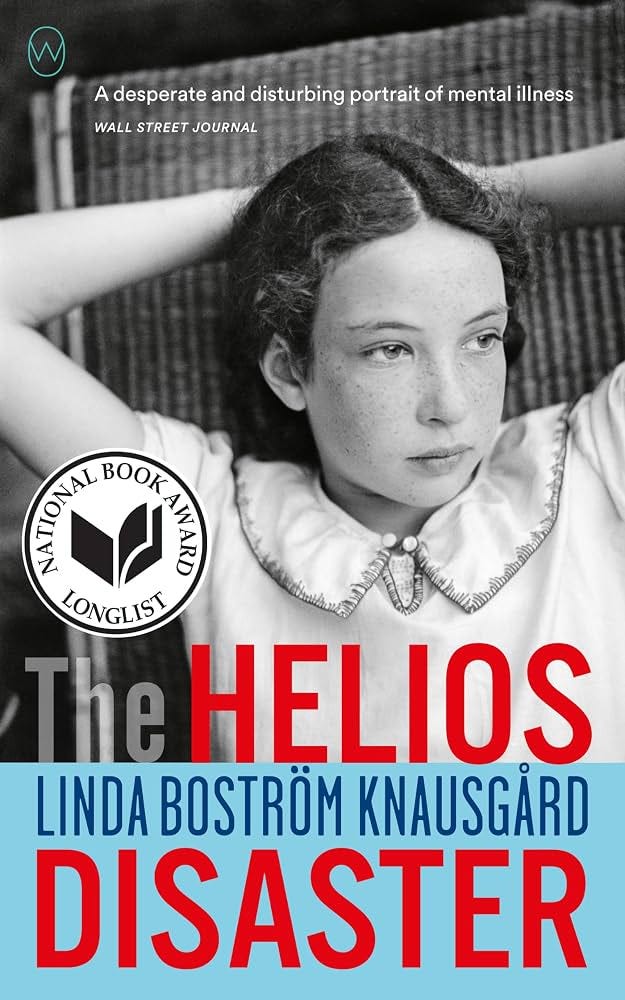
As I write this, I’ve returned to the work of Norwegian writer Karl Ove Knausgaard who, as my close friends know, is one of my favorite authors. But rather than reminisce on any one of the works of his I’ve read over the years, I recall a short novel by his ex-wife Linda Boström Knausgård, a Swedish author and poet whose literary talent, undeniably darkened by the shadow of her former marriage, deserves higher praise than it seems to receive. I read The Helios Disaster in August of 2021, her third book, originally published in 2013 and translated into English two years later, a modern reimagining of the Greek myth of Athena. It begins with the birth of Anna, bursting forth from her father’s head as a fully formed twelve-year-old who promptly retreats into the snowy Swedish sylvan-side. Not long after, she’s discovered and placed into the hands of a deeply religious foster family, where she’s forced to learn the customs of ordinary life, all while grappling with antenatal amnesia. As she slowly acquires language, social awareness, and an understanding of the world around her, Anna becomes increasingly obsessed with reconnecting with her father, whose cryptic letters allude to the past she cannot remember. When she suddenly starts speaking in tongues, her family and community take it to be a divine miracle, but the event precedes a psychological collapse that destabilizes the story so far, ushering forth a denouement that still stays with me to this day. I remember blitzing through this short novel, totally mesmerized by Anna’s enigmatic first-person narration, rendered in prose I’ve seen likened to the work of Sylvia Plath and Anne Carson, and then reeling from the wild conclusion that caught me completely off-guard. Linda Boström Knausgård is an unsung talent, and The Helios Disaster proved that in spades. I have another one of her works, an unread October Child sitting on my shelf, and I think it’s high time I crack its cover.
Art(ist) of the Week: “Ezekiel’s Vision” by Raphael (1518)
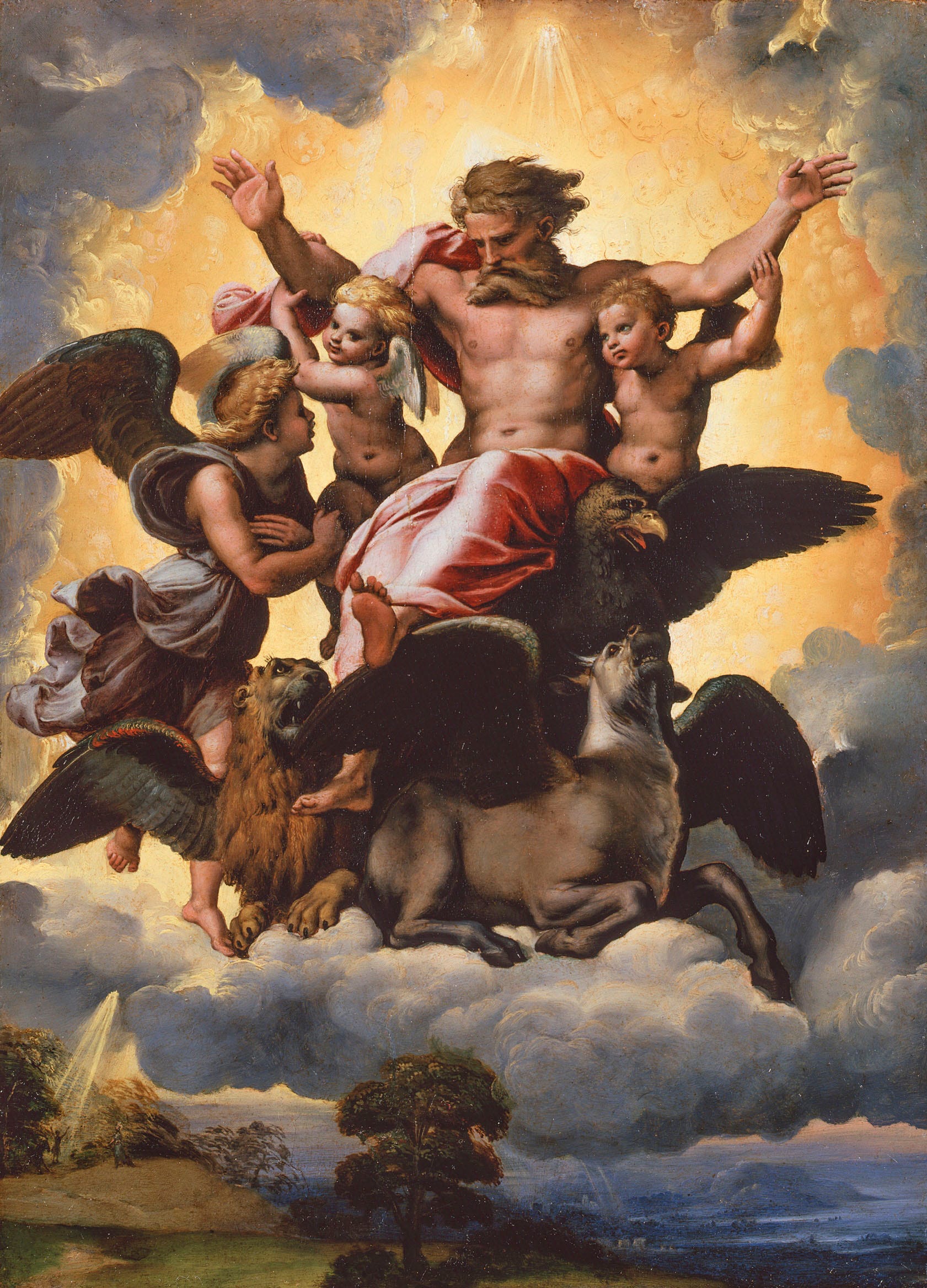
Recently I read Angel Down by Daniel Kraus and wrote a critical essay exploring the theological themes abounding through the text via major plot points and tiny details alike. And one such tiny detail is the painting Solly Madonna by Raphael, which sent me rushing down a rabbit hole of the Renaissance painter’s work, whereupon I found this exquisite painting: “Ezekiel’s Vision,” unveiled in 1518. This small scale painting (measuring 16 x 12 in) depicts an important moment in the Bible, the opening of the Book of Ezekiel, when the prophet Ezekiel witnesses God: “As the appearance of the bow that is in the cloud in the day of rain, so was the appearance of the brightness round about. This was the appearance of the likeness of the glory of the Lord. And when I saw it, I fell upon my face, and I heard a voice of one that spoke” (Ezekiel 1:28). Centered upward-frame, God emerges from luminous golden clouds, half-clothed in flowing robes of rose, his flaxen hair and beard billowing as he stretches his arms outward, grasped by two cherubim on either side. A man, a lion, an ox, and an eagle, the four living creatures of Ezekiel’s vision, surround the Lord, their sharply shaded forms floating in the focus of the frame. And under them, basking beneath Heaven’s brilliance, lies a landscape, the tranquil verdure of whose rolling hills is stippled by trees, overlooking the azure of a land far below, as two tiny figures behold golden rays showering down leftward frame. It’s a scene of grandeur rendered in Raphael’s characteristic style contrasting light and dark, hard and soft textures, and colors that span the palette spectrum, transforming a fearful vision into an epiphany. In 1799, during the Napoleonic Wars, French forces broke into the Uffizi and stole the painting, bringing it back to Paris where it stayed for over a decade before being returned to the Palatine Gallery at the Palazzo Pitti in Florence, Italy, where it continues to hang today.
Music(ian) of the Week: “Basking in the Glow” by Oso Oso
On Friday, June the 26th, I joined my close friends at the Spruce Street Harbor Park, an outdoor venue on the Delaware River, to catch a free concert headlining Oso Oso, an emo band from Long Beach, New York, whose unique blend of indie and grunge, melodic and lyrical unsuspectingness have grown them a great following in recent years. Formed in 2014, their original name was Osoosooso, and they released an inaugural EP before shortening their name to Oso Oso, citing frequent misspellings on tour flyers. After releasing a split album with emo heavy-weights Free Throw, they released their first full-length album, Real Stories of True People Who Kind of Looked Like Monsters, which shot Oso Oso onto the main stage of the genre, paving the path for a second full-length album, The Yunahon Mixtape in 2017, and third album, basking in the glow, in 2019, whence this song comes, its eponymous track. “Little jagged edge/ I’m leaning in again/ And I felt it when you said/ That I am just a mess/ There was nothing I could do/ But see your point of view/ and that’s the truth” runs the first verse, cast against clear-cut chords, syncopated with the percussion, heading straight into an interlude then diving into the chorus: “And these days/ it feels like all I know is this phase/ I hope I’m basking in the glow,” crisp in their classic catchy combination of call-and-response and easy feeling harmonies. The lyrics spell the time-worn tale of being stuck in a certain time of life, caught in the unknown and uncertain, yet hoping that something new, something good is just around the corner. My friends and I danced and sang along as we watched them play this song, friends among a crowd of more friends, each one of us resonating with the relatability rife in the lyrics of this one tune. And perhaps that’s why Oso Oso have taken off like they have: their uncanny ability to connect with their crowd, stirring feet and emotion in a single fell sonic swoop, and doing so with an undeniable groove, a singular suavity and coolness caught by all bearing witness. They’re definitely a band to watch, and I hope I get to see them again.


Wild Card: Werwulf, a new film by Robert Eggers
This coming Christmas will see the arrival of a new film by one of my favorite filmmakers: Werwulf by Robert Eggers. He’s the mastermind behind such incredible filmic feats as The Witch (2015), The Lighthouse (2019), The Northman (2022), and his latest, Nosferatu (2024)—all movies marked by the ecstatic gothic vision, mythic explorations, and horror-stricken sensibilities that have defined his reputation as an undisputed auteur of the highest order. From what I know of it, Werwulf is a period gothic folk horror film which Focus Features describes as “a harrowing tale of devotion, damnation and the devil within.” An original story written by Eggers and his frequent collaborator, Sjón, the acclaimed Icelandic novelist and poet, the film is set in 13th-century England, following a man (Aaron Taylor-Johnson) who undergoes a lycanthropic metamorphosis and “stalks the foggy countryside, transforming local folklore into terrifying reality as villagers face an ancient supernatural threat.” It seems that’s all we know of its plot details, but we also know that Lily Rose Depp, Willem Dafoe, and Ralph Ineson have reunited to star in this upcoming Eggers edition, and I, for one, cannot contain my excitement to ring in the new year with the howls of the Werwulf.