
The Seventy-third
Friday, October 10th, 2025

“But (for Melmoth never could decide) was it in a dream or not, that he saw the figure of his ancestor at the door? – hesitatingly as he saw him at first on the night of his uncle’s death, – saw him enter the room, approach his bed, and heard him whisper, ‘You have burned me, then; but those are flames I can survive. – I am alive, – I am beside you.’ Melmoth started, sprung from his bed, – it was broad day-light. He looked round, – there was no human being in the room but himself. He felt a slight pain in the wrist of his right arm. He looked at it, it was black and blue, as from the recent gripe of a strong hand.” - Charles Maturin, Melmoth the Wanderer (p. 67-68)
Book in the Pipeline: Vathek by William Beckford
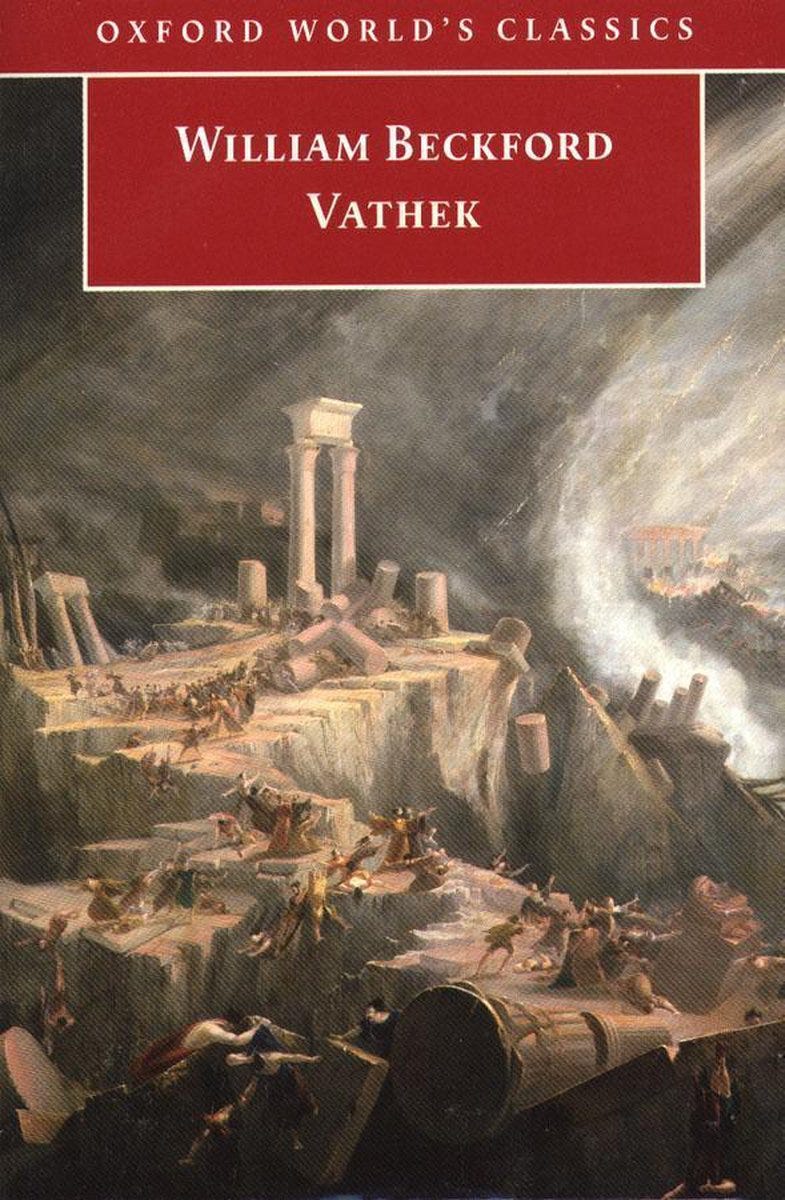
My next Spooky Season submission of Gothic novels I want to read is Vathek by British author William Beckford, who composed the novel in French in 1782 but which was translated into English by Reverend Samuel Henley and published in that form in 1786 under the title An Arabian Tale, From an Unpublished Manuscript, purporting to be a found and translated ancient Arabic document detailing the life and tribulations of its titular protagonist. Vathek is the ninth caliph of the Abbasid Empire, a ruler whose insatiable thirst for knowledge, pleasure, and power leads him down a dark path to damnation. Guided by his diabolical mother Carathis and seduced by the mysterious Giaour with promises of forbidden wisdom, Vathek abandons morality and faith in pursuit of supernatural treasures. His journey, one of decadence, cruelty, and otherworldly occurrences, culminates in the descent to the underworld palace of the pre-Adamite kings, where he finds nothing but eternal condemnation for his hubris. Described as an Arabian Nights-style dark fantasy, Vathek remains an influential work in the annals of Gothic literature, inspiring the likes of poets Lord Byron, Thomas Moore, and John Keats, as well as prose masters of the macabre Edgar Allen Poe and H.P. Lovecraft. It’s a blend of exoticism, horror, and moral allegory, exemplary of the 18th century fascination with the sublime and grotesque, and with its ornate prose, nightmarish imagery, and themes of damnation, Vathek promises to be a strange and sumptuous read, perfect for the spectral ambience of Spooky season.
Book Still on the Mind: Sanctuary by William Faulkner
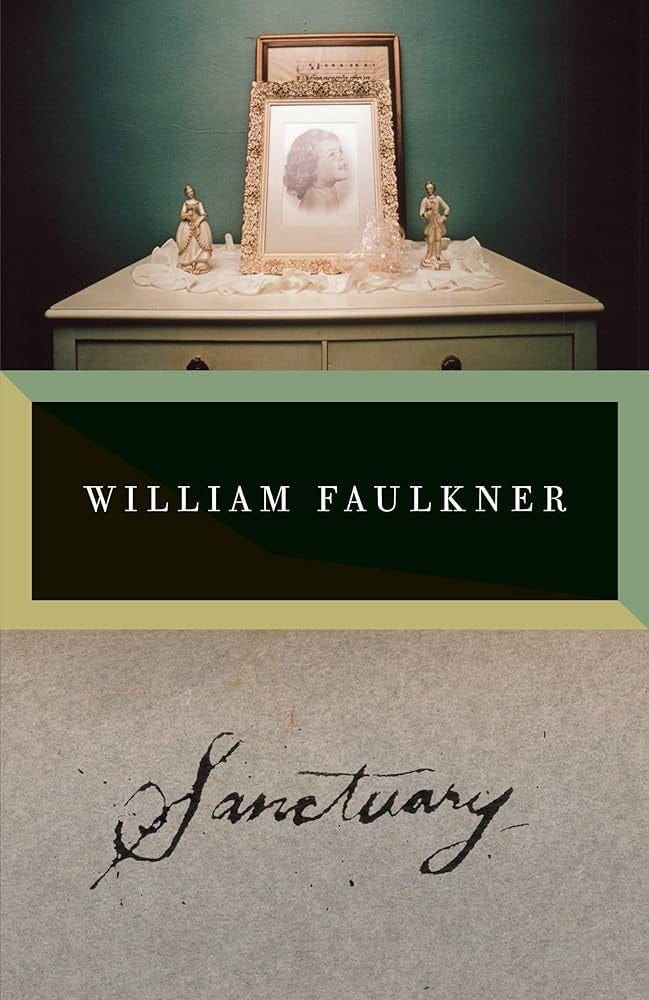
Three Wednesdays ago, one of my favorite writers, William Faulkner, turned 128 years old. He’s the pioneer of Southern Gothic Literature, a Nobel Laureate, a writer raised in Oxford, Mississippi at the onslaught of the twentieth century, the mastery of whose writerly output remains unrivaled in American literature. It’s impossible to overstate the impact that discovering William Faulkner has had on me––on my reading life, my writing life, my life in general. His catalog of works, the extent of which I have yet to truly plumb, stands among, if not defines, the pantheon of literature I hold in the highest regard: he is truly a master in his own class. Which is why I was surprised to find I haven’t yet included Sanctuary among my Book Still on the Mind selects. I read it over the course of two days in June of 2020, falling captivated to the turbulent tale of Temple Drake, a young college student who becomes entangled in a horrific sequence of events after seeking refuge at a bootlegger’s hideout headed by a sadistic criminal named Popeye. Temple is kidnapped, assaulted, and psychologically shattered, while Horace Benbow, an idealistic lawyer whom Temple recently met, attempts to seek justice in a legal system rife with hypocrisy and failure. Set against the backdrop of Prohibition-era Mississippi, the novel explores the brutal realities hidden behind the veil of Southern respectability, and Faulkner employs his signature stark imagery and morally ambiguous characters to challenge conventional notions of innocence, guilt, and justice. I was unable to put this one down, as its topsy-turvy narrative tangles slowly ensnarled me into their snare. What I most remember from this incredible novel is how the bleakness of the Temple’s story was amplified by the bleakness of Faulkner’s prose, a structural relation often found in his works, and which remains, in my opinion, one of his most masterly qualities. Sanctuary is a dark work and one which, I can say assuredly, will leave its mark on any reader brave enough to take the plunge.
Art(ist) of the Week: “The Nightmare” by Henry Fuseli (1781)
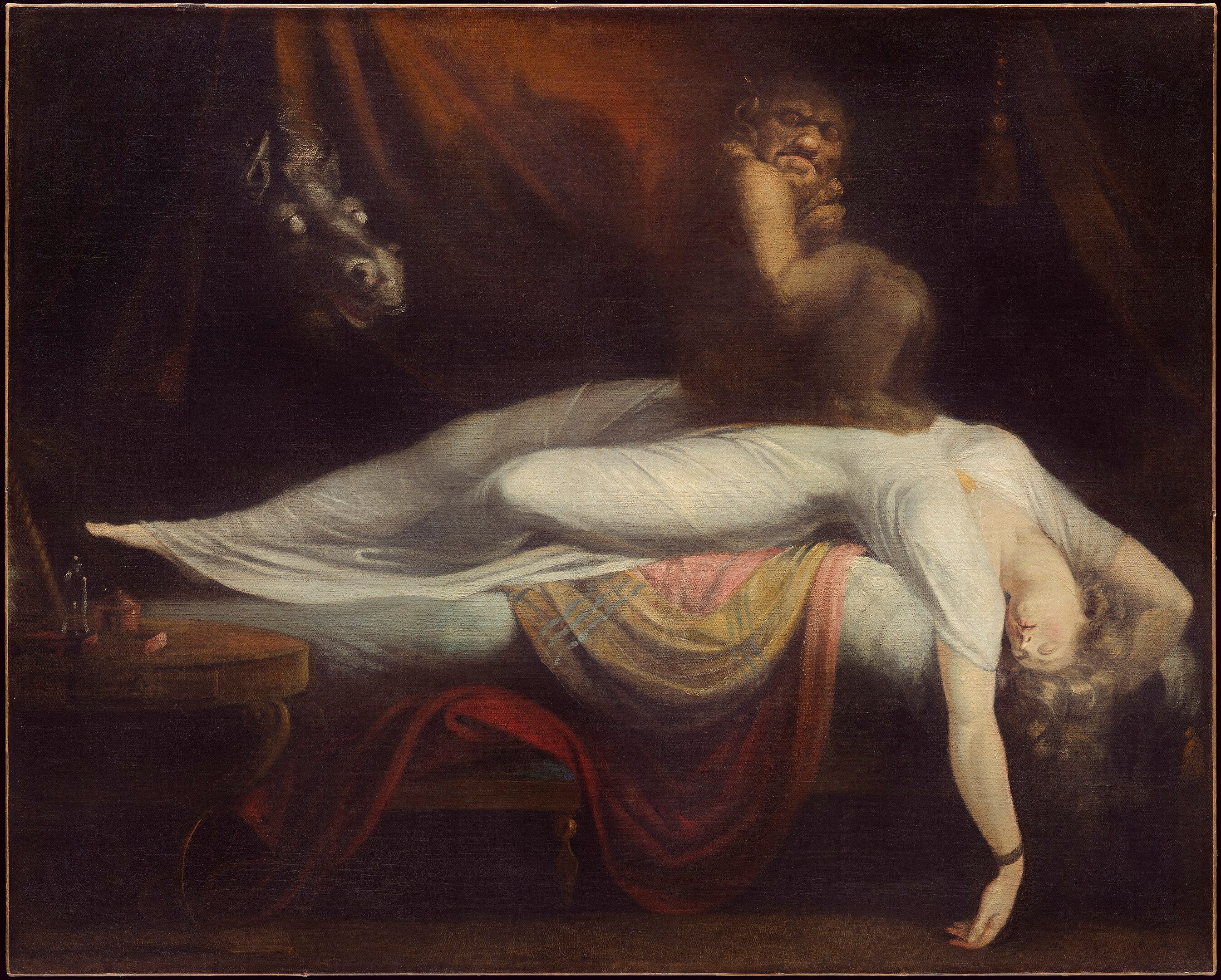
Few paintings carry the weight, prominence, and legacy across the history of dark art more than “The Nightmare” by Swiss painter Henry Fuseli. It’s an icon of the Gothic, an unsettling work that influenced not only other artists but Gothic literary greats including Mary Shelley and Edgar Allen Poe. Captured in frame is a woman sleeping, posed dramatically, lifelessly across the bed, draped in a flowing white night gown that shines in contrast to the shadowed darkness surrounding her. She is limp, her head hanging back over the edge of the bed, eyes closed, mouth slightly parted. Perched upon her midriff is a grotesque, goblin-like creature, the incubus, with hunched posture and bulging eyes. Behind the bed, leftward frame and partially obscured by the dark curtains, looms the head of a ghostly black horse, the literal “night mare,” who, with glowing, vacant eyes and flared nostrils, intrudes into the scene from another realm. It’s a simple sleeping scene turned sinister, inspiring countless interpretations that range from the supernatural to the psychoanalytic to humanly depraved. Many scholars contend that Fuseli, drawing on folklore, has visualized sleep paralysis and the haunting power of dreams. Though its erotic and psychological undertones further reflect a fascination with the unconscious and taboo. Strikingly, Fuseli employs chiaroscuro and exaggerated, expressive forms to heighten the surreal and emotionally intense, aligning the work with the Romantic movement’s emphasis on the sublime, emotional, and imaginative. “The Nightmare” is truly a work straight out of a nightmare, and the more I look at this painting, the more I find something new, something to marvel at, something to disturb, making it an emblematic masterpiece of Spooky season.
Music(ian) of the Week: “Demons” by Zeds Dead
In keeping with Spooky season, I submit “Demons” by Zeds Dead for my music pick of the week, a tune whose accompanying music video is a ghoulish break-dancing zombiefest free-for-all. It’s the first track off the Canadian duo’s Hot Sauce EP which was released in 2013 and also includes such heaters as “Playa” and my personal favorite, “Rave,” a mainstay in so many of my playlists. But it was “Demons” I first thought to consider for this week. It’s a nightmare of a bass tune: its eerie piano intro and haunting samples feel ripped from a forgotten horror film, soon to be devoured by grinding synths and basslines that crawl straight out of the rave grave. Rhythmically possessed, its metallic percussion and minor-key loops circle the main line like a wake of vultures looming overhead with dread and adrenaline. And the music video, directed by Benjamin Millepied, translates this sonic possession into motion: a vampire is confronted by a demon troupe of undead dancers in an empty parking garage in a sequence that reanimates the spirit of “Thriller” with a gritty, industrial, apocalyptic edge. Each convulsive instant hits in sync with the song’s pulsing shadows, the choreography a physical echo of the bass, merging scary sound and hellish image into one single vision of ecstatic horror. I remember when first saw it, thinking just how fun it must have been to make this video, to revel in the demonic dance of death and rebirth, to translate into narrative a completely instrumental tune. And the result is masterful: “Demons” is a certified Halloween classic from Zeds (un)Dead.

Wild Card: The Story of Tartini’s Devil’s Trill Sonata
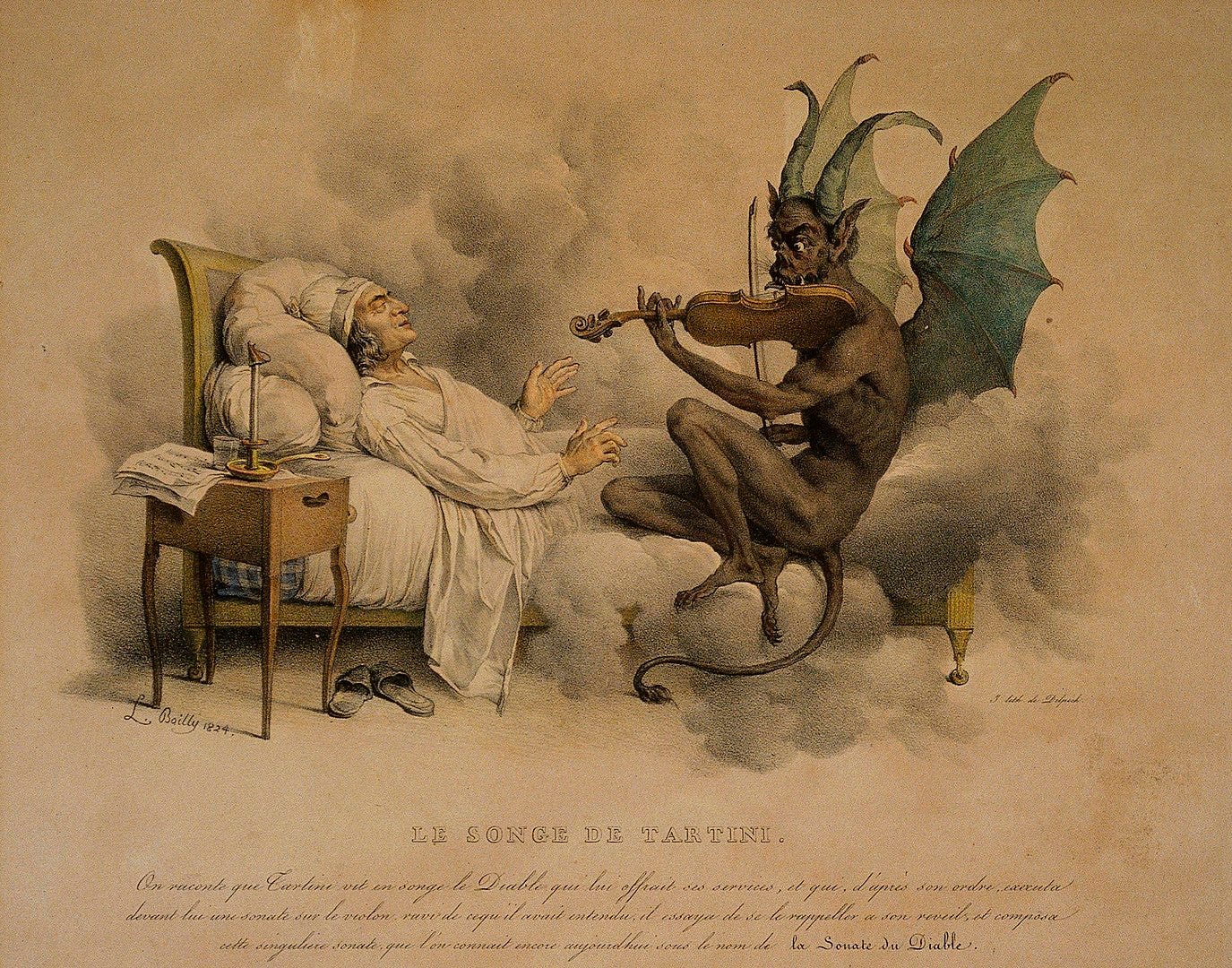
In 1713, Italian composer and violinist Giuseppe Tartini met the Devil in a dream. According to Tartini, he dreamt the Devil appeared at the foot of his bed (not unlike Fuseli’s painting) and offered to be his servant. In the dream, Tartini handed the Devil his violin to test his musical skills, and the Devil played a sonata of such incredible beauty, complexity, and passion that it left Tartini breathless. Upon waking, he tried to recreate the music from memory, resulting in the “Devil’s Trill Sonata,” but, while now regarded his masterpiece, Tartini himself considered it a pale shadow of what he heard in his dream. The piece remains one of the most technically demanding and emotionally intense works in the history of violin music, forever linked with its diabolical origin story. Read Tartini’s own oneiric account, which he penned in a letter to his friend J.J. Lalande:
“One night I dreamt that I had made a pact with the devil; he was my servant and anticipated my every wish. I had the idea of giving him my violin to see if he might play me some pretty tunes (beaux aires) but imagine my astonishment when I heard a sonata so unusual and so beautiful, performed with such mastery and intelligence, on a level I had never before conceived was possible! I was so overcome that I stopped breathing and awoke gasping. Immediately I seized my violin, hoping to recall some shred of what I had just heard – but in vain. The piece I then composed is without a doubt my best, and I still call it the Devil’s Sonata, but it falls so short of the one that stunned me that I would have smashed my violin and given up music forever.”
The story, which has since achieved legendary status, has also spurred visual depictions, including the above, “Tartini’s Dream,” by French painter Louis-Léopold Boilly, unveiled in 1824. And of course, the music itself remains a point of wonder, best listened to with the blinds closed and a candle burning close.