
The Sixty-third
Friday, May 23rd 2025

“She dressed herself in her best, and, so that the neighbours shouldn’t see her, went up a passage between some model lodging-house buildings, and in this roundabout way got into the Westminster Bridge Road, and soon found herself in front of the theatre. ‘I’ve been witin’ for yer this ‘alf-hour.’ She turned round and saw Jim standing just behind her.” - W. Somerset Maugham, Liza of Lambeth (p. 60)
Book in the Pipeline: The Midcoast by Adam White
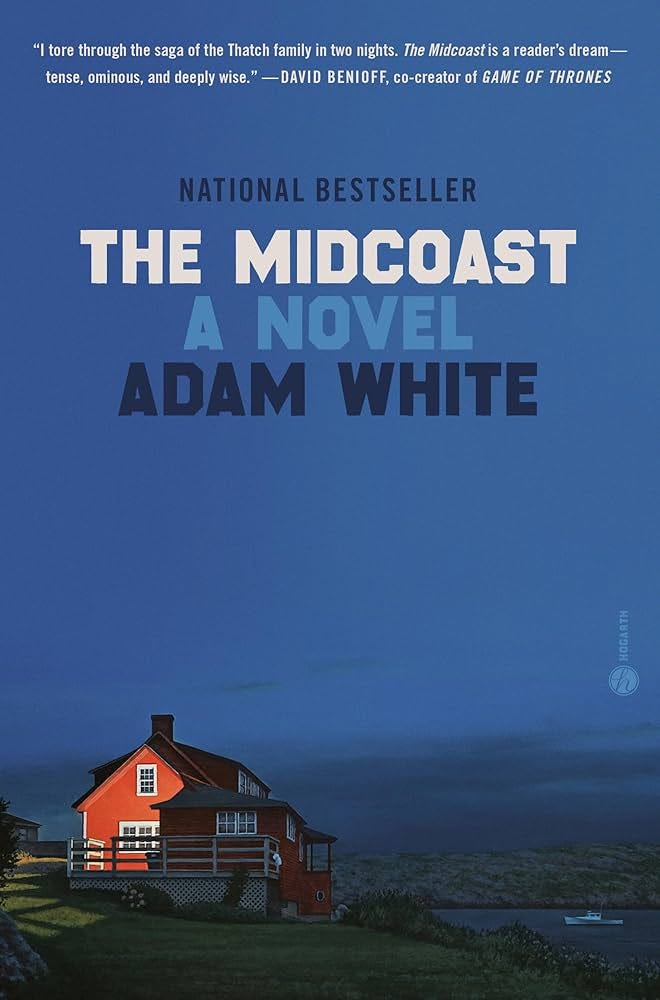
“A native son becomes obsessed with a lobsterman’s fortune,” writes Lee Cole, reviewing for The New York Times American author Adam White’s debut novel The Midcoast, published in 2023. Set in the quiet coastal town of Damariscotta, Maine, high school teacher Andrew attends a lavish reception at the home of Ed and Steph Thatch––former classmates whose unlikely success story has made them local legends. But when Andrew discovers disturbing photos of a charred body, and police raid the party soon after, the glossy image of the Thatches begins to crack. Scandal soon engulfs the town, and as Andrew delves further into the past, “piece by piece, the shape of Ed Thatch’s secret life comes into focus, and so, too, does the complicity of his family members,” as Cole writes. My reading tastes tend to stray from the contemporary, with dead authors beckoning more than live ones, lauded late works more than debuts. But this novel caught my attention when I read Cole’s review. I love a small-town New England setting, a quaint quiescent quality touched by a sinister tinge sweeping and stringing a cast of characters together. And this novel seems a modern embodiment of realism’s defining aspects. As Cole conclude his review, “Brimming with keen observation, not just of the landscape but of dialect and class distinctions and all the tiny, vital particularities that make a place real in fiction, The Midcoast is an absorbing look at small-town Maine and the thwarted dreams of a family trying to transcend it.”
Book Still on the Mind: Run River by Joan Didion
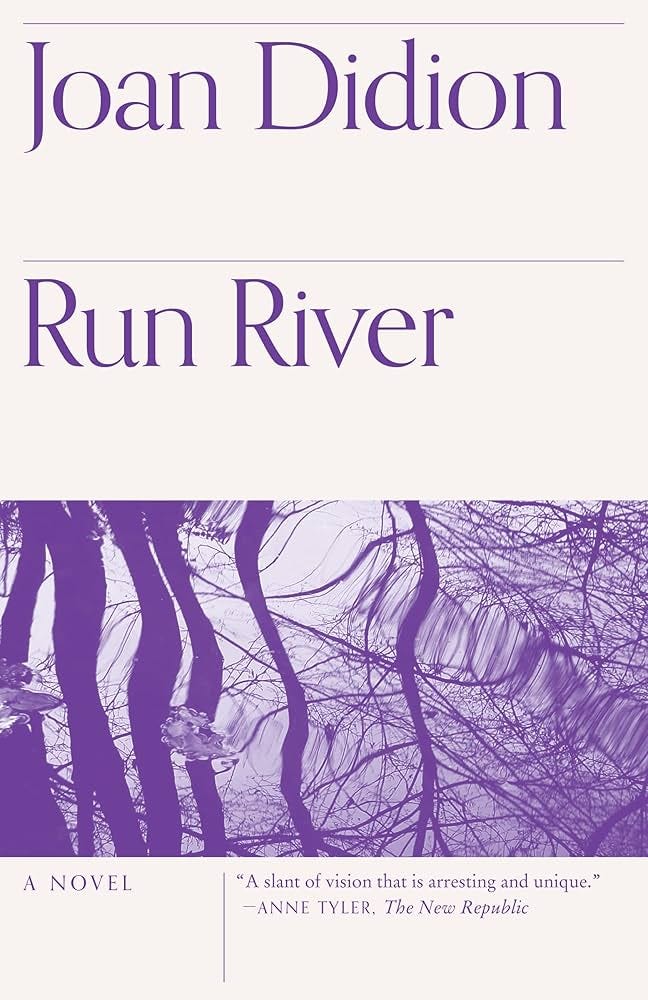
Speaking of debut novels, three years ago this month I read renowned writer Joan Didion’s first novel Run River, published in 1963 when Didion was 29 years old. In a Californian suburb, on a summer night in 1959, Lily McClellan hears a gunshot––her husband, Everett, has just killed her lover on the riverbank behind their home. From this moment of violence, the novel rewinds to Lily at seventeen, newly engaged to Everett, a promising young man. Their future seems bright, but marriage soon gives way to disappointment, strained by parenthood, grief, and growing resentment. As Lily’s quiet discontent deepens into existential unrest, Run River unfolds as a haunting exploration of love, betrayal, and the unraveling of the American dream through the life of a woman trapped by circumstance and expectation. In my original review of the novel, I noted Didion’s early style, as it appears here, versus the later style for which she is more typically known. I wrote: “Run River is almost verbose in its prose – it’s highly descriptive with long, elegant lines of narration, detail, dialogue, and interior monologue. And one can see the changing style, the finding of voice, which occurs in the comparison of her early and late works; her use of italics, from phrases to singular words to singular syllables, remains a formal idiosyncrasy that is all Didion. This novel was fabulous; it hooked me in from the start and propelled me into a beautifully complex, heart-wrenching drama, evocative in its questions and searing in its emotionality.” A strong debut signals strong longevity, and in the case with Didion, Run River is an inaugural augur, foreshadowing a career that stands without rival in the annals of twentieth-century American literature.
Art(ist) of the Week: “Sunlit Interior” by Édouard Vuillard (1920)
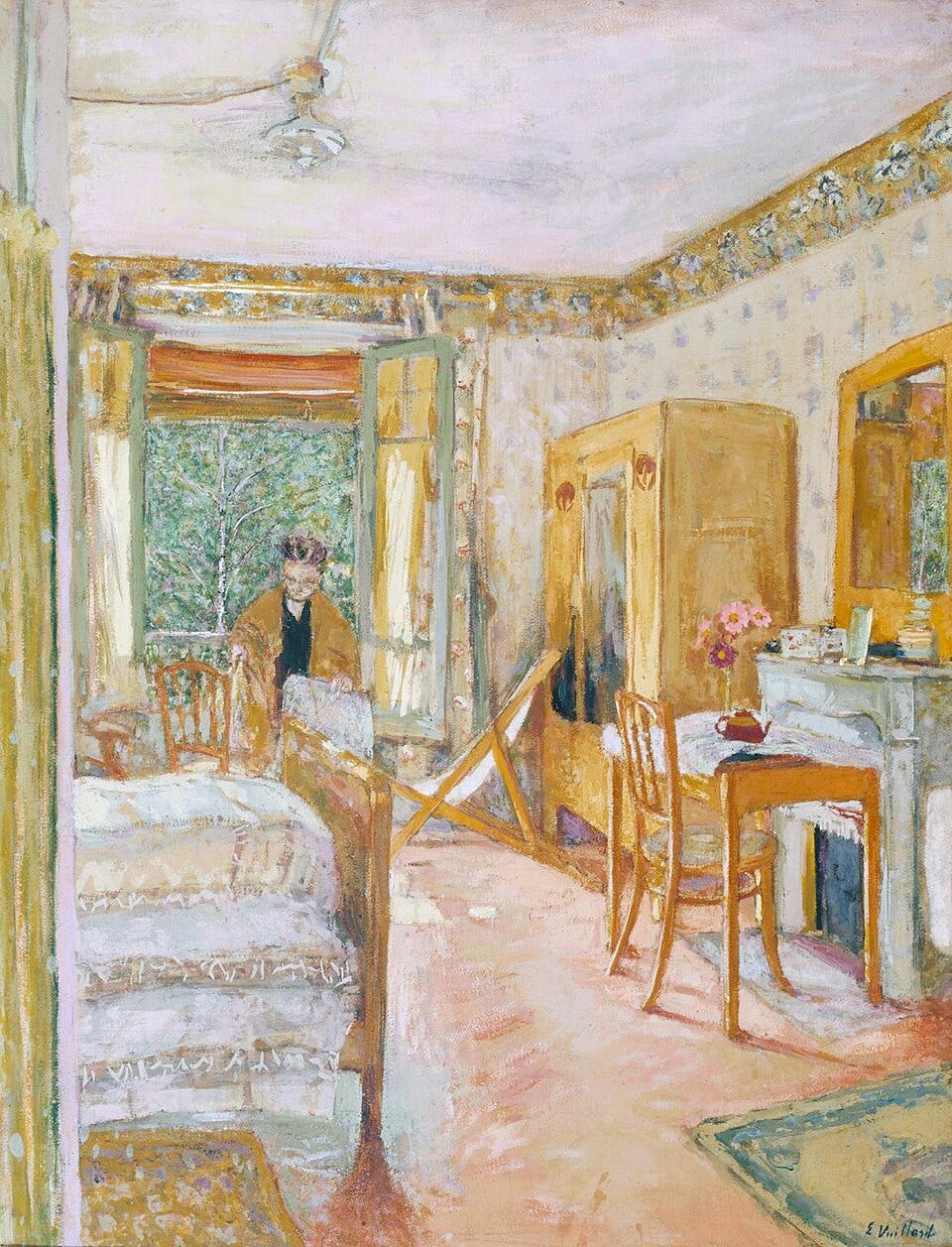
Last week, one of my favorite literary and art critics, Dustin Illingworth, published a new piece on his Substack, his first post in nearly two years. In it, Illingworth writes about spatial representation in the modern novel, excavating the effects of rooms to explore the “inside of the inside of the novel.” Illingworth links this concept with art pieces contemporary to the novels he cites and in so doing, introduced to me to Intimism, a short-lived artistic movement of the fin de siècle whose main pioneers were French artists Pierre Bonnard and the painter of this work, Édouard Vuillard. A member of the postimpressionist avantgarde art group Les Nabis, today Vuillard is most remembered for his vibrant scenes of interior life rendered through rich colors and patterns with meticulous attention to detail. Illingworth, in another article, writes how “Vuillard’s cryptic interiors––beautifully muted rooms bathed in the afterglow of memory––comprise a private, dreamlike vision of domesticity in which uncanny atmospherics estrange the familiar.” Enter: “Sunlit Interior.” The scene: a quiet, sun-drenched room adorned with ornamental wallpaper, textiles, and furnishings that blur the boundaries between figure and setting. A woman sits on the sill of open bay windows, partly obscured by the foregrounded furniture, her presence subdued in favor of the effervescent ambience. Warm tones of yellow and ochre abound, with sunlight filtering through the space, an invisible presence itself. True to Vuillard’s roots, the work emphasizes flatness, decorative surface, and intimacy over narrative or realism, in turn conveying a contemplative, almost dreamlike mood that captures the quiet rhythms of domestic life, transforming them into a deeply personal, psychological space. Quietude, quiescence, quaintness qualify the quintessence of such a work, and the light that plays prominently, mingling with the unseen wind flowing through the open window, elevates this work into a category I’ve deemed “summer paintings,” fitting for the current seasonal transition.
Music(ian) of the Week: “Alive” by Krewella
As summer peers around the corner, and warmer winds whisper their way through city streets, a certain sonic nostalgia beckons: the soundtrack to those summer nights in my early twenties, rooftops under the sunset, strobe lights on the dance floor, the pulse of life palpitating in its powerful, unbridled essence. For me, those moments are marked with the music of Krewella, the Chicago-based EDM outfit whose legacy in electronic music is nothing short of legendary. Sisters Jahan and Yasmine Yousaf burst onto the scene in 2012 with their iconic debut EP Play Hard, and “Alive,” their third single, quickly rose to the top of the charts. It was later re-released on their debut studio album over a year later, but by that time, the tune had already achieved anthem status. “Let’s make this fleeting moment last forever” is a line that rings through the ears of those who were there, present at the frontlines of the scene in the early ‘10s, thriving at the emergence of electronic music innovation. A progressive house ballad, “Alive” turned a new page for the group, departing from dubstep to demonstrate a musical versatility that has since defined their career. A piano melody starts the song, sweeps coursing into the first verse, percussion growing beneath Jahan’s airy vocals which carry into the chorus: “All alone, just the beat inside my soul/ Take me home, where my dreams are made of gold/ In the zone, where the beat is uncontrolled/ I know what it feels like/ Come on, make me feel alive.” Then, explosion, euphony, ecstasy: the melody of the drop, so simple in its succession of synths, sends the listener soaring into the empyrean, elevated into the ethereal, lifted, lost, then let back down into the second verse, Yasmine’s part. Call-and-response is Krewella’s formula, their sonic sororal signature sustaining the stories living within their lyrics. “Alive” is about love––the love between two people; the love between a person and music itself, that magical moment when you succumb to the shining lights, the beat uncontrolled, the world beyond falling away: “You know what it feels like when you’re dancing blind.” Krewella will always inspire that feeling for me.

Wild Card: The Righteous Gemstones
Per repeated recommendations from multiple friends, I finally started watching HBO’s hit comedy-drama series The Righteous Gemstones. And I’m absolutely hooked. Set in the Bible Belt, the show centers on the Gemstones, a wealthy dysfunctional family of megachurch televangelists. Patriarch of the family is the widowed Eli Gemstone (John Goodman), whose three adult children Jesse (Danny McBride), Judy (Edi Patterson), and Kelvin (Adam DeVine) are petulant, avaricious, blundering, and borderline neurotic. As I write this, I’m almost finished with the first season, in which Jesse becomes the target of blackmail when three masked figures threaten to expose a scandalous video. At the same time, Eli’s estranged brother-in-law, Baby Billy Freeman (Walton Goggins), is recruited to head the Gemstones’ new satellite church located in a shopping mall, sparking a turf war with Reverend John Wesley Seasons (Dermot Mulroney). But this meager plot description barely scratches the surface of the outrageous antics that comprise each and every episode. It’s truly hilarious, and I highly recommend to anyone in search of absurd hilarity, impeccable writing, and stellar performances.