
The Thirty-fourth
Friday, April 12th 2024

“Erika, the meadow flower. That’s how she got her name: erica. Her pregnant mother had visions of something timid and tender. Then, upon seeing the lump of clay that shot out of her body, she promptly began to mold it relentlessly in order to keep it pure and fine. Remove a bit here, a bit there. Every child instinctively heads toward dirt and filth unless you pull it back.” – Elfriede Jelinek, The Piano Teacher (p. 23-4)
Book in the Pipeline: The Sot-Weed Factor by John Barth
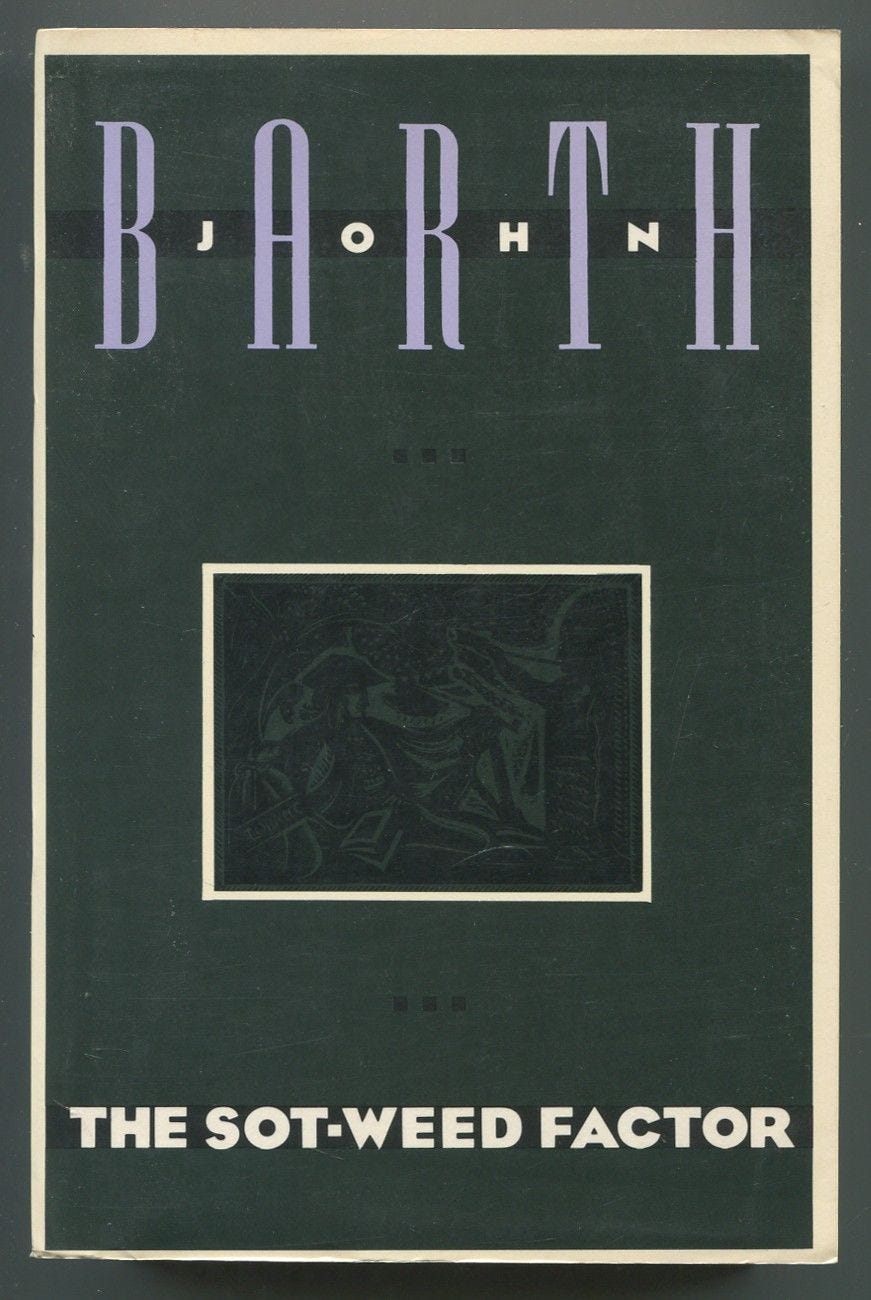
On April 2nd, American author John Barth passed away at the age of 93, and upon news of his departure, the literary sphere began unloading tributes left and right for the writer. Described as a “practitioner and theologian of postmodern literature,” John Barth left an extensive catalog of nearly 20 novels and short story collections, three works of criticism, and a last book of short observations. One can doubtless glean the ambition, wit, and comedy which composed the threads that wove through his works over the past seven decades; however, there is one book in his oeuvre which many consider to be his magnum opus: The Sot-Weed Factor, his third novel, published in 1960. Birthing the burst of Barth’s postmodernist era, the novel is a satirical epic set in the late 1600’s, which tracks the “wildly, chaotic odyssey of hapless, ungainly Ebenezer Cooke, sent to the New World to look after his father’s tobacco business and to record the struggles of the Maryland colony in an epic poem.” But, as I understand it, the novel’s novelty is sourced not from the various adventures of Ebenezer Cooke, himself an invention only a man like Barth could imagine, but rather from the structure and play of the book’s form. The novel is a dense picaresque which weaves frame narratives with numerous digressions, written in a style to emulate the century in which it’s set. Spanning nearly 800 pages, I know this one won’t be an easy feat, but will surely be worth the climb. It’s been on my list for years now; I had learned the title before the name of its creator, and now with the sad news of his passing, the book has jumped into the foreground of my readerly plans, a mountain that looms, casting long shadows as he himself does across the latter half of twentieth century American fiction. For interested readers, here’s LitHub’s compilatory obit.

Book Still on the Mind: The Return of the Soldier by Rebecca West
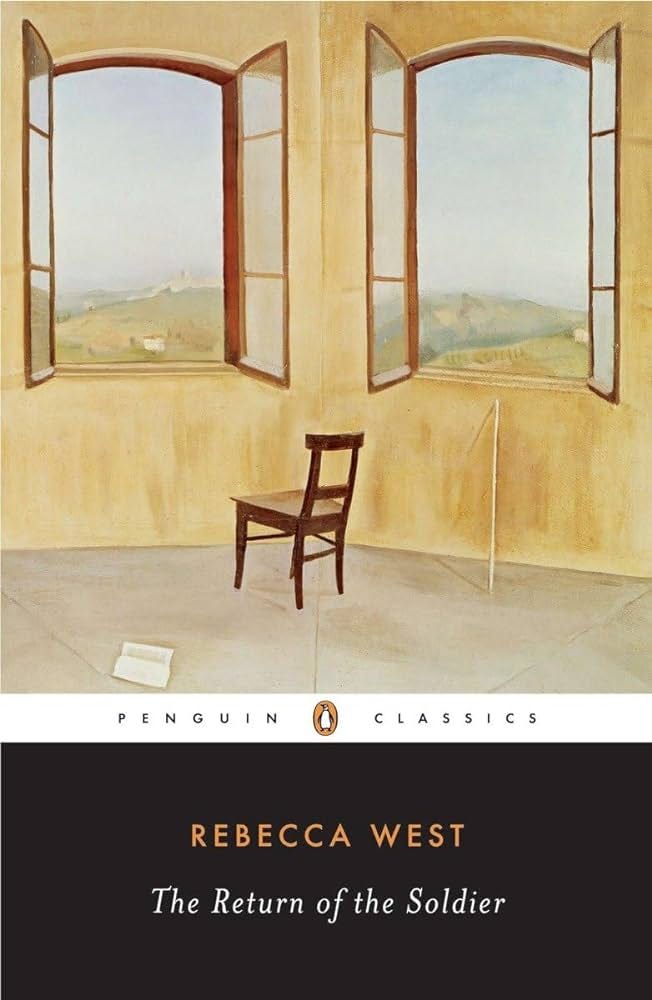
One writer I’ve recently seen making the rounds across online readerly communities is Rebecca West, whose indomitable Black Lamb and Grey Falcon seems a mainstay in many bookish forums. Likewise, that tome remains unwaveringly on my to-read list, as I’ve written about previously. But seeing her name always reminds me of the first of her novels that I read, The Return of the Soldier, published in 1918, her debut. This slim work regales the tale of a British soldier who returns home from the frontlines of WWI a different man. The soldier is the shell-shocked Captain Chris Baldry, who comes home to his wife Kitty and his cousin Jenny, our narrator, believing that he is still twenty years old and in love with Margaret, a past lover from his youth. What unfolds is a heartbreaking yet beautiful exploration into the psychological trauma inflicted by war, the pernicious and complicated dynamics of love, and the moral predicament that arise from the revelation of truth. I read it in January of 2022, for an undergrad class called ‘The Modern Novel,’ and I remember falling headfirst into West’s exquisite prose and provocative tale, whose form and structure were captivating as much as obfuscating. There’s a certain ambiguity that runs the short length of the book, a definite source of its magnificence and enduring memory. In my original review, I remarked how it through our intriguing narrator Jenny we receive “a world comprised of questions without answers, and yet it is in the tiny details of her unwavering eye that a reader can catch a glimpse into the plausible explanations, coming close to closure, but without ever attaining it.” Rebecca West is a lasting name for a reason, and that this short debut contains such strength and power that reverberates with audiences today over a century since its arrival, stands a sure testament to her legacy and writerly prowess. Next on my West list will be The Fountain Overflows, which I’ve similarly heard is one of her best.
Art(ist) of the Week: “Play Shadow” by Leonora Carrington (1977)
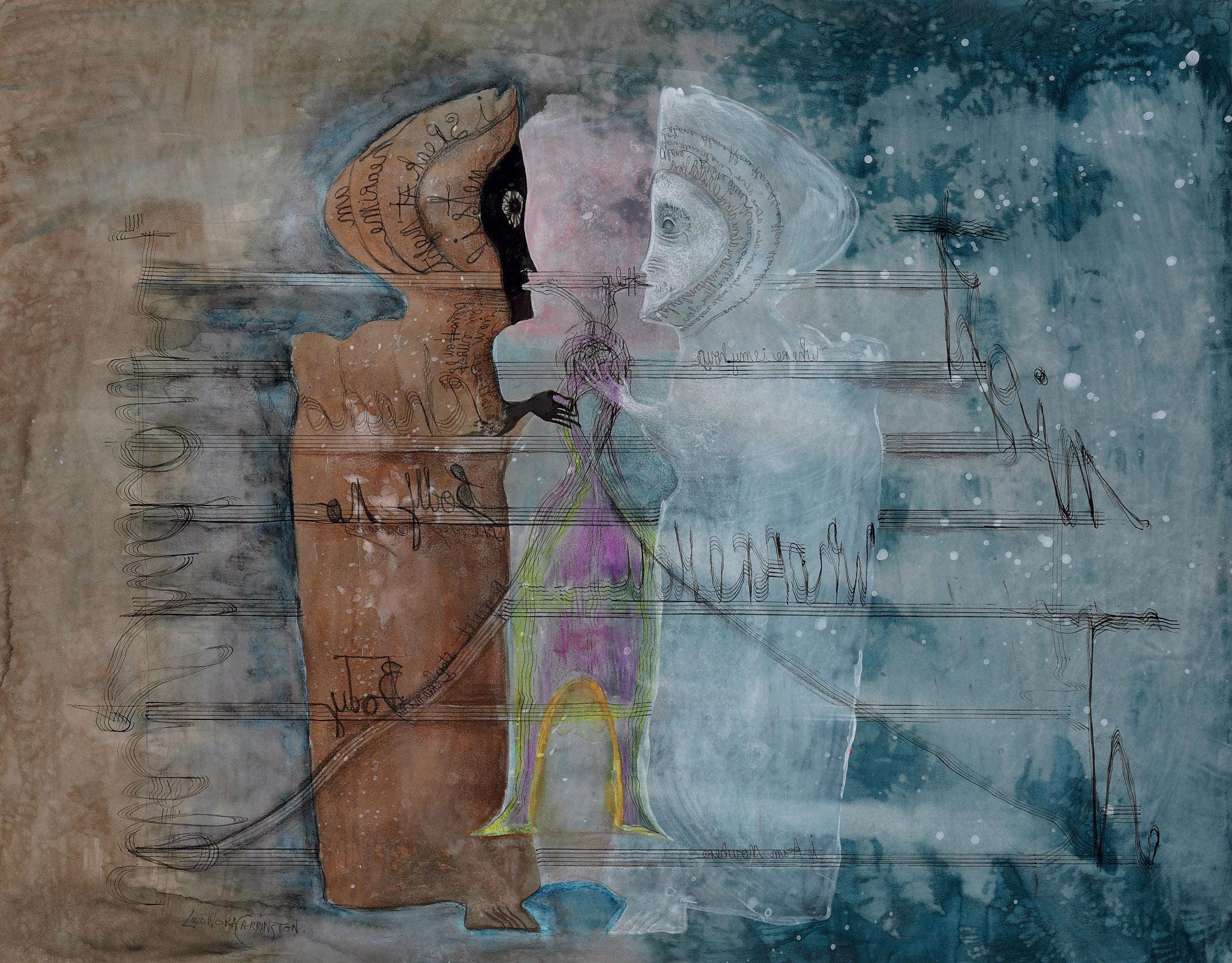
Critic Merve Emre opens her New Yorker article on the British painter and novelist Leonora Carrington with an incredible, legendary anecdote about the artist’s birth: how from an unholy “communion of human, animal, and machine, Leonora was conceived [and] when she emerged, on April 6, 1917, England shook.” Such a story seems befitting for an artist whose paintings and literature have been described as strange, symbolic, and surreal. Indeed, many critics even consider Carrington one of the last participants of the surrealist movement of the 1930s, whose works, both visual and verbal, provide a certain keyhole to an unconscious and dreamlike mind. An observer can surely detect this sort of sensibility in “Play Shadow,” first unveiled in 1977: a painting that doubles as an optical illusion. Tannic tones of earth and umber shade the left side of the canvas, opposite the bluish hues welling the right, swelling inside starry constellations. The seeping colors lie behind two ghostly figures facing inward, their lightened outlines mingling, entangling, and birthing a third figure that stands faceless, upright, and outward towards the viewer. Swirling inside this vacant form are storms of ecstatic purple, striking green, and burning yellow. And yet, across the centered form’s upper half, the hands of the facing wraiths reach out, each clasping the chaotic strings of the sheet music lines that soar from left to right across the frame. Music is part of this painting, as are words as well: mirrored in rounding cursive letters abound backwards-written words which impart more art than meaning, it seems to me. And the longer one looks, the more they will surely find, as Carrington’s famous piece provides a plethora of symbolic meaning to investigate. Life and death, past and future, world and heavens, body and mind, and countless more dichotomies unfurl from this captivating painting, their seething tension thirsting for resolution yet fated never to be resolved. It’s one of many in Carrington’s repertoire which possesses such an effect, and I’m eager to learn more, experience more, think more about her work, her paintings and writing. A happy belated birthday to Leonora Carrington; she would have been 107 last Friday.

Music(ian) of the Week: “daddy of mine” by Four Year Strong
This past week one of my favorite bands released a new tune. The band is Four Year Strong, pop-punk hardcore heavy hitters hailing from Worcester, Massachusetts. The song is “daddy of mine,” the second single in the last six months, hinting towards a new album, which would be the first since 2020. Four Year Strong, or as many fans refer to them, Four Beards Strong, formed in 2001. It wasn’t until 2007 that I discovered them, with their righteous second album Rise or Die Trying, which kicked the band into the alternative limelight. There are only a few albums which I can sing every word of each song straight through, and Rise is one of them. I have followed their sonic career religiously for nearly two decades now. I’ve seen them live a handful of times; I own multiple band tees of theirs; I even touched the beard of frontman Dan O’Connor one time. This band has played a major chord in my upbringing and musical development, and I’m happy to finally rope them into this little project, to briefly muse about this new tune and video of theirs. “daddy of mine” harks a darker side of the band’s sonic signature that strays from the “combination pop punk energy and uplifting singalong choruses, and metalcore flourishes.” While earlier tracks call to mind the music of bands like New Found Glory and Set Your Goals, this one calls to mind the controlled chaos of Comeback Kid and Every Time I Die. The feedback howling beneath the hard churning riffs at the start sounds a sonic sojourn sure to incite a riot. I have to add that this past Friday I attended Emo Nite at the Underground Arts here in Philly, where I screamed my lungs out with my fellow pop punk peers to the songs we grew up with. It was a cathartic experience made all the better by the deejay rinsing an FYS track midway through. This band will truly never cease to excite and enthrall.

Wild Card: The Mookse and the Gripes Podcast | Episode 77: Poetry
I know in my last post I included a podcast in the Wild Card slot, but I couldn’t help myself from doing it again, especially since one of my other favorites, The Mookse and the Gripes, gave me a shoutout on their latest episode. Paul Wilson and Trevor Berrett are the hosts of The Mookse and the Gripes, a podcast dedicated to all things literature and poetry, in each episode of which, the two friends “have a pleasant conversation about books and reading.” I’ve been listening for a little while now and even participated in the Savage Detectives read-along they hosted last month. But I’m excited to include Paul and Trevor’s Podcast in this post because last week, on their 77th episode, dedicated to “Poetry,” the hosts gave me a little shoutout. Instead of spoiling it with a description of what was I said, I’ll simply leave readers with a gentle nudge to go check it out.