
The Twenty-ninth
Friday, February 2nd 2024

“You conquer people by telling them of battles, kings, elephants, and marvelous beings; by speaking to them about the happiness they will find beyond death, the bright light that presided over their birth, the angels wheeling around them, the demons menacing them, and love, love, that promise of oblivion and satiety. Tell them about all of that, and they will love you; they will make you the equal of a god.” - Mathias Énard, Tell Them of Battles, Kings and Elephants (p. 59-60)
Book in the Pipeline: Praiseworthy by Alexis Wright

This coming Tuesday, February 6th will see the release of Praiseworthy, the fourth novel by Wanyi writer Alexis Wright, a work which is already stirring up buzz across the literary sphere. Set in the fictional town of Praiseworthy, located in the northern reaches of Australia, an enigmatic cloud signals impending ecological disaster and portends the presence of ancestral spirits. Amid the turmoil, a mad mystic turns to donkeys as a solution for both the global climate crisis and the economic struggles plighting the Aboriginal community. His wife, seeking refuge from her husband’s eccentricity, immerses herself in the delicate dance of butterflies while exploring the possibility of repatriating her family to China. Meanwhile, one of their sons grapples with suicidal ideations, and the other harbors a wish for his brother’s demise to attain the freedom needed to achieve his own sinister schemes. What a description! It almost harkens works like White Noise and 100 Years of Solitude, though I imagine, at nearly 700 pages, Praiseworthy is a work in its own camp and category. Per the blurb published by New Directions, “Praiseworthy is an epic which pushes allegory and language to their limit; a unique masterpiece that bends time and reality, opening new literary vistas; a cry of outrage against oppression and disadvantage; and a fable for the end of days.” So yeah, safe to say I’m eager to get my hands on a copy.
Book Still on the Mind: Satantango by László Krasznahorkai
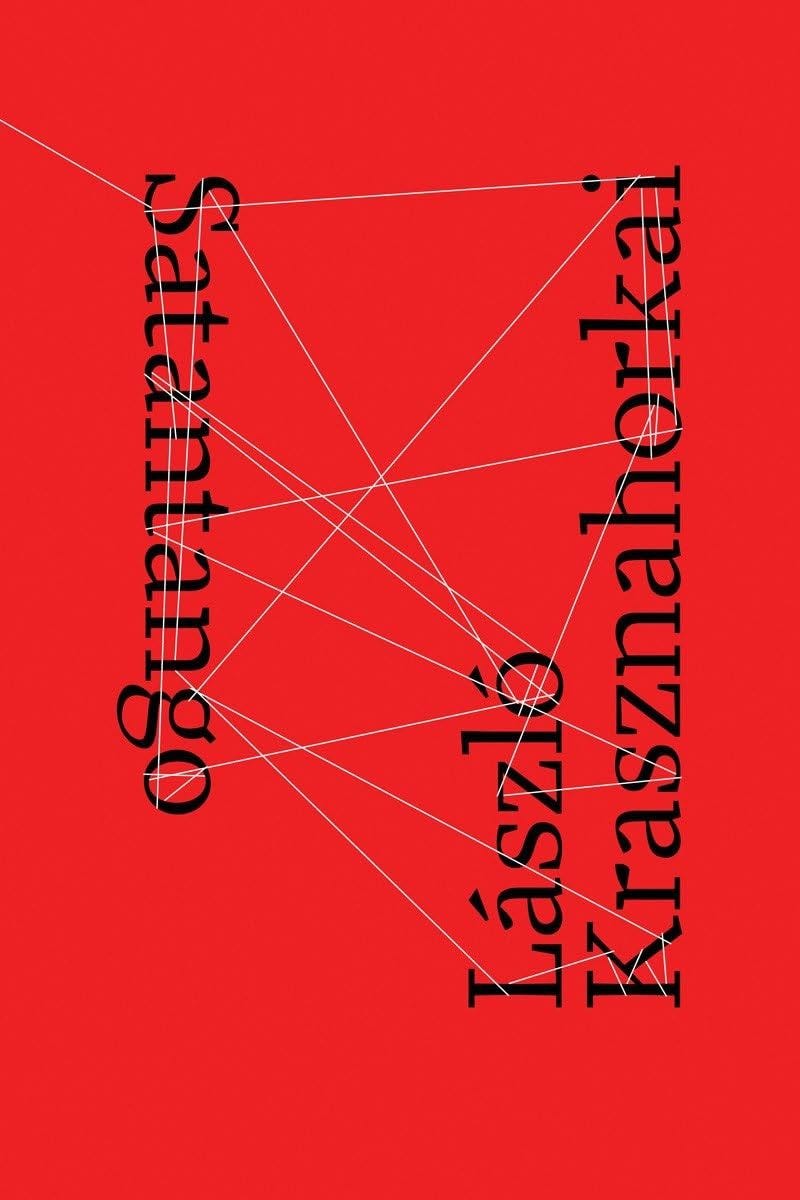
It’s now been more than three years since I read Satantango, the 1985 debut novel by Hungarian novelist László Krasznahorkai, and to this day, it remains indelibly etched into the foreground of my mind. Not only was it my introduction to his work, but it was also my introduction to a type of literature that previously I had not known existed, let alone experienced firsthand. Unfolding over a span of several relentless rain-drenched days, the novel centers around the dozen remaining inhabitants of an unnamed and secluded Hungarian hamlet—individuals marked by failure and stranded in a desolate nowhere. When a man long thought to be dead returns to the town, some inhabitants believe him to be a powerful prophet, while others think him a charlatan. As I wrote in my original review, “What unfolds, just over the course of a few stormy days, is the unusual, tragic, at times hilarious, and unwaveringly bleak portrait of a sad, gray, spider-infested town where even the glimmer of hope is enough to drive people mad.” The novel was my number one favorite read of 2020, a masterful, challenging, but endlessly rewarding work that shatters literary conventions and pushes the edges of the very form. Susan Sontag called Krasznahorkai “the contemporary Hungarian master of the apocalypse,” and that superlative alone aptly limns the mastery contained within the pages of Satantango. I absolutely need to read more of his work, hopefully this year, as well as see Béla Tarr's six-hour film adaptation, deemed a cinematic masterpiece.
Art(ist) of the Week: “Spanish Dancer at the Moulin Rouge” by Giovanni Boldini (1905)

This past week I stumbled upon the Macchiaioli, a group of Italian painters who worked and lived in and around Tuscany during the latter half of the nineteenth century. The name comes from the word “macchie,” translating to stain, smear, spot, and/or speck, which the painters of this movement regarded as a chief component of a painting, an artistic perspective that finds its analog in impressionism. But I was drawn to the work of Italian painter Giovanni Boldini because, though considered a member of the Macchiaioli, his work seems stray from the style of his contemporaries. He was a portraitist, frequently called the “Master of the Swish” for his flowing brushstroke style, on full display here in his “Spanish Dancer at the Moulin Rouge,” first unveiled in 1905. A woman, beautifully donned in a dark dress, whose flowing fabric, flounces, and frill fray and splay in long streaks of black, blue, and gray, as if exploding across the canvas. Order reigns in her upper frame, details defined in her chest, neck, face, and hair, contrasting the chaos that engulfs her in grand splotches and smears of black, ochre, and white, blending in their convulsive dance. Observing, one wonders if the movement captured in the chaos conveys the movement in the greater scene, the chaotic clamor of the Moulin Rouge, replete with countless dancers alike. And yet, that she is the sole focus amid the frenzy, with the waves of light and color washing around her, spilling into the colors of her dress, for me, sources the beauty of the painting. I find it a mesmerizing work that bridges impressionism, abstract expressionism, and realism all in one piece and ties the forms together with an elegant method within the madness. I look forward to discovering more of Boldini’s work, as well as the rest of the Macchiaiolis’.
Music(ian) of the Week: “Murder on the Dance Floor” by Royel Otis (Sophie Ellis-Bextor Cover)
It’s a song that’s taken the internet by storm in the wake of the recent film Saltburn released this past November. “Murder on the Dance Floor” is a dancy disco hit from English singer-songwriter Sophie Ellis-Bextor, a single from her 2001 debut album Read My Lips. And though the original remains a sonic staple sure to stand the test of time, it is this cover by Australian band Royel Otis which has been echoing in my head the past few weeks. Sticks hit to sound the start: bright chords of shining guitar and synth in fast succession with the percussion. The boys bring the song up-tempo, turning a pop tune into a jumping jam, replete with the same iconic melodic flows and catchy cadences of the original. Singer Otis Pavlovic starts in on the verse, unveiling his unique vocal timbre that streams on the higher side of the keys, coated in an easing sheen that just shimmers in stereo. There’s too a choral quality to his voice, like contained reverberation, as if a choir sings in unison through him, in turn creating a layered and nonetheless hypnotic effect few are a capable of achieving. And the intermittent backups from the others add to this effect, enlarging the tune as a whole then sizing it back down, moving from grand to intimate, then back to grand again. The song swells as the band pulls the listener through a sonic sojourn royally reimagined, and the result is nothing short of greatness. I saw that Royel Otis are embarking on an American tour this year, with a May date at Johnny Brenda’s over in Fishtown. Definitely cannot wait to check out more of these guys’ music.

Wild Card: Society of the Snow dir. by J.A. Bayona | Netflix
This past week I watched Society of the Snow (La Sociedad de la Nieve) from Spanish filmmaker J.A. Bayona, released on Netflix at the beginning of this year. The film is based on the 1972 Uruguay Andes flight disaster, one of the most harrowing tales of survival in modern history. On October 13th, 1972, Flight 751, chartered by the members of the Old Christians Club Rugby Team with their friends and families, traveling from Montevideo, Uruguay to Santiago, Chile for a game, crashed in the Andes mountains, immediately killing fourteen and leaving the remaining passengers, many of whom were gravely injured, stranded in the snow-capped mountains at an altitude more than 11,000 feet. Over the next 72 days, the survivors endured unimaginable hardships, including exposure, starvation, altitude sickness, avalanches, and had to resort to anthropophagy to stay alive. Heading out on December 12th, two survivors made a 10-day trek through the mountains and into Chile, where they were finally able to find help, and on December 23, 1972, the remaining survivors were rescued. Of the initial 45 passengers on board, only 16 left the Andes alive. It is an absolutely insane story, which the boys on the Last Podcast on the Left recently covered in a fantastic three-part series. After listening to the series, I watched Bayona’s film, which kept me on the edge of my seat the whole way through. For anyone interested in a shivering tale of triumph against unbeatable odds, the film and the podcast series both come highly recommended.
Happy Groundhog Day!