
The Eightieth
Friday, January 16th, 2026

“No sooner had the warm liquid mixed with the crumbs touched my palate than a shiver ran through me and I stopped, intent upon the extraordinary thing that was happening to me. An exquisite pleasure had invaded my senses, something isolated, detached, with no suggestion of its origin. And at once the vicissitudes of life had become indifferent to me, its disasters innocuous, its brevity illusory—this new sensation having had the effect, which love has, of filling me with a precious essence; or rather this essence was not in me, it was me.” - Marcel Proust, In Search of Lost Time Volume 1: Swann’s Way (p. 60)
Book in the Pipeline: Friday by Michel Tournier
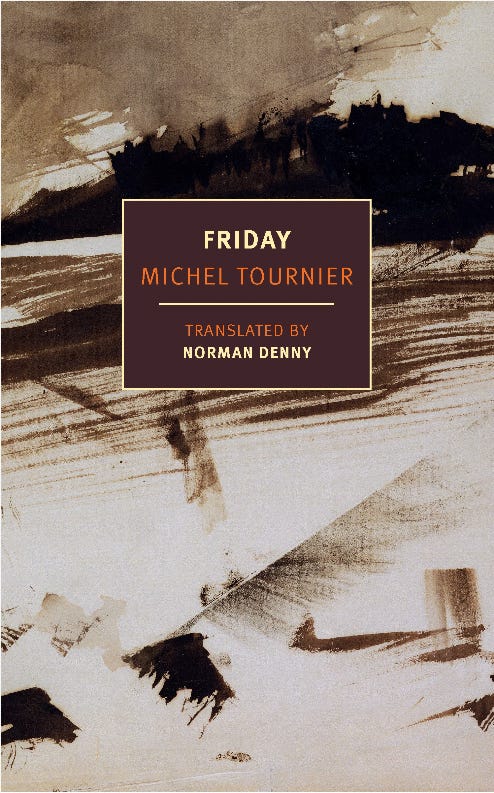
On the last day of last year, The New Yorker published “the first installment in a series of recommendations” from their writers. On this list is an entry by reporter Rivka Galchen, whose pieces span the gamut from science and medicine (she has an MD) to cultural and literary criticism and even fiction. For the list, this eclectic writer wrote about Friday, the debut novel by the French writer Michel Tournier, first published in 1967, a reimagining of the familiar story of Robinson Crusoe. Shipwrecked on a tropical island, Crusoe—deeply God-fearing and convinced of his civilizing mission—devotes years to taming the wilderness and imposing order upon it, a project he nearly completes. But the arrival of Friday, whose irrepressible, blasphemous laughter unsettles Crusoe’s rigid worldviews, initiates a profound shift in power and understanding. When a sudden catastrophe obliterates Crusoe’s painstaking progress, it is Friday who becomes the teacher, exposing the limits of Crusoe’s knowledge and forcing him to confront the illusions that have forever governed his life. About reading it, Galchen, in her entry, writes “I expected the simple pleasures of a perspectival shift. But the book proved to be far more unpredictable and captivating than that, and also so funny, so full of pathos.” I’m usually not much a fan of re-imaginings, but with an idea like this and laudations like Galchen’s, I’m more than inclined to give it a try.
Book Still on the Mind: Books Promiscuously Read by Heather Cass White
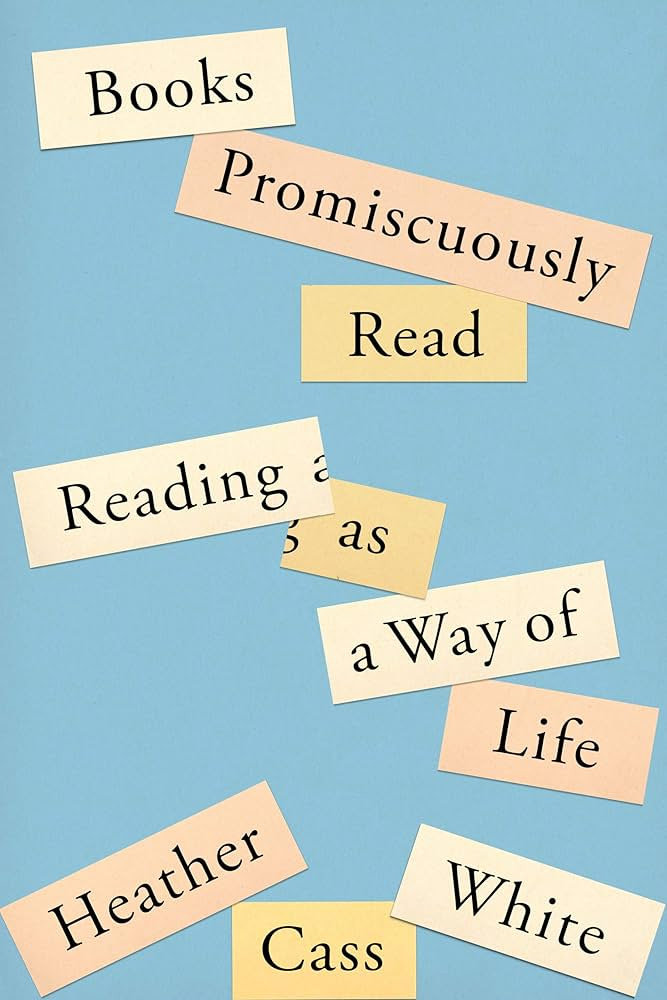
As I work my way through supplemental material on Proust, I can’t help but remember many of my favorites reads that fall into a specific category of books that I love so very much: books about books. High-ranking within this literary camp is Books Promiscuously Read by English professor, poet, and literary scholar Heather Cass White. I first it in the Spring of 2022, as I was finishing my BA, falling headfirst into a celebratory exploration of the pleasures and importance of reading ecstatically, chaotically, disjointedly, wherein White traces the benefits that arise from an attention to aesthetics over instruction. In three sections titled Play, Transgression, and Insight, White leads us through an insightful excavation into literature, with close readings of famous works of both prose and poetry, all the while illuminating in fantastic detail the beauty, strength, and uniqueness in the experience of reading great works. And she does so with extraordinary erudition and wit. As I wrote in my original review, “Beyond White’s impressive scope of literary knowledge, the delight, levity, and even humor which runs throughout makes for a completely enjoyable reading experience; her passion pours from the pages, absolutely inspiring and elevating the whole of literary history and the very act of reading into a new and beautiful light. It is a book about books for both the seasoned reader and novice alike.” It’s a short, ecstatic delight of a read, a work that I continue to keep on my shelf, always already within easy reach.
Art(ist) of the Week: “Impression, Sunrise” by Claude Monet (1872)
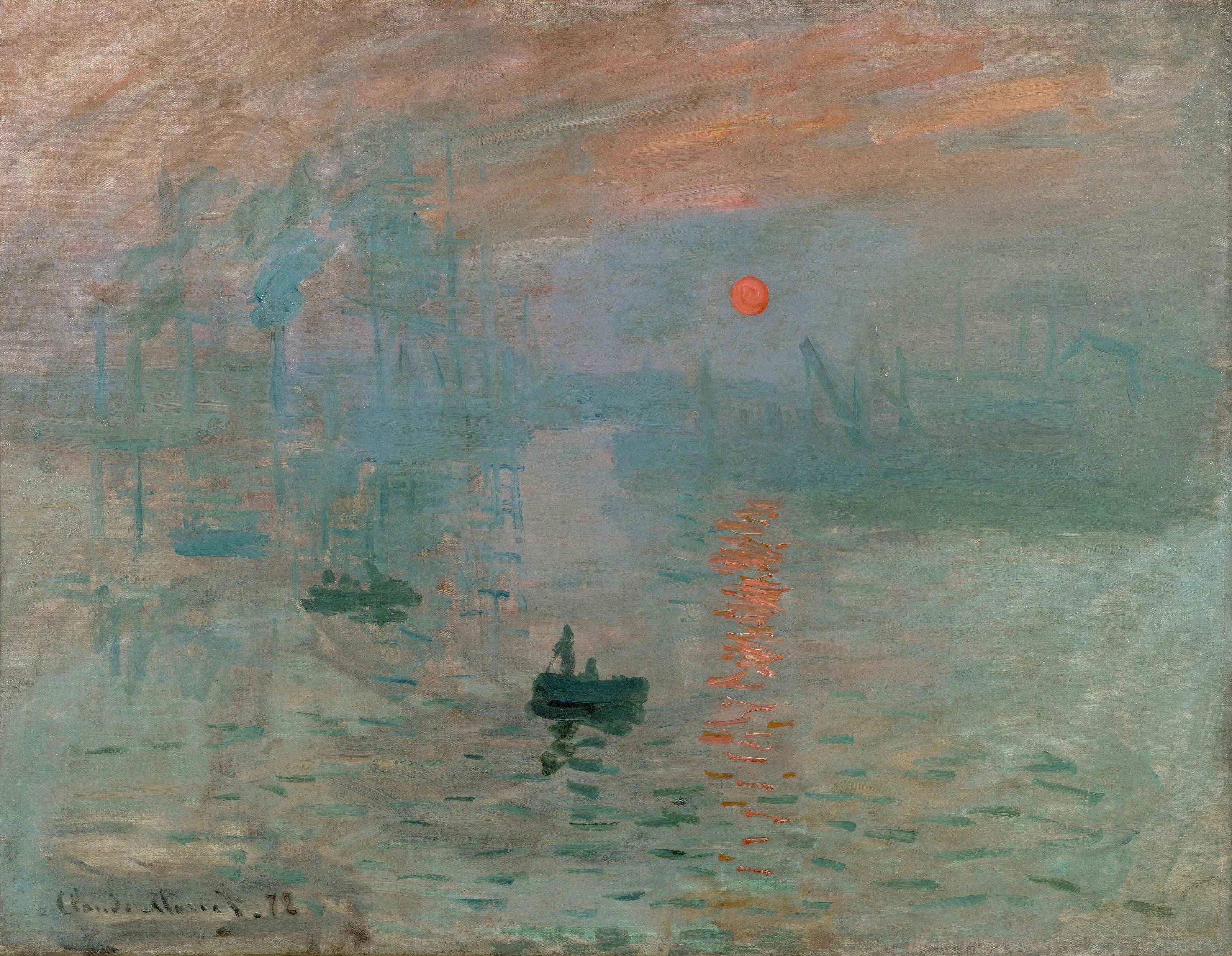
In his book How Proust Can Change Your Life, scholar Alain de Botton writes about how Claude Monet’s painting “Impression, Sunrise,” when it was first unveiled in 1872, the year after Proust was born, “looked like a bewildering mess to most who saw it, and particularly irritated critics of the day.” De Botton uses the painting to demonstrate how “our notion of reality is at variance with actual reality, because it is so often shaped by inadequate or misleading accounts,” a major theme explored in Proust’s work and an idea that inspired the Impressionists. Monet’s painting depicts the harbor of Le Havre at dawn, where the rising sun hovers low over the mist-laden sea, its small orange eye glowing against the cool haze of blue-gray water and sky. The scene is loosely rendered with quick, visible brushstrokes that dissolve solid forms into a shifting atmosphere: ships and cranes emerge as dark, silhouetted specters in the distance, hoisting their mastheads the colors of whose pennants remain shadowed in the offing, while homeward-bound fishing-boats, cleaving the dappled waters, glide across their rippling reflections in the foreground. Rather than detailing the harbor’s structures and capturing in minute, meticulous detail each component, each ripple, tuft, and ray, Monet favors the fleeting sensory experience of the morning light—using the relations between color, movement, and mood to preface clarity—so that the painting feels less like a record of a place than a momentary impression, an instant suspended between night and day, present and past, perception and memory.
Music(ian) of the Week: “Live for the Night” by Krewella
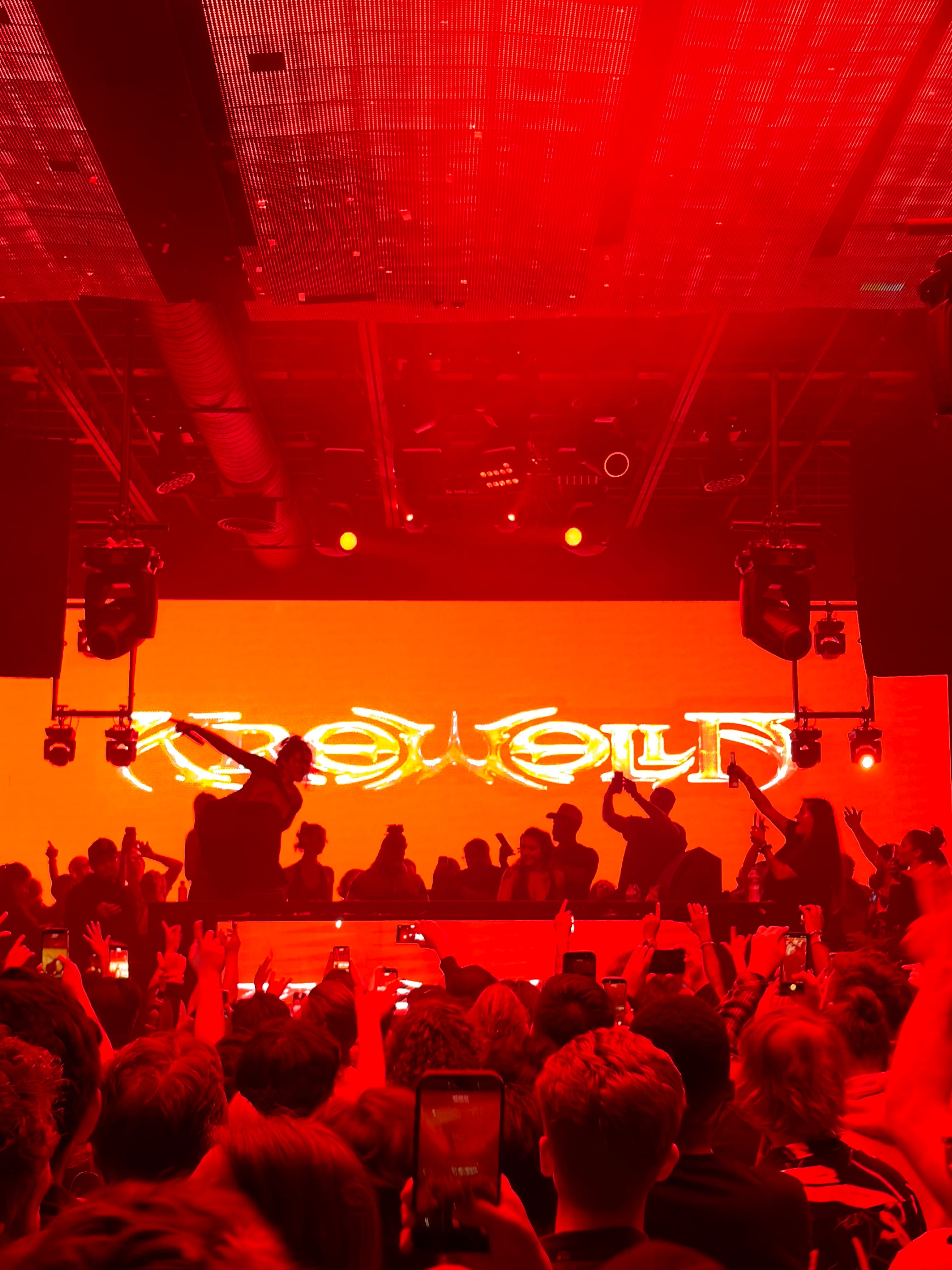
Last Saturday, I saw in concert my third most-played artist of 2025, three of whose tunes were in my top five most-played songs of the year: the bass-breaking, decibel-decimating, eclectic electro duo, the Yousaf sisters themselves, Krewella. I’ve written about them before here, how their music uplifts, invigorates, enthralls in ways few other electronic artists do. Their wondrous blend of progressive house, bass electro, and dubstep, replete with their melodic pop vocals overlaying the instrumentation, pushes them apart in my personal arsenal of astounding artists; but it wasn’t until I experienced them live that I truly realized the extent of their magnificence. They performed at NOTO, a prominent night club here in Philly, and what I witnessed was not unlike that portrayed in this music video for their 2013 anthem “Live for the Night.” The show felt like a party at the end of the world, a magical musical melee in which all in attendance were transported far away. The world without—with all the troubles, pain, confusion, despair—ceased to exist that night, leaving only a singular moment in which we were one, united by love, humanity, and exhilarating music.
Wild Card: Jerskin Fendrix, the Musical Mind behind Bugonia
Far and away my favorite film of 2025 was Yorgos Lanthimos’s black comedy Bugonia, which follows conspiracy theorist Teddy (Jesse Plemons) who, with his cousin Don (Aidan Delbis), kidnaps Michelle Fuller (Emma Stone), a high-profile CEO of a pharmaceutical company whom they believe is secretly an Andromedan extra-terrestrial hellbent on destroying Earth. To stop her, they keep her hostage in their basement, subjecting her to violent bouts of interrogation and torture, which crescendo throughout the course of the film, culminating in a violent, unexpected, and deadly denouement. I was spellbound the first time I watched it, captivated by the performances, storyline, and, overwhelmingly so, the soundtrack, composed by the thirty-year-old English musician Jerskin Fendrix. It is Fendrix’s third collaboration with Lanthimos, having composed the soundtracks of Poor Things (2023) and Kinds of Kindness (2024). In reading about him, I was awed to discover that, for this film, Fendrix did not see the final cut nor was even allowed to read the script before composing his full-length film score. Lanthimos gave Fendrix only three words: “bees,” “basement,” and “spaceship,” and said, go create. And what he created is nothing short of a masterpiece.