
The Eighty-eighth
Friday, May 8th, 2026

“All the letters I wrote her, drunken ones with a blunt stub, crazy ones with bits of charcoal, little pieces from bench to bench, firecrackers, doilies, tutti-frutti; they will be going over them now, together, and he will compliment me one day. He will say, as he flicks his cigar ash: ‘Really, you write quite well. Let’s see, you’re a surrealist, aren’t you?’ Dry, brittle voice, teeth full of dandruff, solo for solar plexus, g for gaga.” - Henry Miller, Tropic of Cancer (p. 56-57)
Book in the Pipeline: Kallocain by Karin Boye
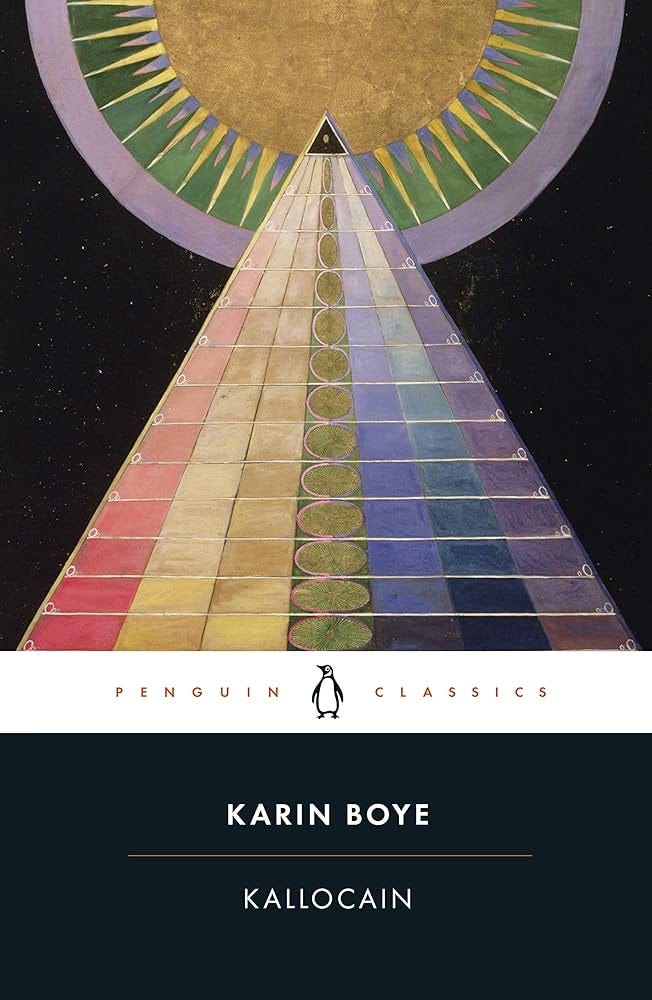
It’s always exciting to discover an unsung classic by a writer I’ve never heard of, and just that happened a few weeks back when I stumbled upon Kallocain by the poet and novelist Karin Boye, published in 1940. It seems an outlier of Swedish literature for its time in that it’s a work of inter-war dystopian science fiction from a female writer, following in the footsteps of such forebears as Yevgeny Zamyatin’s We (1924) and Aldous Huxley’s Brave New World (1932); also an outlier for Boye, her fifth and final novel, following four works of social realism and multiple collections of poetry. Set in a future totalitarian World State, the novel is narrated by Leo Kall, a research chemist and once-loyal arm of the regime, who pens his memoirs from a jail cell, recounting the events that led him there. He describes his invention of Kallocain, the most powerful truth serum in existence, compelling individuals to reveal even their deepest unconscious thoughts, and its rapid adoption by state authorities eager to eliminate all private dissent. Kall recalls the drug’s testing and deployment, how it came to expose unsettling secrets, including those buried within his own marriage, prompting a gradual unraveling of his unwavering fealty to the regime and a revelatory reckoning with the consequences of his work. Today, critics contend that Karin Boye wrote the novel by drawing on the horrors of WWII and the authoritarianism she saw wreak havoc over Europe at the time, crafting a work that not only interrogates the nature of identity and the meaning of life under totalitarian control but professes the enduring, triumphant power of love and human connection. Though, as I have learned, critics are quiet about the mysterious and grim circumstances that surround the novel’s publication. After it hit bookshelves in 1940, Karin Boye publicly declared “I’m scared”—about what, readers remain unsure, but the following year, she committed suicide at the age of 40, soon to be followed by her partner. I personally cannot help but wonder whether it was despair or fear or something else that drove her to end her life so young and, in so doing, cut short a career the legacy of which might ring so much louder than it seems to more than eight decades later.
Book Still on the Mind: Voyage in the Dark by Jean Rhys
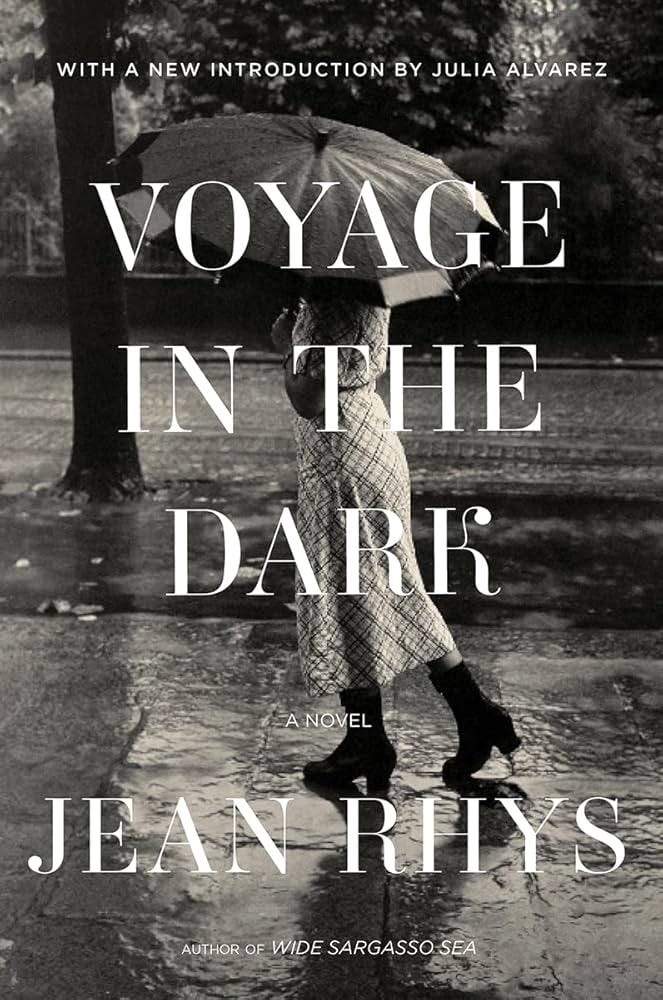
After reading back-to-back works by Raymond Radiguet and Jean Cocteau recently, and being embroiled in the tumultuous romantic relationships therein, I was a reminded of another literary affair I had the painful pleasure of experiencing through the page a few years ago. I first read Voyage in the Dark by English novelist Jean Rhys, published in 1934, in the Fall of 2023, when frigid airs flowed through the barren city streets, a scene, an essence fitting for the story, indeed the voyage, Voyage contains. It follows eighteen-year-old Anna Morgan, who, after the death of her father, is uprooted from her Caribbean home by her cold and callous stepmother and forcefully relocated to London, where she struggles to survive financially, working as a chorus singer and drifting between shabby lodgings. Her fortunes briefly improve after meeting Walter, an older, wealthy man who offers Anna a sense of stability and affection. Slowly, she starts to advance towards a life more secure than that which she’s only known. However, when Walter abruptly abandons her, ending their affair by letter, Anna is plunged back into the isolation and hardship she sought to escape, which only worsens as the novel unfurls. It was my second work of Jean Rhys, after reading Good Morning, Midnight (1939), which I wrote about here; and in my original review for Voyage, I wrote about the thematic similarities of the two novels: a woman grappling with loneliness, despair, and disconnection from the world around her. However, as I further wrote, “whereas Midnight stands submerged deep in the ocean of modernism, Voyage seems closer to the surface than its successor, floating in between convention and experimentation, as if Rhys were still only wading into the waters.” I also compared Anna Morgan to Joan Didion’s Maria Wyeth and called Voyage “a short and savage novel, a bleak story of love and loss and the ramifications that result from horrific heartache.” Darkness is a motif I’m often drawn to in literature, if only, amid this burgeoning Spring season, to strengthen the sunlight that struggles against the shade.
Art(ist) of the Week: “Jupiter et Sémélé” by Gustave Moreau (1895)
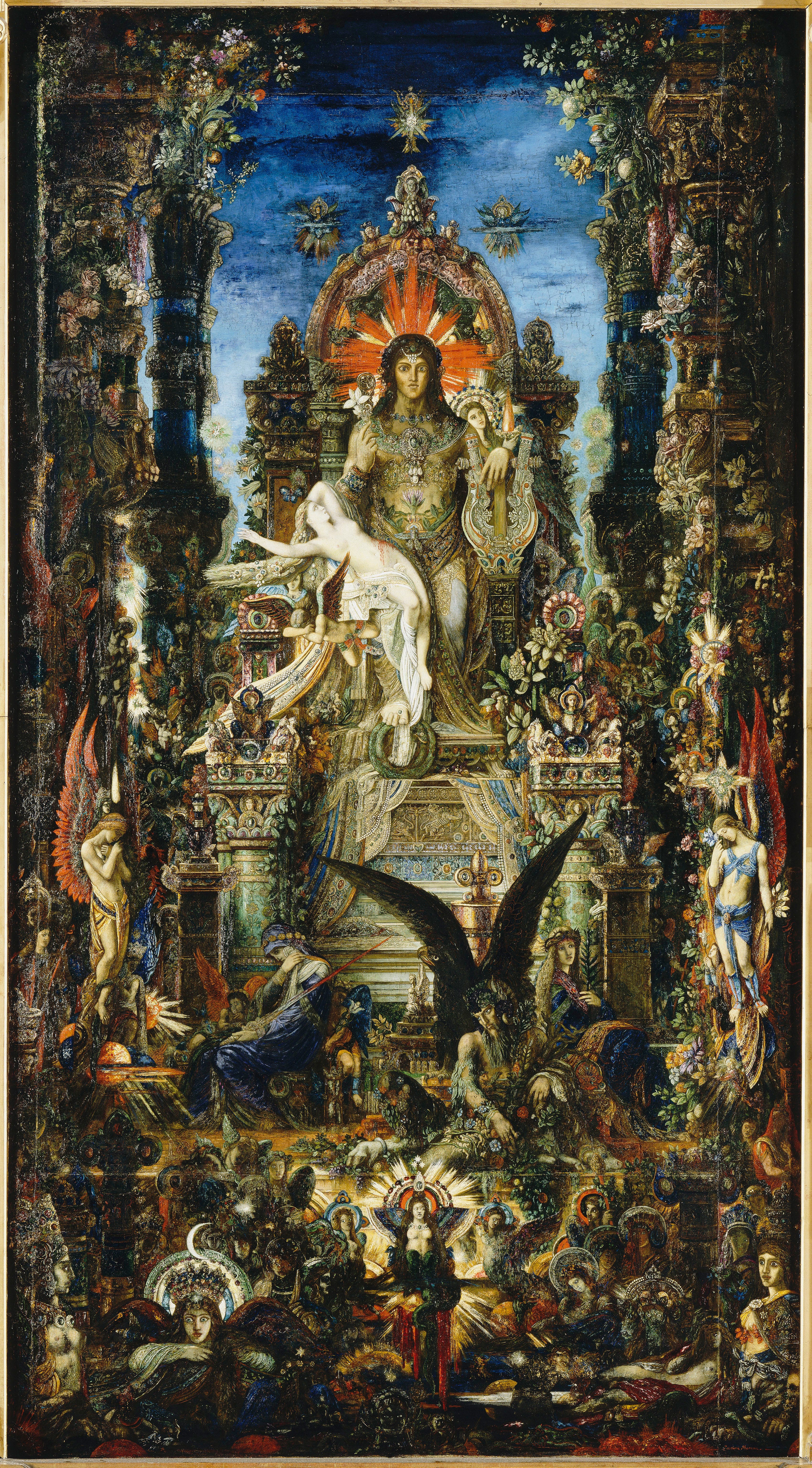
Fans of Roberto Bolaño will surely recognize this week’s art selection, as it famously dons the cover of the Picador edition of the Chilean author’s 2004 posthumous masterpiece 2666, which I immediately pulled from my shelf upon stumbling upon a picture in Paintings in Proust that reminded me of it—soon to confirm that the paintings were one and the same. Jupiter et Sémélé is one of the many magnum opuses by the famed French symbolist painter Gustave Moreau, unveiled in 1895, about which the painter himself wrote: “In the midst of colossal aerial buildings, with neither foundations nor roof-tops, covered with teeming, quivering vegetation, this sacred flora standing out against the dark blues of the starry vaults and the deserts of the sky, the God so often invoked appears in his still veiled splendor.” An ekphrasis like this needs no companion; Moreau’s words stand enmeshed in the verses of his Symbolist compatriots, with echoes of Verlaine and Rimbaud humming through his description. And indeed, Moreau’s painting rings with a Decadent opulence, a penetrating pictorial equivalent to the works of Wilde or Huysmans, a kunstkamer capturing the classical comportment of the Renaissance yet forbearing fantasies of the future. It’s an overwhelming vision of a divine encounter: Jupiter sits enthroned in a rigid, hieratic stillness, while Semele collapses in ecstatic annihilation beneath him, as mythological figures, hybrid creatures, baroque ornamentation transform the scene into a sacred, kaleidoscopic and hellish hallucination. Rather than narrate the myth plainly, Moreau creates a dense symbolic cosmos where erotic desire dances with spiritual transcendence, destruction with beauty, ecstasy extermination. “Semele, penetrated by the divine effluence, regenerated and purified by this consecration, dies struck by lightning and with her dies the genius of terrestrial love, the genius with the goat hooves,” further wrote Moreau, in turn ratifying a work of extremity, a masterpiece of vast magnitude, into the annals of art history.
Music(ian) of the Week: “Konichiwa” by Donny Benét
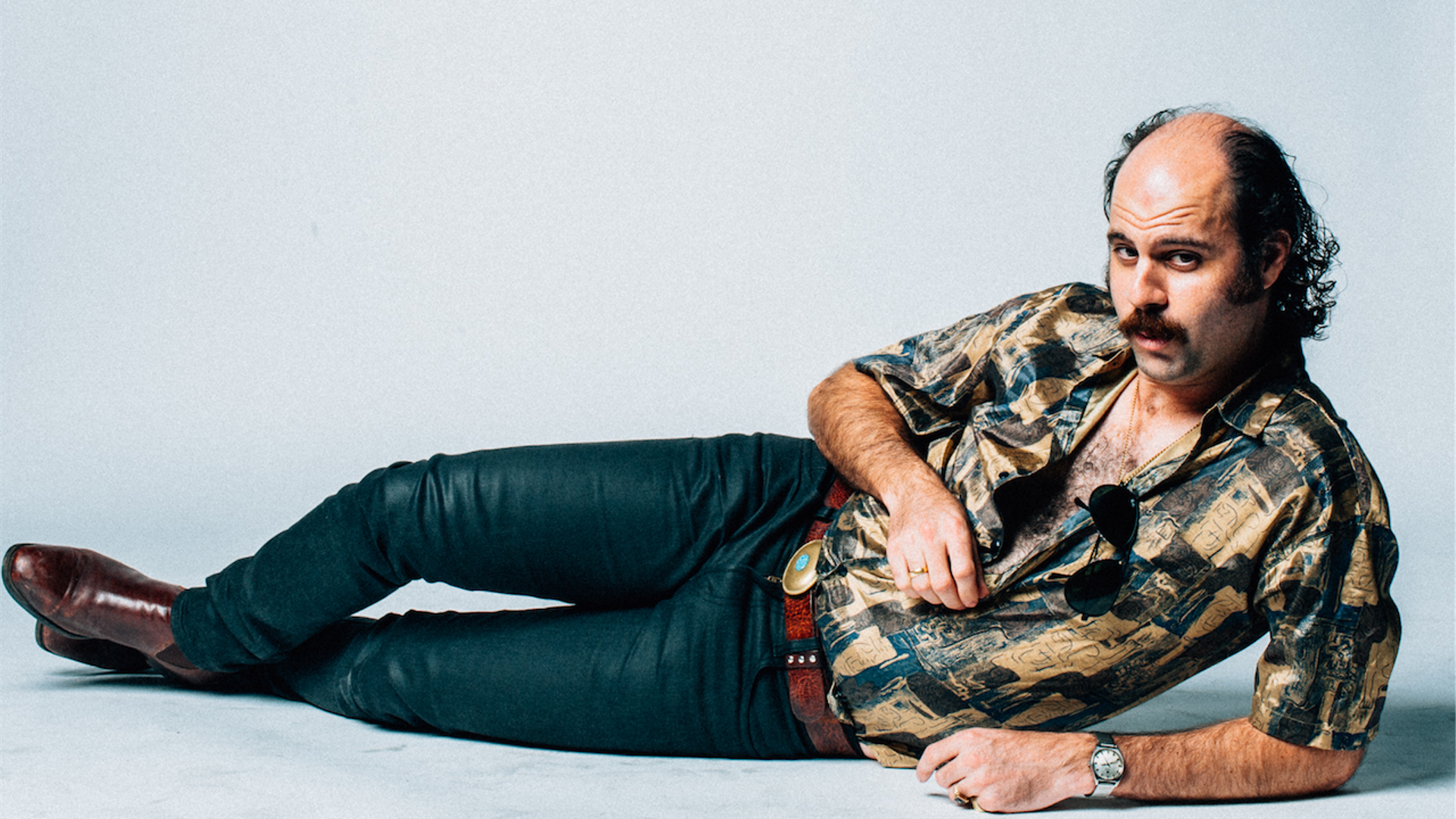
A few weekends back, two of my closest friends introduced me to the incredible work of Donny Benét, an Australian singer-songwriter whose post-disco sound and inventive music videos instantly took me by surprise. He’s a man, a musician, a myth who spurns easy description: a satin-shirted, pastel-pleated bald-and-mustachioed emissary from an alternate 1980s uncanny universe, a love-struck lothario whose lust-tinged longing lingers in his every track, whose glossy texture of vintage synth-pop, Italo disco, and yacht rock resonate over analog synths soaring beneath an almost satirical sense of romantic melodrama. A bassist by training, Benét wields his four-stringed battle axe like a courtly knight his broadsword—less to sunder than to seduce, each groove a velvet vibration thrusting in an endless duel of desire—a sonic sensibility whose soulmate shines in Benet’s audiovisual aesthetic, surely on full display in this tune and its music video: “Konichiwa,” featured on his fourth studio album The Don released in 2018. Like a late-night postcard sent from the neon-drenched backstreets of Tokyo, “Konichiwa” glides upon a supple bassline, glassy synths and a pulsing drum machine beckoning from a dream. Lyrically, Benét leans into his persona, suffusing his verses with a suave and playful eroticism before coming to the couplet of the chorus: “Konichiwa, My love/ Konichiwa, let’s make love.” What keeps the song from slipping into satire is how seriously Benét commits to the bit, delivering every line with a hushed conviction, as if this softly lit rendezvous, a simple room and simple scene, stands of the utmost importance, a dream from which we don’t want to wake. Submerged like a sly smile behind dark sunglasses is Benét’s comedic tinge, which seeps through the track, turning a slow dance between irony and sincerity into a work both seductive and surreal. He’s truly one-of-a-kind. I saw that he’s coming to Philadelphia this Fall, so I’m looking forward to witnessing firsthand this sultry sultan of sonic seduction.
Wild Card: “Welcome to Mountport” – Game Changer by Dropout
My girlfriend recently introduced me to the wonderful, wacky world of Dropout, the CollegeHumor comedy platform whose arsenal of hilarious shows contains one that has quickly become my new favorite: Game Changer. It’s a clever, chaotic comedy competition, created and hosted by Sam Reich, which features a trio of comedians who are thrown into a completely new game in each iteration without being told the premise or rules in advance. Per Reich’s introduction, “The only way to learn is by playing; the only way to win is by learning; and the only way to begin is by beginning.” The result is a blend of quick-witted improvisation, puzzling problem-solving, and fiercely funny face-offs, with no shortage of outrageous moments and fantastic feats of fast-acting formulation. And one of the most impressive and iconic episodes is the 2021 fourth-season episode titled “The Official Cast Recording,” which sees comic contestants Zeke Nicholson, Zach Reino, and Jess McKenna, accompanied by pianist Scott Pasarella, improvising an entire musical on the spot. It opens with “Welcome to Mountport,” an introductory group number that calls to mind all the classic, cheesy clichés of musical theater, which the comedians take and run with, soaring into new heights of histrionic hilarity. What follows for the next half-hour is a full-fledged, fast-and-loose foray into faux-Broadway brilliance: choruses, character bits, cleverly cobbled-together callbacks that coalesce into a narrative chronicling a girl who moves to the mountain/seaside town of Mountport to pursue her dreams as a baseball player but is forced to confront an evil adversary named Tina who vows to sabotage her. It’s absolutely ridiculous and truly one of the greatest things I’ve seen in a while—a performance that feels at once fleeting yet fully-formed, a lighting-in-a-bottle bit of collaborative chaos that captures the giddy, anything-could-happen energy at the heart of the show. And, coming fittingly full-circle, “Welcome to Montport” received an animated adaptation, giving this once ephemeral experiment a second, vividly illustrated life.
Additionally, I discovered that Zach Reino, Jess McKenna, and Scott Pasarella have their own live-recorded improvised musical theater podcast called Off Book: The Improved Musical with more than 360 episodes! I’ve already started listening and can’t get enough.