
The Ninety-first
Friday, June 19th, 2026

“And so, after gently showing us out, it was simply from breeding and jollity that in a stentorian voice, as if addressing someone off-stage, he shouted from the gate to Swann, who was already in the courtyard: ‘You, now, don’t let yourself be alarmed by the nonsense of those damned doctors. They’re fools. You’re as sound as a bell. You’ll bury us all!” - Marcel Proust, In Search of Lost Time Volume III: The Guermantes Way (p. 819)
Book in the Pipeline: The Summer Book by Tove Jansson
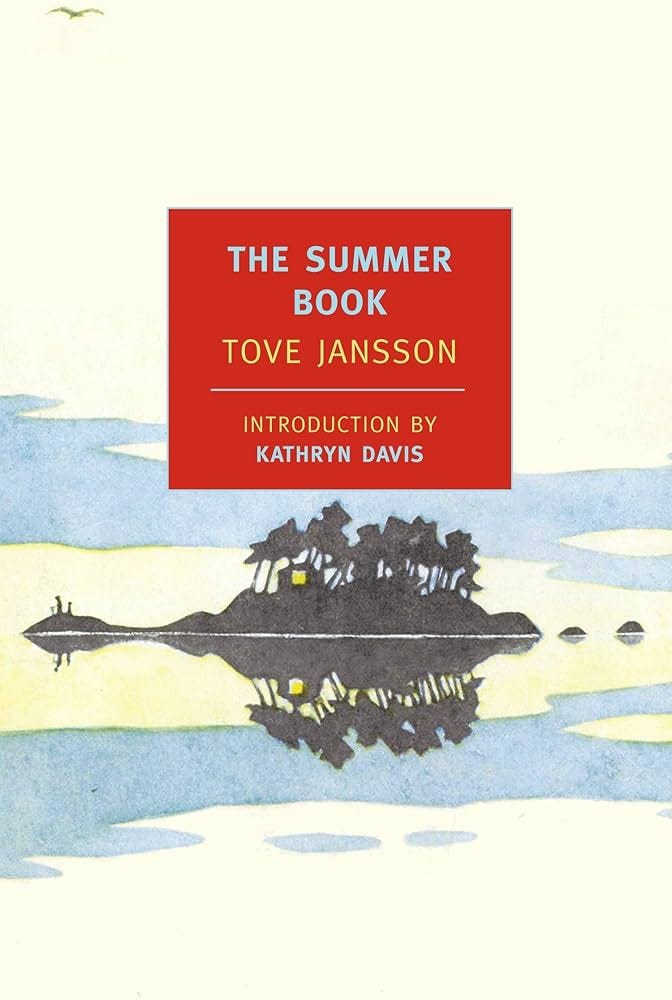
While this Sunday will see the official solstice, summer has nonetheless already started. The song of the sparrows sings through the air, as does the sunlight seep through the tree branches, brightening their leaves’ shaded verdancy into a lush, lightened green, stippled with the shifting blue of the sky beyond. Warmth has wended its way into the world once more and with it, as is wont to happen, a wish for summer-set stories. For me, few spring to mind faster than Danish novelist Tove Jansson’s The Summer Book, published in 1972, a slim novel that’s long sat on my old bookshelf in the attic at my Dad’s house, waiting to be opened. It follows six-year-old Sophia and her grandmother as they spend a summer on a small island in the Gulf of Finland following the death of Sophia’s mother. Through a series of episodic conversations and tiny adventures up and down the coastline, the two explore nature, imagination, aging, mourning, and the mysteries of life, while Sophia’s father works silently in the background. From what I’ve read about it, the novel decenters the grief that grips the three characters, instead bolstering the beauty imbued in the banal, in turn magnifying quiet moments of introspection in the wake of tragedy. And I’ve also read how lauded the novel remains today: novelist Ali Smith has written how Jansson’s “writing is all magical deception, her sentences simple and loaded; the novel reads like looking through clear water and seeing, suddenly, the depth,” and likewise Eve Tushnet wrote, fittingly for this musing, that “it’s a perfect read for summer which will, I think, be memorable for many of us as a kind of shadow season, a time carved out from normal life and defined by the absence of normality.” Yesterday, thanks to my Dad, I was able to retrieve my copy of this one; I bought my girl one, too, with plans to read it together; so, The Summer Book has officially jumped to next in the pipeline.
Book Still on the Mind: Light in August by William Faulkner
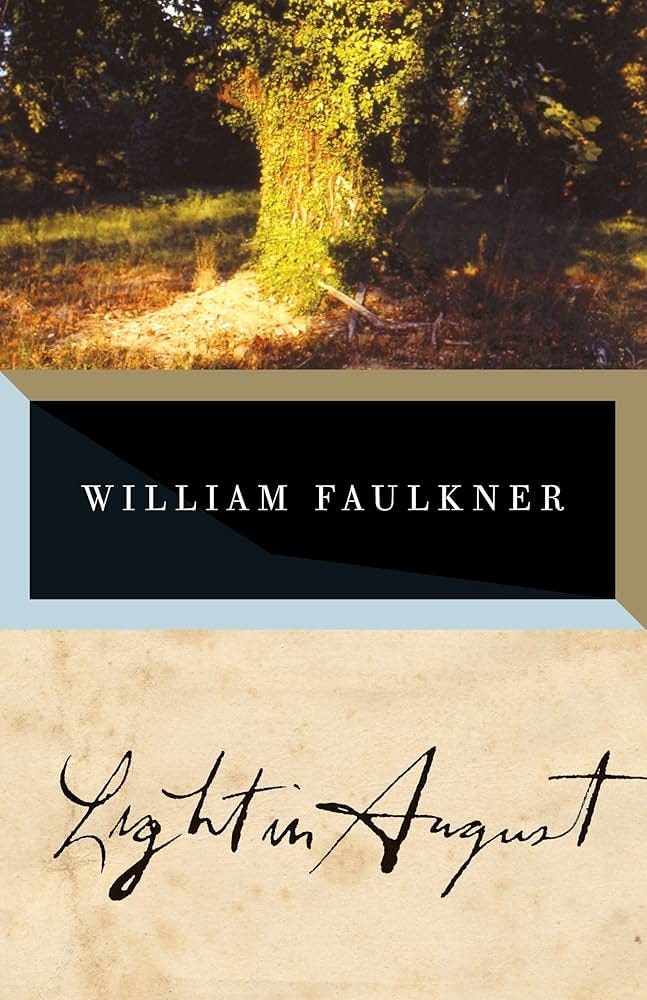
Exactly two years ago, I read Light in August by William Faulkner. I began the novel on a Friday, settled in a train car headed to Rhode Island for a friend’s wedding and on the Sunday sojourn back down to Philly, finished it. And I so vividly remember how, through the train car windows, the city and natural landscapes, buildings and foliage emblazed by the summer sun rushing in the rapidly changing frames, rivers glimmering under bridges, furrowed fields flowing into the offing, seemed to converge with my mental vision of the scorched streets of Jefferson, Mississippi, the trees and dust, heat and humidity seeping through the pages of Faulkner’s novel, wrenched from ink to meet me in real life. Like many of his works, it’s a masterpiece of Southern Gothic fiction, following the entangled lives of three individuals: Lena Grove, a young pregnant woman who arrives in Jefferson in search of her baby’s father, Lucas Burch, who, having previously abandoned Lena, now moonlights as a mill worker under the alias Joe Brown. At the mill, he has met and befriended Joe Christmas, a man of mixed ancestry whose own dark past continues to persist into the present, especially as the two men begin an underground bootlegging business. As I wrote in my original review, “while events unfold in the present, the pasts of all these characters unfold as well, swirling and surging in their spectral reverberations until ultimately revealing a tale in whose complex tragedy is bound the bloody and brutal history of the American South.” I named the novel my fourth favorite of 2024, highlighting how “I was truly transported from the Amtrak train car and dropped in the viscid summer South, a first-hand witness to the wildness.” Just writing this blurb makes me want to pick up another Faulkner fiction and return to those scorched streets of Jefferson, if only to experience again the grotesquery buried beneath the words.
Art(ist) of the Week: “A Bigger Splash” by David Hockney (1967)
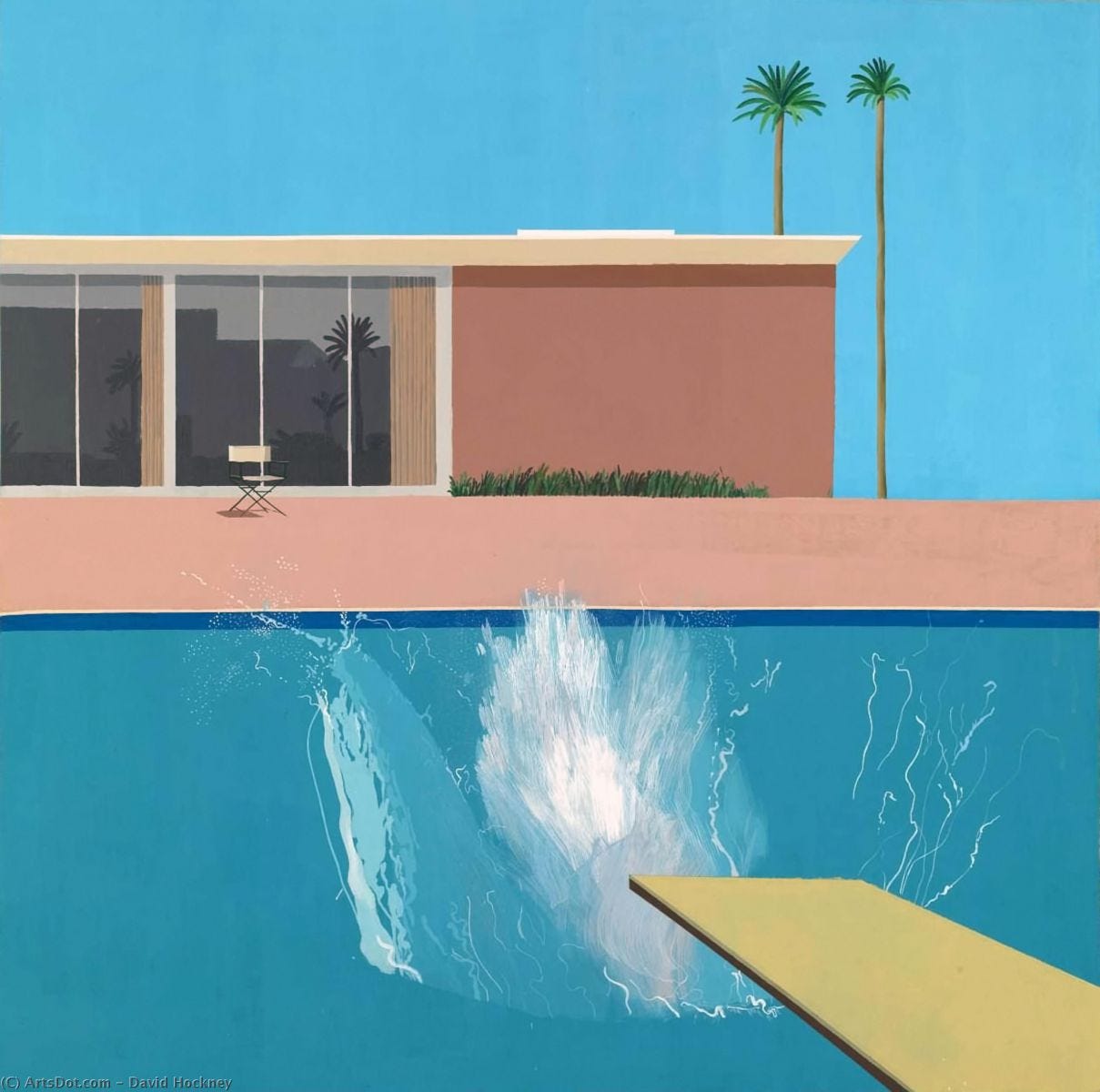
Last Thursday saw the death of one of Pop art’s foremost pioneers. David Hockney was a British painter, stage designer, and photographer who, over a career spanning more than six decades, is today remembered as one of the most influential artists of the twentieth and twenty-first centuries. He first gained prominence while studying at the Royal College of Arts in the early ‘60s, producing works which, with his signature vibrancy of color combined with simplistic set design and allusions to contemporary culture, helped advance the Pop art movement emerging in the UK and US at the time. One of his most iconic works was this one: A Bigger Splash, unveiled in 1967, which depicts a sunlit California swimming pool set outside a modernist house under a cloudless blue sky, two thin palm trees standing solitary behind it. Captured in its foreground is the instant of a dive breaking water—ecstatic white splash disrupts the cool calm sheen of the pool’s deep blue surface below a lone yellow diving board, the diver invisible beneath the contrast of color, a contrast carried in the crisp geometric lines and flat panes of color, rendered with almost photographic clarity and posed against the frenzy of the splash, inspiring the tension between stillness and energy held together in a sense of suspended time. In this work, Hockney transforms an ordinary moment into a meditation on movement, absence, perhaps even pursuit, while harkening a distinctly American idealism through which resonate the allusions to contemporary culture that define his legacy. It’s one of my favorite paintings of his and one which, I think, with his death arriving at the start of summer, feels especially elegiac, a final reminder of our own fleetingness against the enduring passage of time.
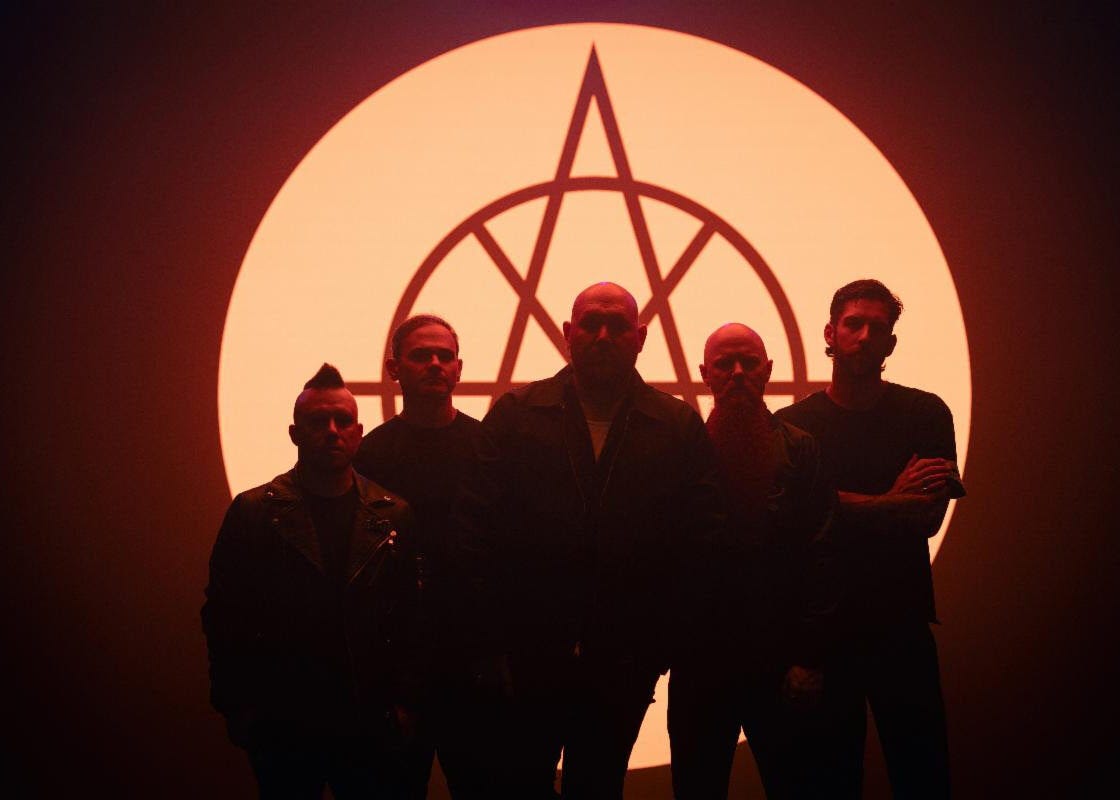
Music(ian) of the Week: “Ex’s & Oh’s” by Atreyu
Last week I got presale tickets for a December show in Philly that I already know is sure to be the best I attend this year. Headlining is Underoath, one of my favorite bands whom I’ve written about here, on their 20th anniversary tour of the seminal album Define the Great Line, one of my favorite records of all time. However, supporting Underoath are heavyweights of metalcore and screamo August Burns Red, Atreyu, As Cities Burn, and Emery, all bands that I grew up listening to. But of them all, the only one that I have not yet seen in concert is Atreyu. They’re a metalcore, post-hardcore outfit from Yorba Linda, California, who, as other former emos will know, have long been in the game. They formed in the late ‘90s, broke through in the early aughts with their second studio album The Curse (2004) and were featured on several film soundtracks, amassing a following that only expanded with the arrival of A Death-Grip on Yesterday in 2006, their third studio album, whence comes this song, my personal favorite, “Ex’s & Oh’s.” It’s a kicker of a tune whose hard-hitting breaks and thrumming percussion belie the poignancy of its lyrics. At its core, it’s a story of alcohol addiction amplified by an amorous ambiguity: “You took me home/ I drank too much/ ‘Cause of you my liver turned to dust.” Immediate is the metaphor, surging forth like the liquid the lyrics allude to, a love-hate relationship vocalist Alex Varkatzas sings of from the vantage of personal experience. And the passion, the reckoning, the redemption of his words echo the force with which he sings them, turning a hardcore record into an anthem to which so many can relate. It’s one of their most famous songs, a staple of their setlists, and a tune I greatly look forward to experiencing firsthand when I see them live in December.
Wild Card: An Idiot Abroad
English actor and producer Karl Pilkington has built a career out of being the butt of a decades-spanning joke instigated by his friends (perhaps foes) Ricky Gervais and Stephen Merchant—a joke that has resulted in a show that today still stands as one of the funniest series I’ve ever seen: An Idiot Abroad, produced by Sky One. It came out in 2010, but it wasn’t until my old roommate back in Richmond put me onto it that I realized what I’d been missing. It’s a travelogue comedy documentary series with a simple premise: Ricky and Stephen send Karl around the world, especially to remote, culturally distinct, even dangerous locations, for the sole purpose of seeing how Karl will react, knowing full well that he’s going to hate it. Describing the show, Ricky states, “Nothing is funnier than Karl in a corner being poked by a stick. I am that stick. And now I have the might of Sky behind me. This is one of the funniest, most expensive practical jokes I have ever done.” The result—three seasons of Karl traveling around the world, being forced to climb the Great Wall of China, jump in the Ganges, wrestle Mexican luchadores, ride camels in Egypt, dance in a Brazilian carnival parade, camp along the insect-infested riverbanks of the Amazon, sleep in a cave in Jordan, eat exotic-if-nausea-inducing foods, and so much more, all while enduring extremes of climate and culture that clash with Karl’s ignorance and feeble constitution—has been an unwavering source of hilarity for me for years now, and I feel like it hasn’t received the attention it deserves. Fortunately, the show, all three seasons in their entirety, is available for free on YouTube, so I highly recommend people check it out.